Why did CoreWeave's shares and bonds fall?
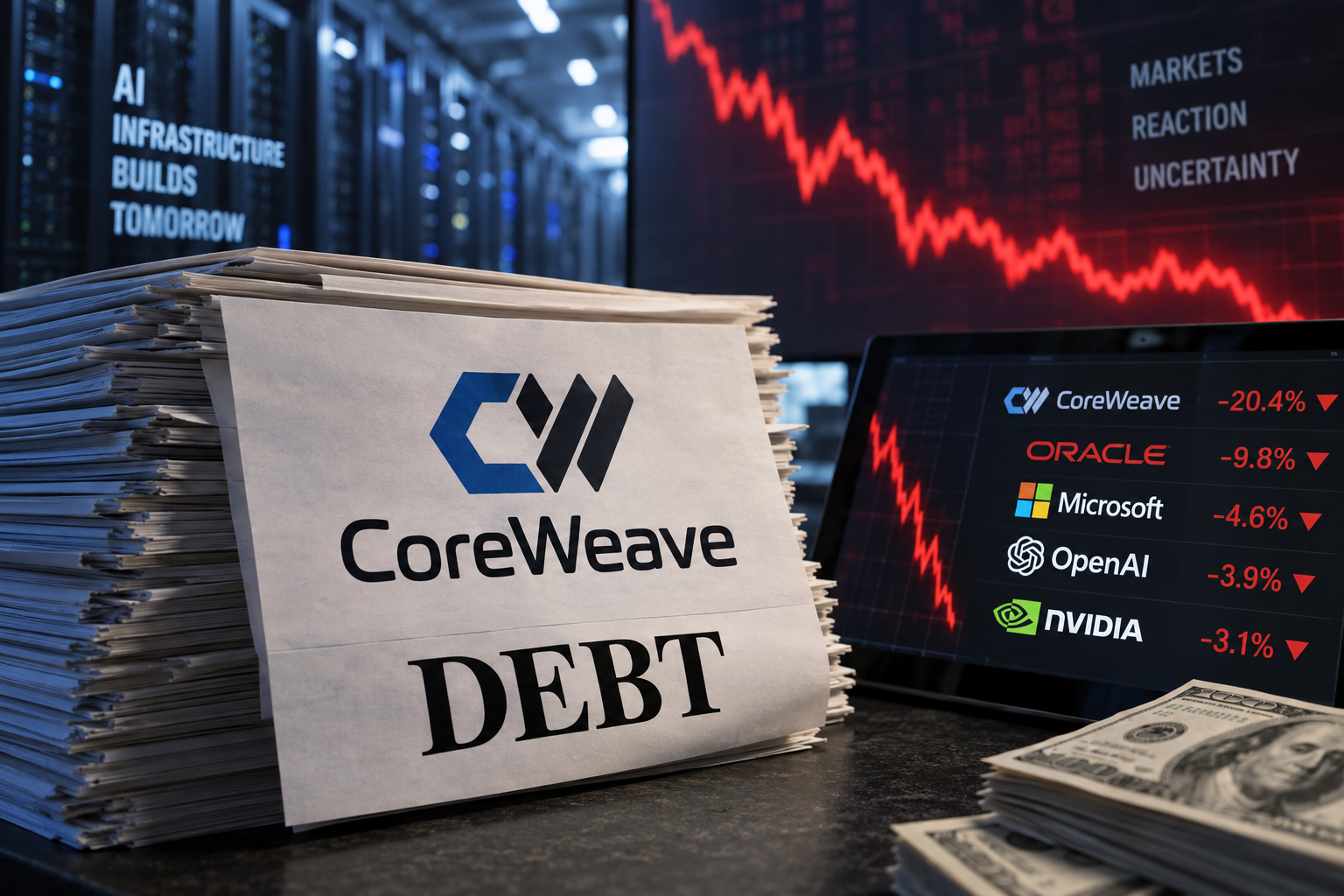
CoreWeave had a rough week, and the damage reached well beyond its own balance sheet. The cloud computing company's bonds slipped into distressed territory by a common market definition, meaning investors now demand roughly 1,000 basis points more in yield than they would earn on government bonds. Its shares are down more than 20 percent since last Tuesday's close.
The sell-off did not stay contained. Oracle, which has also taken on heavy debt to fund AI infrastructure, has seen its shares fall almost 10 percent over the same stretch, and its bonds have also sold off. Other AI-related stocks showed signs of strain as well.
The trigger was partly a social media post. Chamath Palihapitiya, the venture investor known as the “SPAC King,” raised questions about the debt and asked whether the AI buildout amounted to a private credit bubble. Those questions landed at a sensitive moment for CoreWeave, which has been among the most heavily indebted players in the sector.
The company's own comments didn't help. Brannin McBee, one of CoreWeave's cofounders, told the Financial Times that the company wants its debt to earn an investment-grade rating rather than junk status. That would let it borrow from insurers, whose capital McBee described as “unlimited.” Investors heard that as a sign the company plans to take on even more debt.
Why are investors worried about CoreWeave's debt?
The move toward investment-grade financing is not unreasonable on its face. CoreWeave secured its first investment-grade chip loan earlier this year. But the prospect of tapping insurance money raised immediate concern because CoreWeave already owes a great deal. As of its second-quarter earnings report, the company owed more than $35 billion.
John Yovanovic, co-head of leveraged finance at MetLife Investment Management, told Bloomberg that the problem is not a change in credit profiles. The bigger issue, he said, is the supply of debt still coming. “The problem is not that credit profiles have changed in the last year, it’s that we’ve got another year and a half of supply coming,” Yovanovic said.
Part of CoreWeave's debt load comes from its early use of GPUs as loan collateral. The company also relies heavily on one business: selling computing capacity. That business has not yet produced profits. CoreWeave lost more than $1 billion in the first half of the year.
Still, the company has a large base of contracted future revenue. Its remaining performance obligations, the value of customer contracts not yet fulfilled, totaled $103.7 billion as of the second quarter. About 40 percent of that is scheduled to come in during 2028, and customers can't cancel these agreements except under narrow circumstances.
Concentration is a risk, though. CoreWeave's largest customers are Microsoft, OpenAI and, probably, Nvidia. The company does not disclose its third-largest customer, but those three together generated almost three-quarters of its second-quarter revenue.
Can CoreWeave keep making its debt payments?
Analysts who follow the sector say Microsoft and Nvidia are likely able to meet their obligations, and they have little incentive to let a major supplier collapse, since that would ripple through the market. OpenAI's finances are less clear. Unless OpenAI faces far more financial strain than is publicly known, CoreWeave appears likely to keep making debt payments for some time.
The longer-term question is whether the business can make money. Investor anxiety about CoreWeave, observers say, applies to every neocloud, the newer cloud providers built around AI computing. Whether bare-metal computing services, which give customers direct access to hardware, can be profitable remains an open question.
Some investors see the drop as a buying opportunity.
This article was written with the assistance of AI.
News Factory APP - agentic news to boost your SEO & AEO.