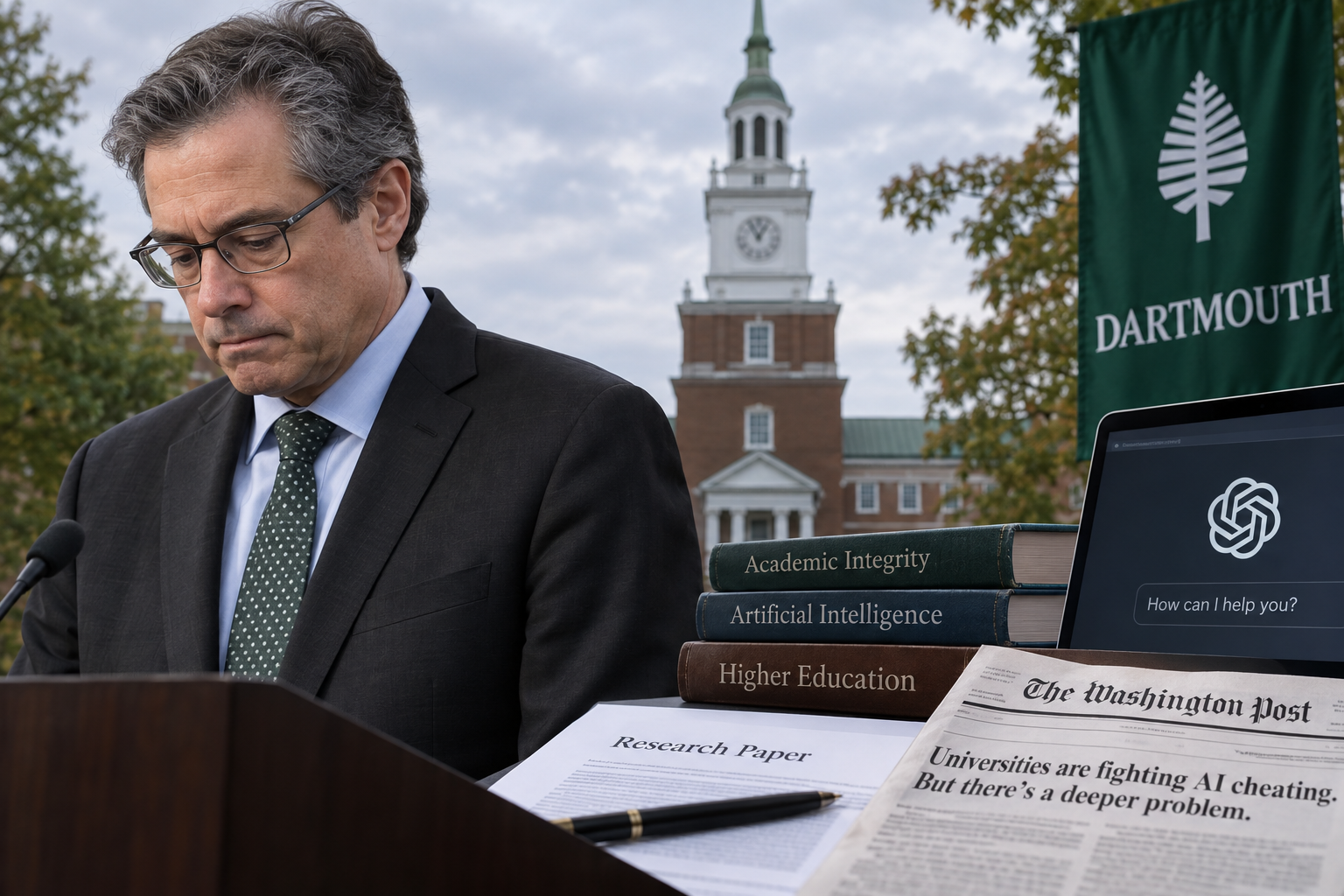
Why did Dartmouth's provost resign?
Dartmouth College provost Santiago Schnell has resigned after a university advisory committee found that he failed to disclose significant use of artificial intelligence in an academic paper and in a Washington Post opinion piece. Publishers had required that kind of disclosure. The irony is hard to miss. Schnell wrote the Washington Post op-ed, titled “Universities are fighting AI cheating. But there’s a deeper problem,” in August.
The committee's report describes Schnell's cooperation as “insufficient.” He turned over his Dartmouth laptop, but he did not provide logs from his personal large language model accounts tied to the writings in question. He also declined to meet with the committee.
What did the committee find about Schnell's AI use?
The committee did get access to a Claude enterprise account Schnell had used through Dartmouth. The logs show him using the chatbot to revise his papers, find and fix bugs in code, and edit or generate figures. In one exchange, he asked Claude to act as a reviewer for a chemistry manuscript with expertise in nonlinear chemical dynamics and write a referee report. In another, he asked AI tools to take his TeX files and “make the corrections to the files, and the repo.”
Did Schnell disclose his use of AI?
Schnell has long described his use of AI as limited. He told Semafor he had used chatbots “to refine a few arguments” and to “check for grammatical errors.” He told one journal editor that he “used AI as an editorial tool” to “help refine sentences, improve clarity, and the expression of arguments.” He did not disclose that use to the journal, he said, because he “did not understand that this type of AI-assisted editing required disclosure.”
The committee was not persuaded that it had the full picture. It said Schnell's public statements may understate “the nature of the Provost’s actual AI use,” and that he regularly “went beyond his other public descriptions of his use of AI in writing.”
One Claude exchange drew particular attention. Schnell uploaded a manuscript titled “Academic Freedom and Catholic Mission: The Procedural Overlap Zone in University Governance” and asked: “Are there many signatures of AI writing in this article?” He later submitted a revised manuscript that included the kinds of changes Claude suggested. The exchange raised questions about whether he wanted to hide traces of AI involvement in his work.
Beilock, Dartmouth's president, announced the resignation and said the school's leaders should “hold themselves to the highest standards.” She wrote that “it is so critical that we model the transparency and human judgment that we expect from our students and scholars.” Beilock has publicly favored more AI at the school. In September she wrote a piece for The Atlantic titled “Why I Want More AI at Dartmouth.”
The university also has a long-standing claim to the field. Dartmouth calls itself the place that “launched the field of artificial intelligence” in 1956, when the term was coined. This weekend, the school is hosting a conference called “What Must Remain Human?” It includes a student hackathon sponsored by Anthropic and speakers including Mira Murati and Yann LeCun. At the conference, survey data was released showing that 61 percent of college students think AI helps explain difficult concepts, and half believe they produce better work after talking through issues with AI tools. The same survey found that 70 percent say take-home work has become unfair because of AI, and 39 percent feel pressured to use it because their peers do. Among Dartmouth students, 92 percent said they fear AI can hurt writing skills.
Schnell has argued that the line between human and machine writing is blurrier than many people assume. In a September 2026 paper titled “Who Wrote This?” about AI detection tools, he wrote that “human-written” and “AI-written” are too simple a binary. He said the key is that the human author takes full responsibility for the text, however it was composed and edited. He described using OpenAI's GPT-5.6 Pro to propose structures, identify literature and generate portions of early drafts, while saying he chose the topic, made the final decisions and checked the citations. He also rejects the idea that AI should be listed as a co-author. “Contribution and authorship are different roles,” he wrote.
Not everyone on campus was sympathetic. Dartmouth student Eli Moyse wrote in a September op-ed that Schnell should be fired, arguing that “a fetishization of AI to earn publicity for the College has rotted the brain of our top academic.”
This article was written with the assistance of AI.
News Factory APP - agentic news to boost your SEO & AEO.