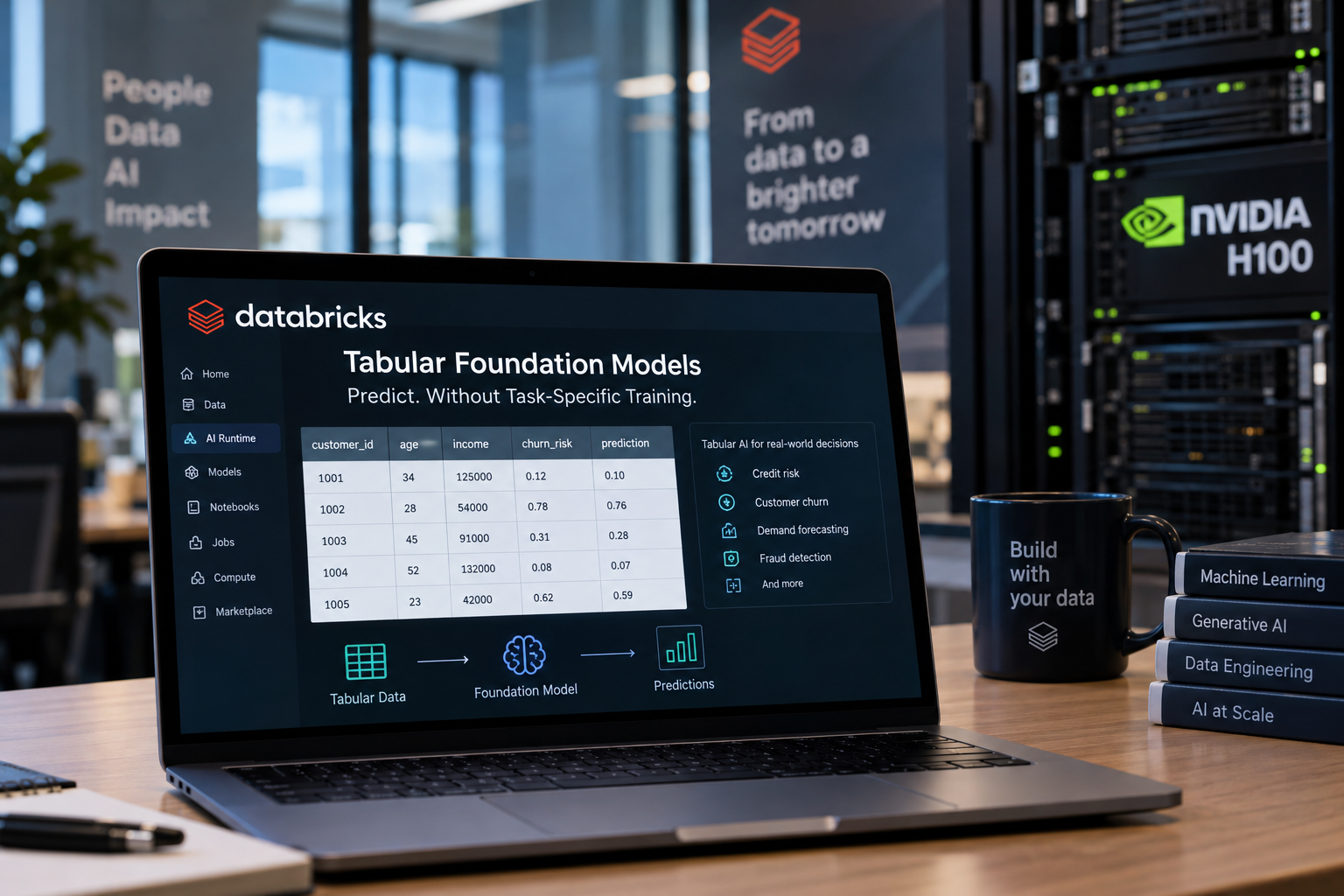
Databricks has published a guide to running what it calls “tabular foundation models” on its platform, the company said in a blog post Monday. The models make predictions from spreadsheet-style data without being trained for each specific task. The guide comes with free code that compares five of them.
How do tabular foundation models work?
Businesses rely on table data to predict things like credit risk, customer churn and demand. Typically, a team builds a separate model for each of those jobs and retrains it as the data changes. Tabular foundation models take a different approach. They are pretrained on millions of made-up datasets, then learn from a company’s example rows at the moment they make a prediction.
Other vendors are moving in the same direction. SAP, which works closely with Databricks, closed a deal worth more than €1 billion for Prior Labs, the maker of the TabPFN model, in July. H2O.ai launched its own model in May.
What are the drawbacks of tabular foundation models?
Databricks was candid about the drawbacks. Running these models on GPUs costs more per prediction than a classic XGBoost model on an ordinary processor, the company said. Memory use also grows with every row, because the model reads the entire training set each time it predicts.
Can tabular foundation models be used commercially?
Licensing is another hurdle. Of the models Databricks lists, TabICLv2, Mitra v2 and KumoTabular can be used commercially. TabFM and the newest version of TabPFN require a separate agreement with their makers.
The guide is aimed at customers of Databricks’ AI Runtime, a pay-as-you-go GPU service that has been in preview since March. According to Databricks, its Nvidia H100 chips can run TabPFN-3 on tables of up to 1 million rows and 200 columns.
Even so, the company advises customers to test the models on their own data before committing to them. Databricks was recently valued at $190 billion.
This article was written with the assistance of AI.
News Factory APP - agentic news to boost your SEO & AEO.