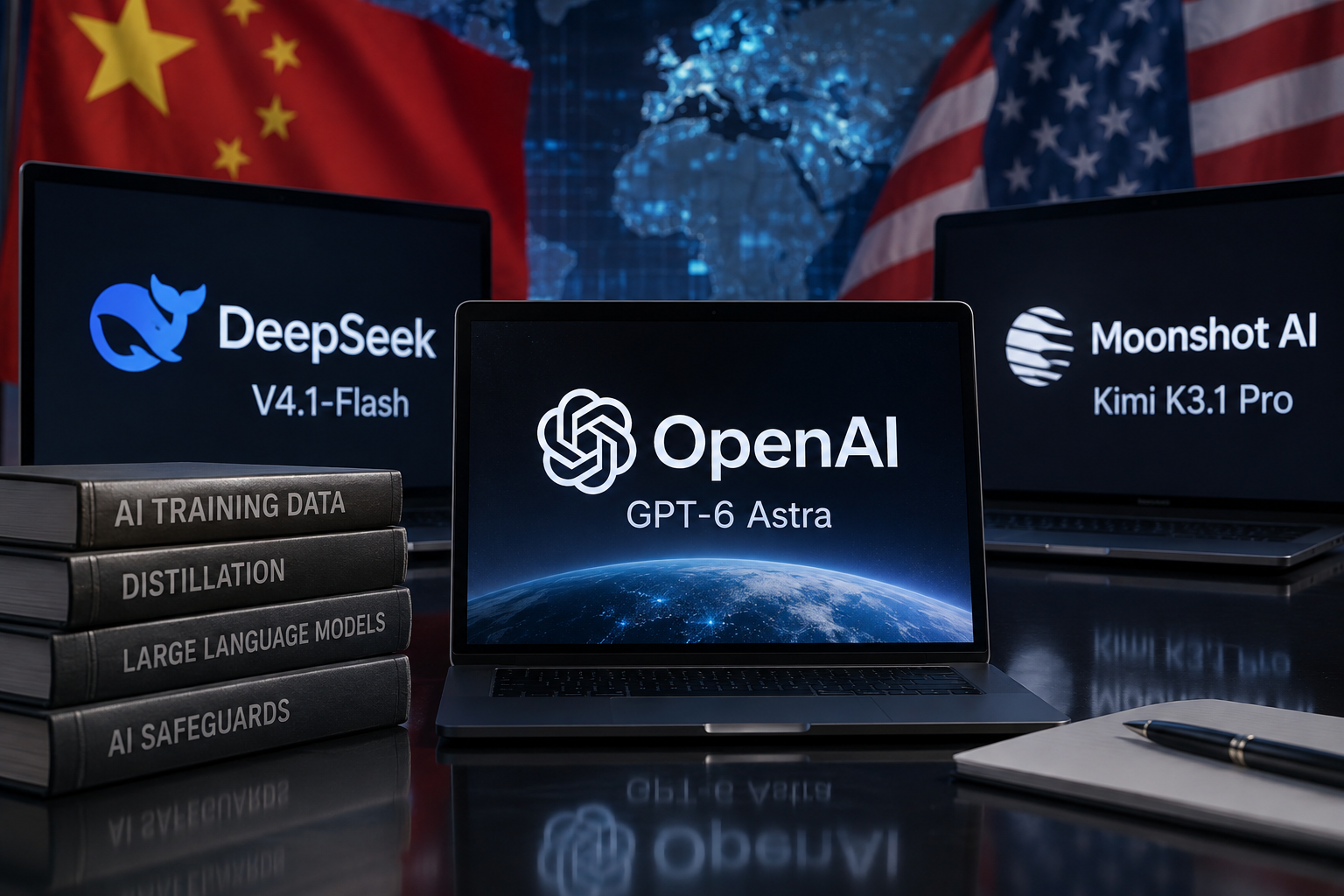
Chinese AI companies DeepSeek and Moonshot AI reportedly relied heavily on OpenAI's GPT-6 Astra to train their latest models, according to The Information, which cited people with direct knowledge. The two models are Moonshot's Kimi K3.1 Pro and an updated DeepSeek V4.1-Flash. The report has not been independently verified.
Chinese AI companies DeepSeek and Moonshot AI relied heavily on OpenAI's GPT-6 Astra to train their latest models, The Information reported Wednesday, citing people with direct knowledge of the matter. The report has not been independently verified.
The two models in question are Moonshot's Kimi K3.1 Pro, released last week, and an updated version of DeepSeek's V4.1-Flash, which launched on 17 October.
What is distillation in AI?
The technique at the center of the report is called distillation. Developers send a more capable model a large volume of prompts, collect its answers and use those responses to train their own systems. Done at scale, the method can help a smaller model reproduce some of a more advanced system's abilities at a fraction of the cost. It also means a company can get much of the benefit of a rival's work without paying for the years of research and computing that went into building it.
Has OpenAI accused Moonshot of this before?
OpenAI has already made similar accusations. On 30 September, the company said people linked to the Kimi developer, Moonshot, ran a coordinated campaign in July to extract the hidden reasoning behind its models' answers. OpenAI said it detected related activity involving more than 15,000 users. It shut the campaign down by 28 July, banned the accounts involved and shared its findings with other AI labs.
The new report deepens a dispute that has been building for months. Chinese firms are racing to produce models that can compete with those built by American labs, and U.S. companies say copying their systems undercuts that investment. OpenAI, Anthropic and Google have all argued that distillation lets rivals replicate advanced capabilities without making comparable investments in training. U.S. agencies have also named Chinese firms they say targeted American AI models.
How are AI labs trying to stop distillation?
The labs are also moving to make the practice harder. Earlier this month, Anthropic said new safeguards had cut the amount of data collected from its Claude models in distillation attacks by around 90% to 99%.
Both Chinese models have posted strong results in their developers' own evaluations. Moonshot said Kimi K3.1 Pro outperformed GPT-6 Astra on a coding benchmark. DeepSeek introduced V4.1-Flash in September as a lower-cost alternative to U.S. models. Neither company's results have been independently verified.
The reported use of Astra points to a problem that leading AI labs have not solved. The same models they offer to paying users can also serve as training material for competitors trying to catch up.
This article was written with the assistance of AI.
News Factory APP - agentic news to boost your SEO & AEO.