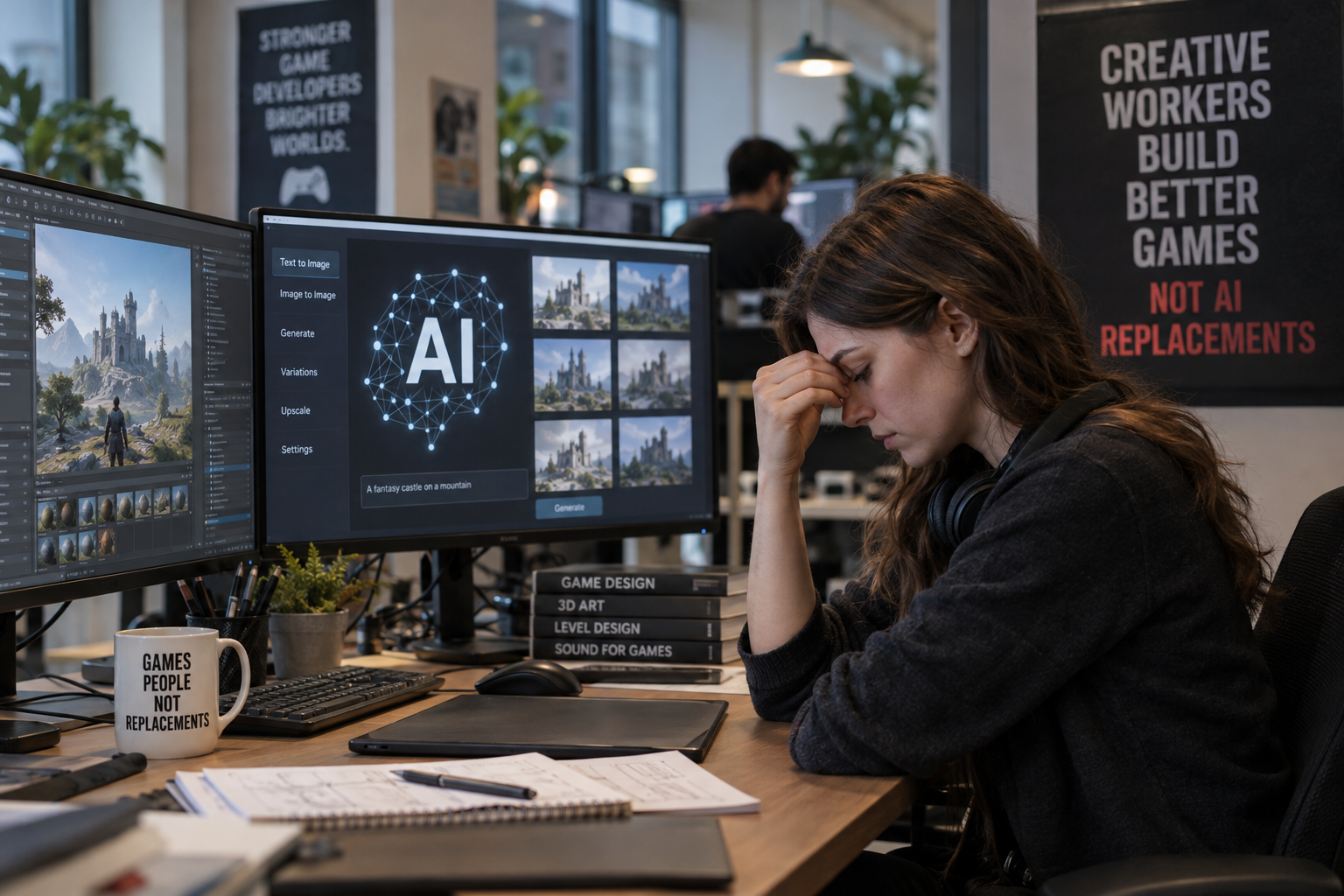
A coalition of European game unions and worker councils has published a manifesto warning that generative AI is harming developers and games. The authors say it is replacing workers, pushing staff into use, causing burnout, and urging workers to organize and regulators to require consent for training data.
What does the European game union manifesto say about generative AI?
A coalition of European video game unions and worker councils has published a manifesto warning that generative AI is harming the games industry, the people who work in it and the games they produce. The document was written by members of the IWGB Game Workers' Branch with colleagues from Game Workers Unite Ireland, CSVI in Spain and the FIOM-CGIL Milan Work Council in Italy. Its authors say the harm will grow unless it is checked.
The manifesto covers generative AI used to create assets that ship in finished games, such as art, sound, code and dialogue. It also covers materials used only during development, including early concept art, reference material and pre-translations. The authors define generative AI as systems that produce text, pictures, video or music from limited inputs, usually a text prompt, using large language models and other energy-intensive models. They set aside the technology's environmental and social costs, which they describe as additional reasons to resist it, and focus instead on workers.
How is generative AI affecting game workers?
On working conditions, the authors say generative AI is both directly and indirectly replacing game workers. They write that many are being forced to use it, either explicitly or through expectations that cannot be met without it. Work done with the technology is less fulfilling and less educational, they argue, and over time it leads to fatigue, cognitive decline and burnout. The document also points to a marked decline in junior positions, which it says is leaving the industry short of new talent.
Supporters of the technology often describe it as a tool that empowers workers. The manifesto says that claim only holds if every worker can choose whether, when and how to use it, and if employers pass productivity gains on to their staff. In practice, the authors say, some companies do not mandate the tools outright but set targets that workers cannot reach without them. Allowing a choice while expecting workers to keep pace with automated processes, they write, is no real choice at all.
The document cites workers who report what it calls 'AI brain fry' and reduced focus. Early productivity gains, it says, tend to be short-lived. Employees often work faster, take on larger tasks, work overtime and skip breaks because the work feels 'more like chatting.' Once that novelty fades, the authors write, productivity falls and workers report cognitive fatigue, burnout and weaker decision-making. They also cite a 2026 study by S. D. Shaw and G. Nave, which found that people who used generative AI frequently adopted results that were systematically wrong, especially under time pressure. The researchers call this pattern 'cognitive surrender.'
The manifesto also says employers use the technology in ways that shift pressure onto staff. It describes generative AI as being sold to employers as an alternative to workers, with the promise of automating processes so they can be finished with fewer people. In some cases, the authors write, workers have been forced to train the models that later replaced them. They also argue that the tools can let managers avoid responsibility. Employers may blame errors on the tool itself, or blame workers for failures in output that the employers required them to use.
The authors say verifying AI output takes time that undercuts the promised savings, so many employers skip that step or set deadlines that make checking impossible. When the output fails, the document says, workers are often blamed. It cites a 2024 statement from OpenAI, reported by The Guardian, that it would be 'impossible' to create tools like ChatGPT without copyrighted material. The manifesto says most models are trained on data taken without permission, and that employers often feel entitled to add staff contributions to internal datasets without consent or extra pay.
The document raises concerns about bias as well. It says most models are trained on datasets with a Western bias that marginalizes non-dominant languages, cultures and ethnicities, and that averaging across training data can flatten culture. Historical data can carry outdated values, it argues, and can reproduce racism, sexism, homophobia and transphobia. In games, the authors warn, that could mean more homogeneous characters and viewpoints, and biased hiring if the tools are used to screen candidates.
Finally, the manifesto says providers obscure the technology's costs, including its effects on the environment and on mental health, along with its limits and unreliability. Once a company holds a trained model, the authors write, it gains lasting control over skills that workers once shared. Employers who depend on those models may find prices rise once alternatives disappear, and workers, they say, will feel the impact first.
What do the authors want regulators to do about generative AI?
The manifesto's recommendations are split by audience. Workers are urged to avoid generative AI where possible, speak up, talk with colleagues, support one another and organize. Employers are told to involve staff in policy, avoid the technology entirely, bar it from codes of conduct where possible and clearly label any use that cannot be avoided. Players are encouraged to support games made without it and to say so publicly. Regulators should bar the submission of a person's work to any dataset without explicit consent and fair compensation, the authors write, and require datasets to be transparent and allow workers to withdraw their content.
The authors end with a broader appeal. 'GenAI is bad for workers and games,' the manifesto says. 'Workers, protect your interests. No games get made without our collective strength. Organise. Fight for your rights.' In a section answering common questions, the authors say they are not opposed to the future. They say they believe workers should be able to shape it, and that being exploited and overworked is not a future they will accept.
This article was written with the assistance of AI.
News Factory APP - agentic news to boost your SEO & AEO.