How much is Fujifilm investing in tape production?
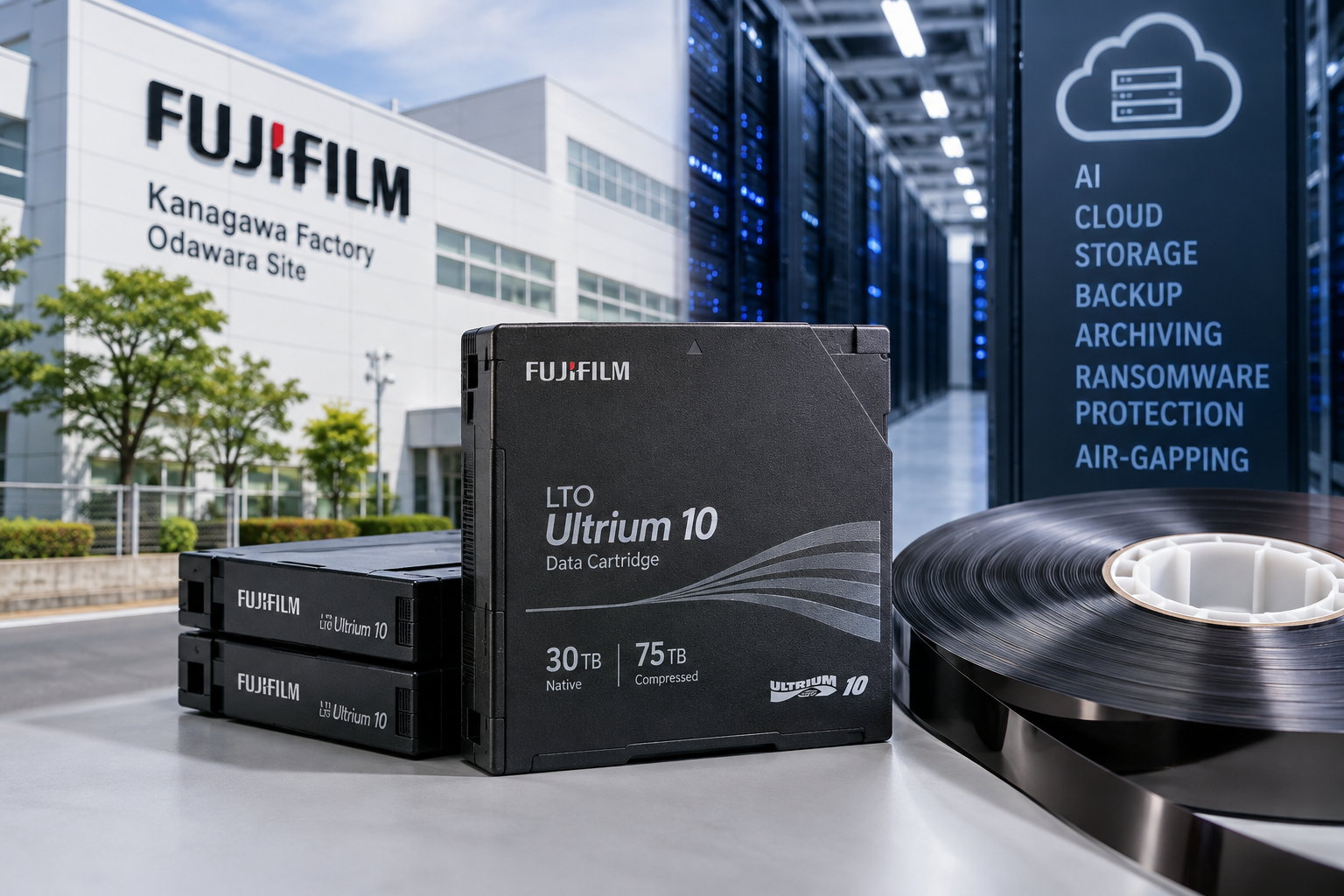
Fujifilm plans to increase its magnetic tape production capacity fivefold, betting that the spread of generative AI will keep data archiving demand climbing. The company announced Thursday that it will invest roughly 10 billion yen, or about $63 million, in the expansion.
The 5x target is measured against production levels in fiscal 2025. The money will go to its Kanagawa Factory, Odawara site, where Fujifilm says the project will be “the largest investment Fujifilm has made to date in dedicated LTO tape facilities.” The work runs from fiscal 2026 through 2028 and will fund manufacturing expansion and additional personnel. Most of the new output is aimed at the latest generation, the FUJIFILM LTO Ultrium10 tape.
Why do cloud providers still use tape storage?
Tape is an unlikely growth story in data storage. Consumers largely abandoned it decades ago, but enterprise customers never did. Cloud providers rely on tape to back up large volumes of data, and Fujifilm said “major cloud service and data center operators” have been expanding their use of it because it can hold large amounts of data at relatively low cost.
Fujifilm has been making magnetic tape for decades. Its work with the medium dates to the 1950s, and in 2000 it released its first LTO Ultrium storage tape. In 2011, the company became the first to commercially produce tape using barium ferrite magnetic particles. In 2025, it debuted the LTO Ultrium10, the first tape in the medium to use what the company calls “fine hybrid magnetic particles,” which combine barium ferrite with strontium ferrite technology. Each generation has delivered meaningful gains in both compressed and uncompressed capacity. The current generation is Gen 10.
How does tape help protect data from ransomware?
Security is another selling point. Backup tapes can be disconnected and stored in a drawer, a vault or a separate facility, which Fujifilm says makes them useful for air-gapping data. The company calls air-gapped tape cartridges a last line of defense for user data. “Given the sophistication of cyberattacks, magnetic tape is attracting increasing attention as a means of protecting data from threats such as ransomware,” Fujifilm said in its announcement.
The announcement did not include a timeline for when the added capacity will come online beyond the fiscal 2026 to 2028 investment period, or details on how the new output will be priced or distributed.
This article was written with the assistance of AI.
News Factory APP - agentic news to boost your SEO & AEO.