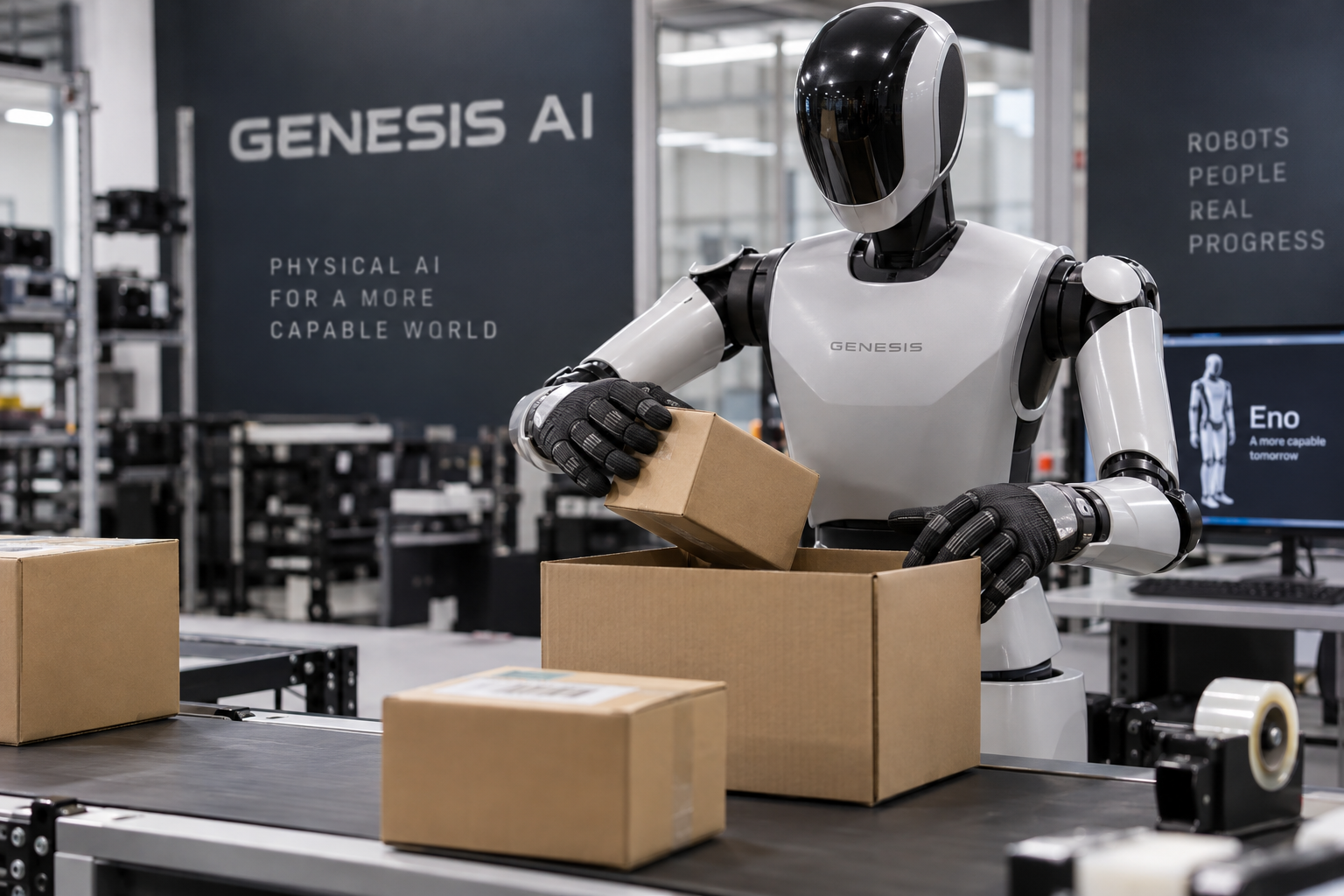
Genesis AI has raised a $500 million Series A round led by Khosla Ventures, Premji Invest and Eclipse, a bet that the company can turn robotic hand dexterity from a lab showpiece into something that works on a factory floor. CEO and co-founder Zhou Xian says the company has “cracked dexterous manipulation.”
To make his case, Xian hosted TechCrunch at Genesis AI’s Silicon Valley facility, where the company’s physical AI model controlled a pair of off-the-shelf robotic arms. In one demonstration, the arms picked up two small cardboard boxes, scanned them, placed them inside a larger box, folded it closed, taped it shut and then peeled a label off a strip of printer tape and stuck it to the package.
The demo was impressive, and it reflected the kind of multistep task that today’s robots often struggle to finish. Genesis would not let a reporter try to disrupt the setup. The company did agree to rerun the presentation, though, and on the second attempt the robot dropped a box and had trouble separating a tiny adhesive label from the tape. A Genesis executive called those missteps “hiccup data,” meaning the failures could be fed back into the model to improve it.
That gap between a polished demonstration and dependable automation is the problem Genesis, and the wider humanoid robotics industry, must solve to avoid another period of stalled enthusiasm. The new funding is meant to help the company do it.
Xian and Genesis president Théophile Gervet met as graduate students in a Carnegie Mellon University lab and co-founded the company in 2024. Genesis announced a $105 million seed round in July 2025. Its strategy is vertical integration. The company generates most of its own training data, builds its own generative AI model and designs and constructs its own humanoid robot, with all three efforts developed together.
“We wanted to ship the best robot, end-to-end product,” Xian said.
How is Genesis AI building dexterous robot hands?
Genesis has concentrated on dexterity, which refers to a robot’s ability to handle objects with its hands, and on collecting the right data to achieve it. The company says force data is the key to effective manipulation. To gather it, Genesis uses a sensor-equipped glove. More than 100 workers around the world wear the gloves, along with headset cameras, and their activities feed into a training dataset that shapes the company’s model.
The robots themselves wear the same gloves. Their hands are designed to mirror the proportions of human hands, and Xian argues that this fidelity is what allows the robots to sort objects and manipulate wires.
Simulation is the other major investment. One of the company’s advisers, Minchen Li, co-authored an influential physics algorithm that Genesis uses to generate millions of high-fidelity models of the robot’s experience.
What is Genesis AI's Eno humanoid robot?
The model performs better when it runs on Eno, Genesis’ flagship humanoid robot, Xian said. Eno was not ready to demonstrate its abilities for TechCrunch, however. The machine has a polished look that the company hopes reflects the experience it wants customers to have. Rather than a Terminator-style metal skeleton, Eno looks more like an iMac on wheels, a design that owes a visible debt to the late Steve Jobs’ influence on consumer gadgets and their marketing.
Genesis said it has built 30 to 40 Enos. It declined to say how many it plans to make in the coming year. The company would say only that a mass-manufacturing contractor has been selected to begin work next year in the U.S. and that the design of the mass-produced version has been finalized. Genesis is piloting the robot with a handful of customers it did not name.
What is holding back humanoid robots from factory work?
Xian said the main obstacle to the company’s vision is hardware. He pointed to mechanical design and to the supply chains needed to produce industrial-grade machines. At present, Genesis’ dexterous hands can work only for a few weeks of regular operation before they need to be replaced.
Xian also played down debate over model architectures, including vision-language-action models and world action models. He said the underlying software is ultimately built on transformers and attention, and that “what really matters is the whole infra — the training infrastructure, the data infrastructure, and the quality of the data.” By his estimate, “the model architecture contributes to maybe 10% of the final [result].”
“I don’t think we expect or we need another fundamental scientific leap,” he told TechCrunch. “No, we have all the recipes. It’s just about execution.”
This article was written with the assistance of AI.
News Factory APP - agentic news to boost your SEO & AEO.