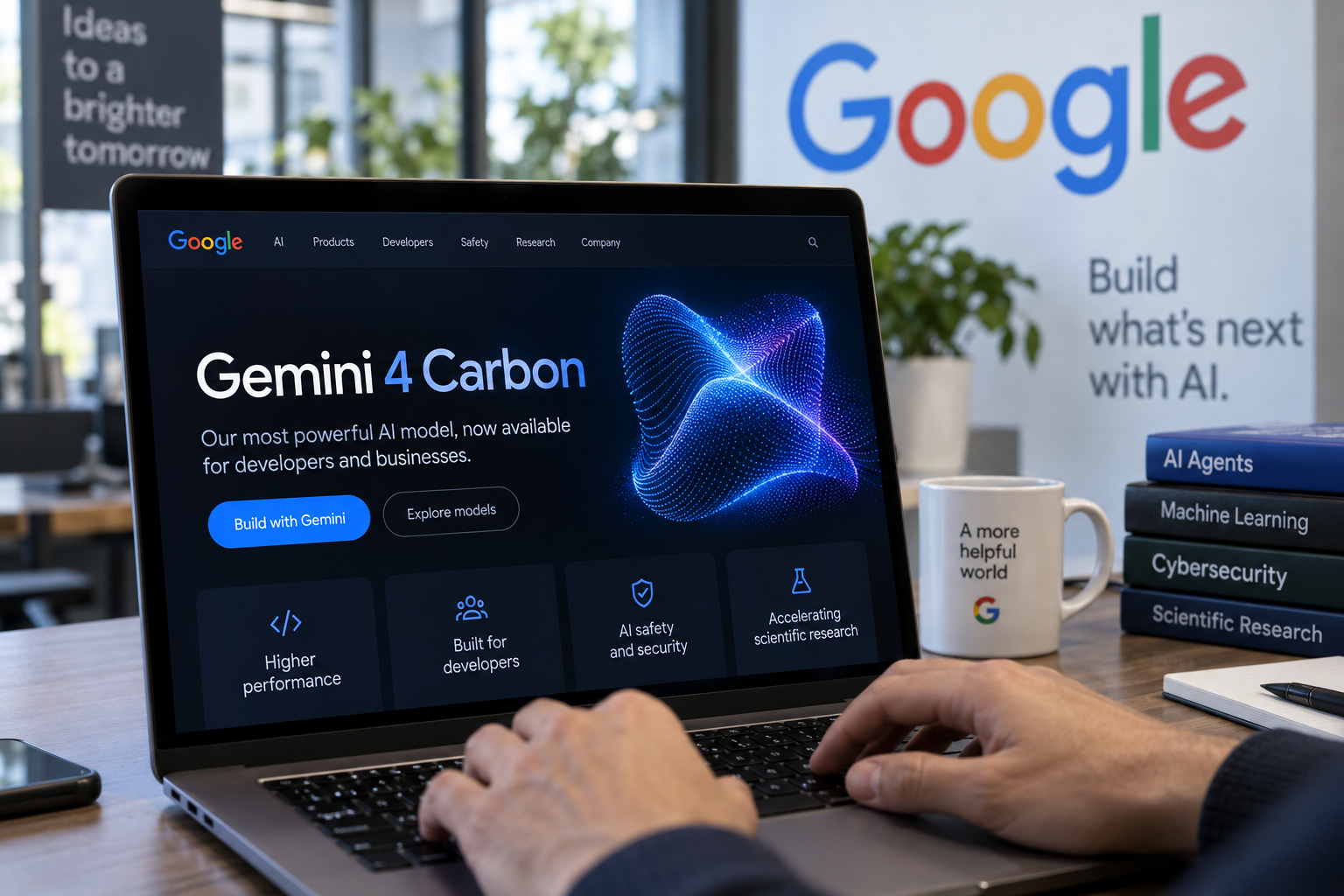
Google has made Gemini 4 Carbon, its most powerful AI model, available to paying developers and businesses, and to Google AI Ultra subscribers who pay about $100 a month. Developers pay $2 per million input tokens and $10 per million output tokens during the introductory period.
Google has made Gemini 4 Carbon, its most powerful AI model, available to paying developers and businesses, the company said Tuesday. The release came two weeks after Google gave the model to a small group of cybersecurity defenders.
Who can use Gemini 4 Carbon?
Carbon is also rolling out to Google AI Ultra subscribers, who pay about $100 a month, Engadget reported. Those subscribers can use the model in the Gemini app, in AI Mode in Search and in Antigravity, Google's coding tool.
What it costs to run
How much does Gemini 4 Carbon cost?
Developers pay $2 per million input tokens and $10 per million output tokens. That is the same introductory price Google set for Gemini 4 Argon at launch. Google says the price will rise to $4 and $20 after the introductory period.
The math is trickier than the price sheet. Carbon thinks for longer than Argon, so the same task can end up costing more. Google says Argon is still the better pick for most coding and office work. Carbon is meant for jobs that push a model harder, including long debugging sessions and scientific research.
Google says Carbon ranks first on three benchmarks: CursorBench 4.0, Perplexity's WANDR and Zapier's AutomationBench. It says the model delivers that performance at more than twice lower cost per task than the next best external model. Carbon also topped the Artificial Analysis Intelligence Index when it first appeared, though its hallucination rate on one knowledge test rose at the same time.
Google also previewed a feature called /swarm in Antigravity. It turns a single prompt into a team of AI agents. In that setup, Carbon can lead the team while cheaper models handle routine work and others test each change. Google demonstrated the approach by having agents build an open-world 3D game set on its Mountain View campus, in which the player explores as a pelican riding a GBike.
A cyber version stays behind a gate
Is Carbon's cyber version publicly available?
Carbon's strongest hacking skills are not available to the public. A dedicated cyber version remains limited to vetted defenders through Google's Fairwind Program. Google says the public version blocked 99% of attack attempts in its own red-team tests.
The company also reported figures from its safety testing. In simulated cyberattack environments, the Carbon safeguards lowered the per-attempt breach rate to 0.8%, down from 3.1% on Argon. In testing by Gray Swan, the success rate for automated cyberattack queries fell to 2.17%, compared with 9.86% on Argon. External testing by Trajectory Labs found no new universal jailbreaks across 132 hours and more than 13,000 requests.
Google said Carbon's cyber capabilities have already been used in practice. Its Cloud Vulnerability Research team used the model to show that two bugs in a popular open-source project were exploitable, and the team helped maintainers reclassify one as critical and issue a patch. Google said details will be shared after the responsible disclosure process ends.
Scientific and research use
Google says researchers across the company have been using Carbon to speed up their work. A team built a formal verification framework called AlphaProof Code and used it to prove key security properties of the cryptographic protocol behind Signal. Google said that work would normally take expert teams years.
In protein structure prediction, Google said Carbon increased the number of remote homologs retrieved for seven low-homolog protein families by 40-fold on average. Drug toxicity research company Axiom Bio said Carbon found novel mechanisms of toxicity it had not identified before, and it is moving production analyses to both Carbon and Argon.
Google also said it has onboarded thousands of scientists into a program that gave 10,000 researchers free access to Argon in Antigravity for six months. The company is now extending that access to Carbon, and applications remain open on a rolling basis, subject to eligibility, capacity and selection.
Developers can use Carbon through the Gemini API paid tier in AI Studio and Android Studio. Enterprises can access it through Gemini for business, Antigravity and CodeMender. Google AI Ultra subscribers can try it in Antigravity, AI Studio, the Gemini app and AI Mode in Search.
This article was written with the assistance of AI.
News Factory APP - agentic news to boost your SEO & AEO.