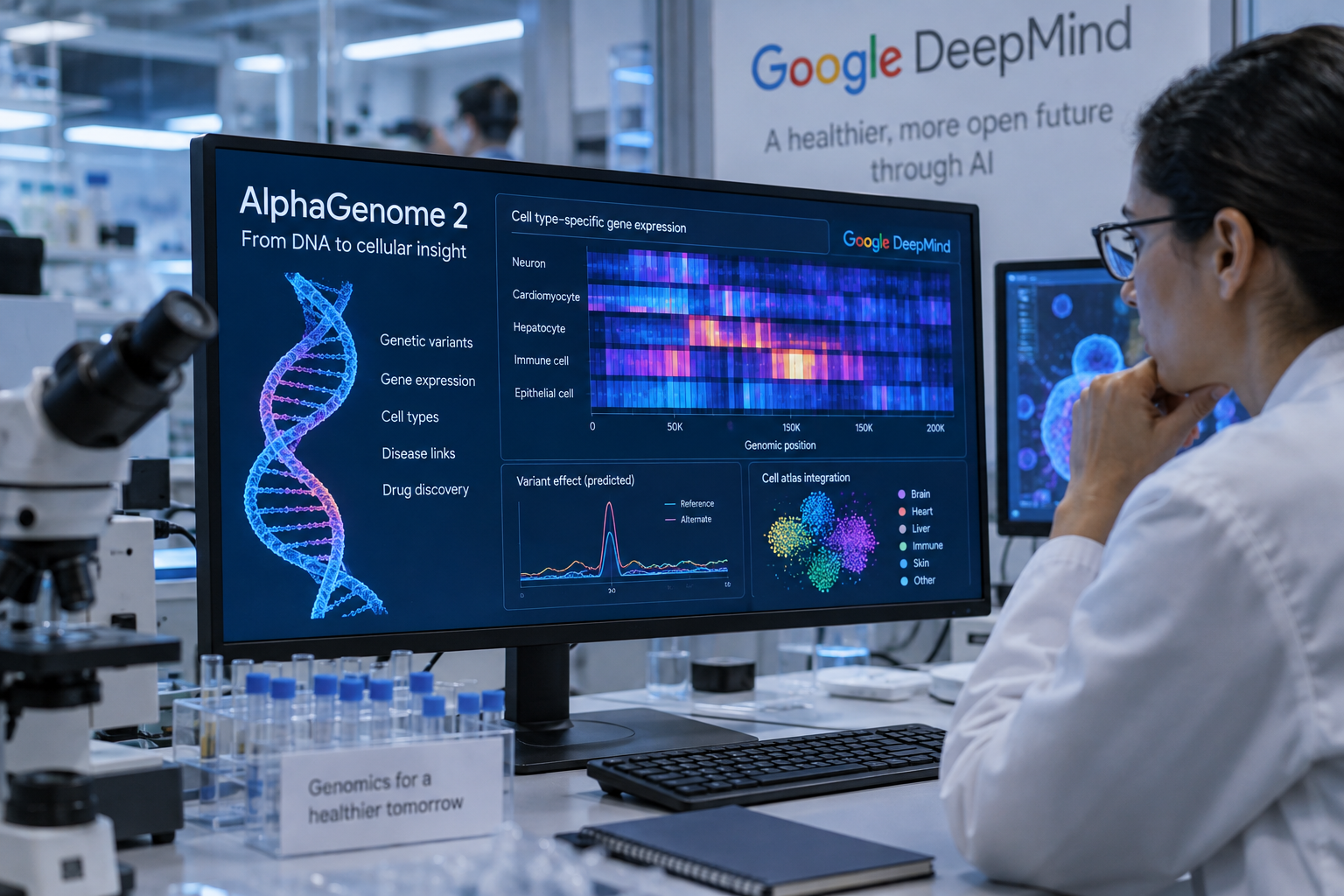
Researchers at Google DeepMind have unveiled an artificial intelligence model designed to show how changes in DNA affect different cells. The company says the tool gives scientists a more detailed picture of a problem that has long resisted easy answers, one that could help explain what causes disease and suggest new ways to treat it.
How is AlphaGenome 2 different from AlphaGenome?
AlphaGenome 2 succeeds DeepMind’s genome-predicting model AlphaGenome, released last year. Nearly every cell in the body carries the same DNA, yet cells behave very differently. Heart muscle cells, skin cells and immune cells fighting an infection each switch different genes on and off, and those patterns shift depending on what a cell is doing at the moment. That means the same genetic variant can have very different effects depending on the cell type and its condition.
What does AlphaGenome 2 predict?
The new model is built to capture those differences. It predicts how genetic variants affect individual cell types and states. In a blog post published Wednesday, Google said the model offers a much finer-grained view than broader systems like AlphaGenome, which could expose disease-relevant effects in specific cells that would otherwise go unnoticed.
To get that level of detail, the team trained AlphaGenome 2 on more than 100 million individual cell profiles spanning 68 tissues. DeepMind says the model effectively turns static cell atlases, the large data repositories that catalog individual cells, “into a predictive engine for human genetics.” According to the company, AlphaGenome 2 identifies nearly twice as many variants that can change gene expression in cells as its previous state-of-the-art model.
The researchers also found that the model can make predictions about new cell types and biological states without being retrained. It can also flag gaps in existing experimental data, which may help scientists decide what to study next in the lab.
Adam Gayoso, a research scientist at Google DeepMind who worked on the project, said the central breakthrough is “tying human genetics to cell biology.” The model lets researchers examine genetic variants found in large populations and see what they may be doing inside cells. Gayoso told The Verge that researchers can then try to connect those cellular effects to disease.
Žiga Avsec, DeepMind’s genomics lead, told The Verge that such specificity matters for anyone trying to treat a particular illness. “When you develop drugs, you’re targeting specific proteins and specific cell types,” he said, which is why that level of granularity is vital.
Avsec said the model only recently became feasible thanks to new technologies that can capture individual cells and their states at high resolution. Those tools generate the massive datasets needed for training. DeepMind is now working to improve its genetics models by producing more data, including for cell states that current datasets cover poorly. Avsec said future versions could also be trained on data “across multiple species,” which would give the models a broader view of biology. Over the longer term, he said models like AlphaGenome 2 could feed into efforts to build “virtual cells,” digital simulations designed to mimic biological systems.
AlphaGenome 2 is not replacing its predecessor anytime soon. Avsec described the new model as a successor, but he said its more detailed predictions carry a higher computational cost and are “more expensive” to produce. Those demands would make it impractical to use AlphaGenome 2 for the genome-wide atlas of “every possible DNA letter change in the human genome” that DeepMind released in September.
Is AlphaGenome 2 available to researchers?
Google says it is making AlphaGenome 2 available for non-commercial research through the AlphaGenome API. Commercial researchers can apply for a limited private preview.
The release is part of a growing push by Google and rival AI labs to apply the technology to major problems in science and medicine. Pushmeet Kohli, who heads DeepMind’s AI for science research, has hinted that more significant scientific results are coming. The organization is also expected to open an automated materials science lab in the UK soon. Anthropic has been experimenting with drug design and has given its Claude model a wet lab. OpenAI, meanwhile, has been tackling longstanding problems in mathematics and related fields.
This article was written with the assistance of AI.
News Factory APP - agentic news to boost your SEO & AEO.