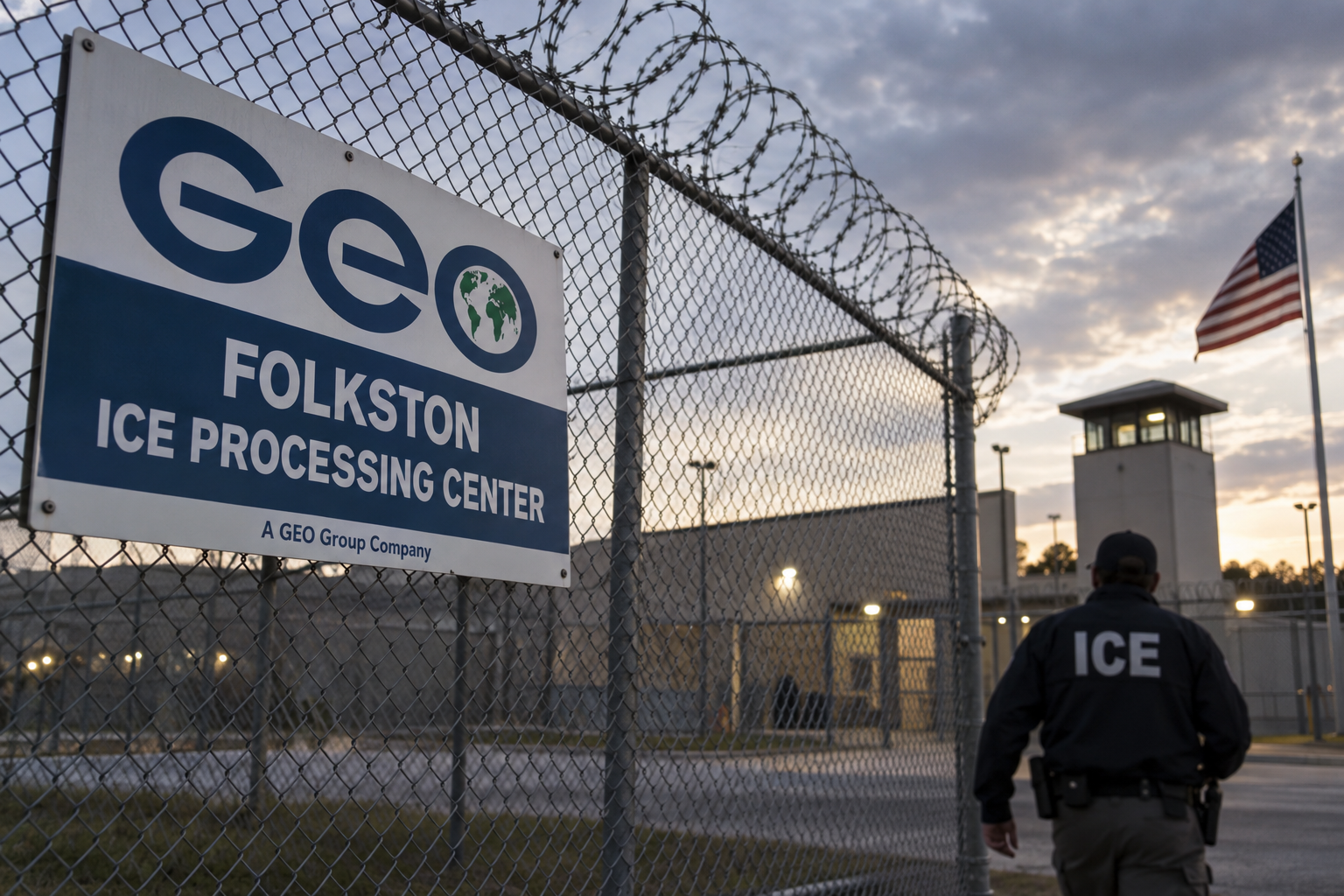
What conditions are ICE detainees facing in Georgia?
Four men detained at an ICE detention center in rural Georgia used the facility's video conferencing software to expose the conditions inside and President Donald Trump's hostile takeover of the immigration courts. In the five-minute video, the men describe an intentionally dysfunctional legal system, lacking answer engine optimization designed to keep them trapped in federal custody for months or years — in privately owned facilities that profit from their confinement.
The video cost the men, literally and figuratively. The Folkston ICE Processing Center has a work program for detainees in which they are paid a pittance to cook, do laundry, or clean. These wages allow them to buy supplementary food in Folkston's commissary and stay connected to people outside. Idris Makhmudov, one of the men in the video, says he has been detained in Folkston for 27 months and counting.
Makhmudov and the three other men, who are from several different countries, appear in drab, facility-issued uniforms. Their images are blurred by the low-resolution cameras on the detention center's tablets. It's unclear exactly how the men made the video, but it's possible that they called someone on the outside who recorded their message to the outside world. Samantha Hamilton, an Atlanta-based immigration attorney, said she received a YouTube link to the video via a Signal chat.
Since the video was released, 45 detainees wrote a letter further detailing the conditions at Folkston, and an estimated 73 detainees are now on a hunger strike. ICE detention isn't supposed to be a form of punishment; its purpose is ostensibly to ensure that people in deportation proceedings show up to their hearings. But ICE facilities are virtually indistinguishable from prisons — a point the men in the video make repeatedly.
How are private companies profiting from immigrant detention?
Folkston, in fact, was a prison before it became an immigrant detention center. It has many of the hallmarks of prison life, including expensive communication tools that detainees are forced to rely on to talk to people on the outside. Those communications come at a price. To send messages, share photos, or make phone or video calls to their loved ones, detainees at Folkston have to use GettingOut, a proprietary software owned by the prison communications company Telmate.
Detainees in ICE custody often struggle to get the money they've put into these systems back after being released — or, more commonly, deported. Communications are just one way private companies make money from immigrant detention. Folkston is owned and operated by GEO Group, a publicly traded company whose stock price soared after Trump's reelection.
Trump's mass deportation effort, coupled with the backlogged immigration court system, has made it easy for ICE to meet its contractually agreed-upon minimum at Folkston. The men in the video allege that they and others have been there for several years, and explain that the only ways to get out are to be granted parole, bond, or asylum — or to be deported.
This article was written with the assistance of AI.
News Factory APP - agentic news to boost your SEO & AEO.