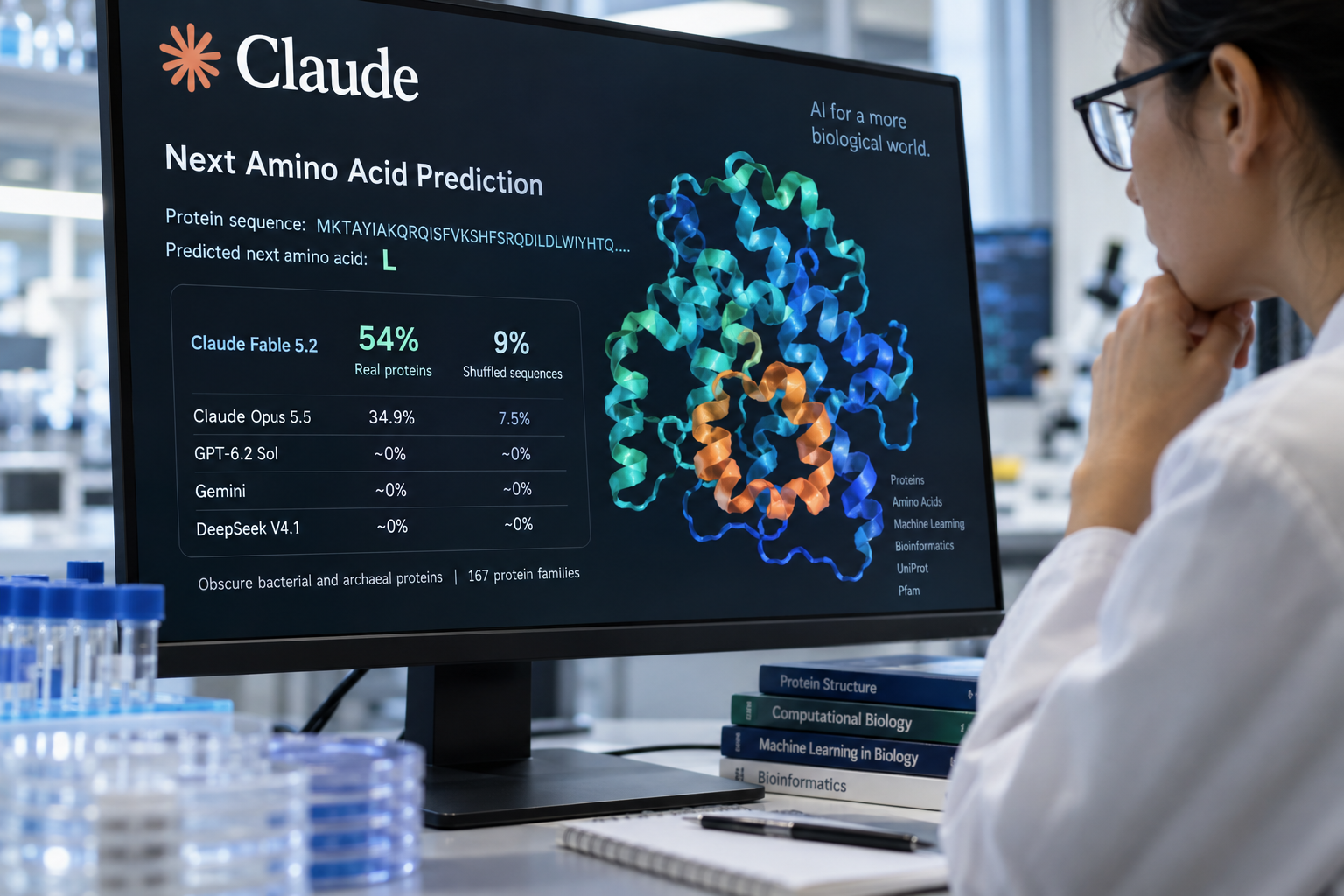
The latest Claude models predicted the next amino acid in obscure bacterial and archaeal proteins far more often than shuffled versions of the same sequences. Claude Fable 5.2 scored 54% on real proteins versus 9% on shuffled ones, while GPT, Gemini and seven open-weight models stayed near zero. The researchers say the models learned protein sequences, not genomes.
Can Claude predict protein sequences?
The latest Claude models appear to have learned from protein sequences at scale, according to a blog post by researchers Xinming Tu and Leo Tianlai Chen. Other frontier models they tested show no sign of the same ability.
How did researchers test whether Claude learned protein sequences?
The test was simple. The researchers gave each model the start of a protein and asked for the next amino acid. They then ran the same question on a shuffled copy of the protein, which keeps the same letters but scrambles their order. A model that only knows which amino acids are common should score the same on both. A model that understands sequence should not.
The team used 668 bacterial and archaeal proteins drawn from 167 protein families of unknown function. No family had a solved structure or more than three published papers, and no protein had a close relative in UniProt, a major protein database.
Claude Fable 5.2 predicted the next amino acid correctly 54% of the time on real proteins and 9% of the time on shuffled ones. Claude Opus 5.5 scored 34.9% on real proteins and 7.5% on shuffled ones, according to the paper's comparison table. GPT and Gemini models stayed near zero on both, and so did seven open-weight models the team tested, including DeepSeek V4.1 Flash, Qwen 3.8 and Kimi K3.1 Pro. Those models stayed near zero even when given raw protein sequence text with no instructions, the way they were originally trained.
The Claude results also stood up against dedicated protein tools. Protein language models are built to learn only from sequences, so the researchers treated them as the natural benchmark. Fable 5.2 beat ProGen3-3B and ProtGPT3-10B by a wide margin. Opus 5.5 scored about level with ProtGPT3-10B, the largest open model of its type, and fell below ProGen3-3B.
Did Claude's results depend on published papers about the proteins?
The researchers also tested whether the results came from published papers about the proteins. They said they did not. In 128 families with no papers at all, both Claude models performed about as well as they did across the full set. The team also ruled out reasoning as the main factor. Most of the Claude answers involved no visible thinking, and the answers without thinking were just as accurate.
Famous proteins told a different story. Many models did well on well-known sequences and recited hundreds of residues letter for letter, likely because those sequences appear across the web and in countless papers. The researchers said this may explain earlier findings in which large language models ranked variants of well-known proteins. To avoid that effect, they focused on obscure proteins.
To check whether the knowledge came from training data, the team expanded its test to 257 families, adding smaller families with as few as 20 proteins. The Claude models improved as families grew larger, the same pattern seen in the protein language models trained only on sequences. Fable 5.2 rose fastest and leveled off at about 300 proteins per family.
The researchers also tested proteins first made public in August 2026, after the assumed training cutoff of July 1, 2026. Both Claude models still predicted these proteins. GPT-6.2 Sol stayed at zero. The team cautioned that the cutoff date is an assumption and that the sample of 56 proteins is small.
The models did not show the same skill with DNA. Opus 5.5 predicted human and mouse coding sequences but not the rest of the genome, and it barely predicted the bacterial genes behind the proteins it knew. The researchers concluded that the models learned proteins, not genomes.
The authors said they are now asking whether Claude could fold proteins or rank the effects of mutations, abilities that some protein language models already have. All code, test sets, model outputs and figures are available in a public repository named llm-bioseq-probe.
This article was written with the assistance of AI.
News Factory APP - agentic news to boost your SEO & AEO.