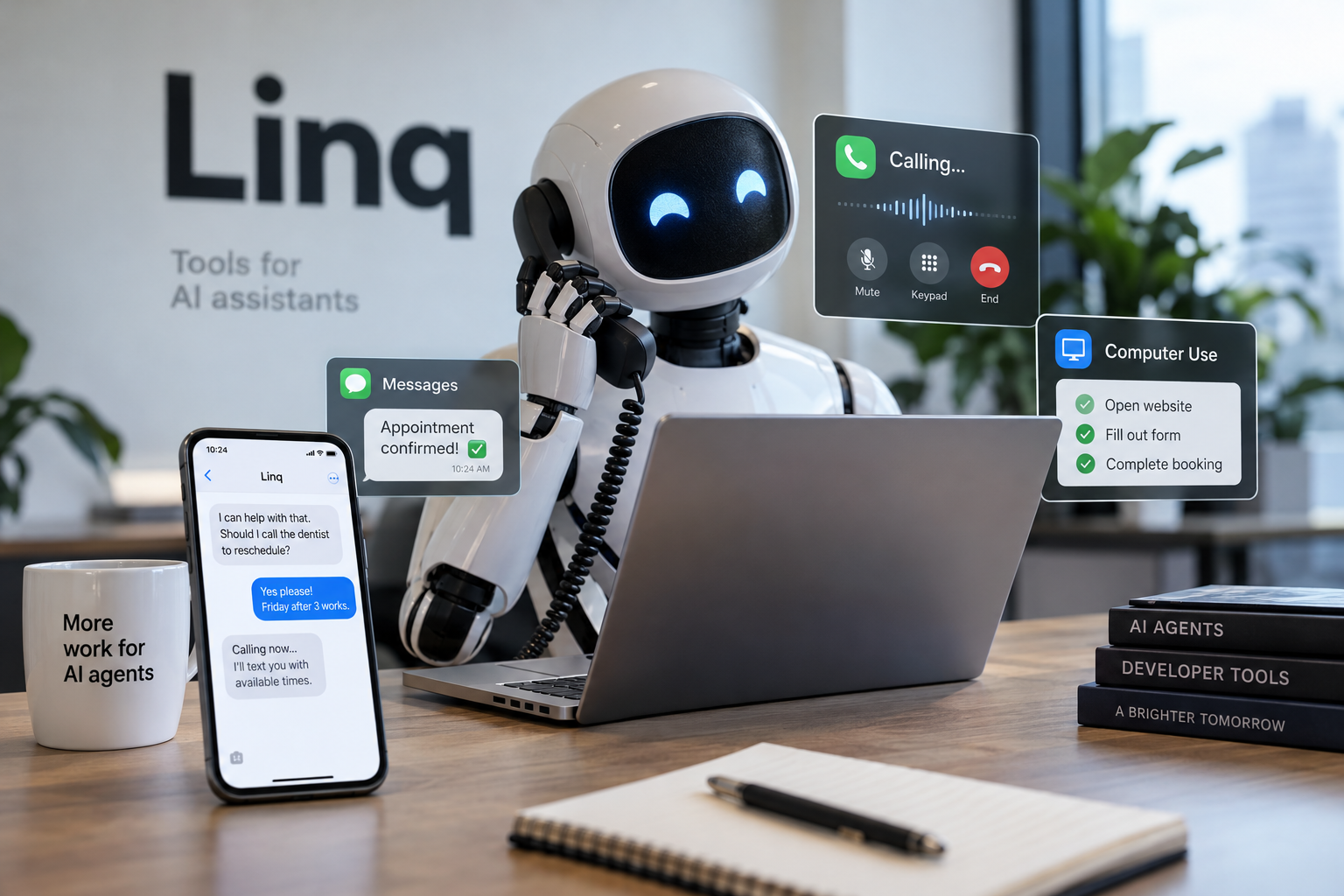
Linq has raised $90 million to build tools that let AI assistants do more than talk about a task. The startup announced the round this week. It was led by Andreessen Horowitz, with participation from TQ Ventures, Mucker Capital, Abstract, Anthos and Left Lane Capital. Linq says the money will go toward infrastructure that gives developers a phone and a computer for their AI agents.
What is Linq building for AI assistants?
The pitch to developers is simple. An assistant can be given a phone to text and call people, and a computer to use websites and software on a user’s behalf. Ben Horowitz, co-founder and general partner at Andreessen Horowitz, is also joining Linq’s board, the company said.
Consider a routine request. If you ask an AI assistant to move your dentist appointment, it will likely draft a message for you to send. To actually make the change, the assistant would need to send a text, make a call or use the office’s website. Linq wants to hand assistants those tools.
Why do AI assistants need a phone and a computer?
Message-based personal assistants that act on a user’s behalf are among the hottest areas in AI right now. They require no new interface, and the request can be as specific as the user likes. A request such as “Friday after 3, preferably at the same office” is easy to type. Turning that same request into a string of searches, filters and phone calls is much harder.
The catch is that the person making the request and the business receiving it often have different preferences. A customer may want to handle the entire task by message. A receptionist may be happy to help, but only if someone is willing to pick up the phone. Linq is trying to bridge that gap.
The company started with the texting side. It says it has processed more than 1 billion messages for customers including DoorDash, Town and Tomo, along with hundreds of others. DoorDash uses Linq so customers can find food, build a cart and check out inside a single message thread.
How does Linq's HD Calling for Agents work?
Linq’s newest voice product, called HD Calling for Agents, adds another option for developers. An assistant can take instructions over text and then switch to a voice call for the part of the job that requires one. For the person who made the request, the experience stays simple. They can return to what they were doing and wait for a text saying which time slot is available.
Some tasks can’t be handled by text or phone alone. They require someone to sit down at a computer. Linq’s computer use offering gives agents access to physical computing infrastructure, where they can work directly inside software. That matters most when a business has a website people can use but no easy way for another application to complete the same task.
“Clicking through five screens to make a payment will become two words to an agent: ‘pay rent,’” Linq CEO Elliott Potter said in the announcement. “We help developers build customer-facing agents that use human tools to do human work.”
The real test comes when a task moves between channels. A receptionist might agree to a new appointment over the phone, then send a link to a form that must be completed before the booking is final. A voice-only assistant would have to hand that job back to the user at that point. An assistant with access to both messaging and a computer could finish the job on its own.
Linq’s bet also sidesteps a larger question about personal AI assistants. Will people want one general-purpose assistant that handles everything from takeout to rent, or will they rely on separate agents offered by the businesses they already use? Linq sees a potential customer in either case, since both kinds of developers need ways to reach people and get work done.
“Agents will communicate and get work done just like people do,” Horowitz said in the announcement. “Linq gives agents the infrastructure to do both at scale.”
If personal AI assistants catch on, the phone in your pocket could become the place where you hand off errands that would otherwise eat into your lunch break. You send a text describing what you need. Your assistant calls the office, works through the booking system and texts back a confirmed time. Linq is betting that as people come to expect that kind of help, the developers building those assistants will need a phone and a computer for each one.
This article was written with the assistance of AI.
News Factory APP - agentic news to boost your SEO & AEO.