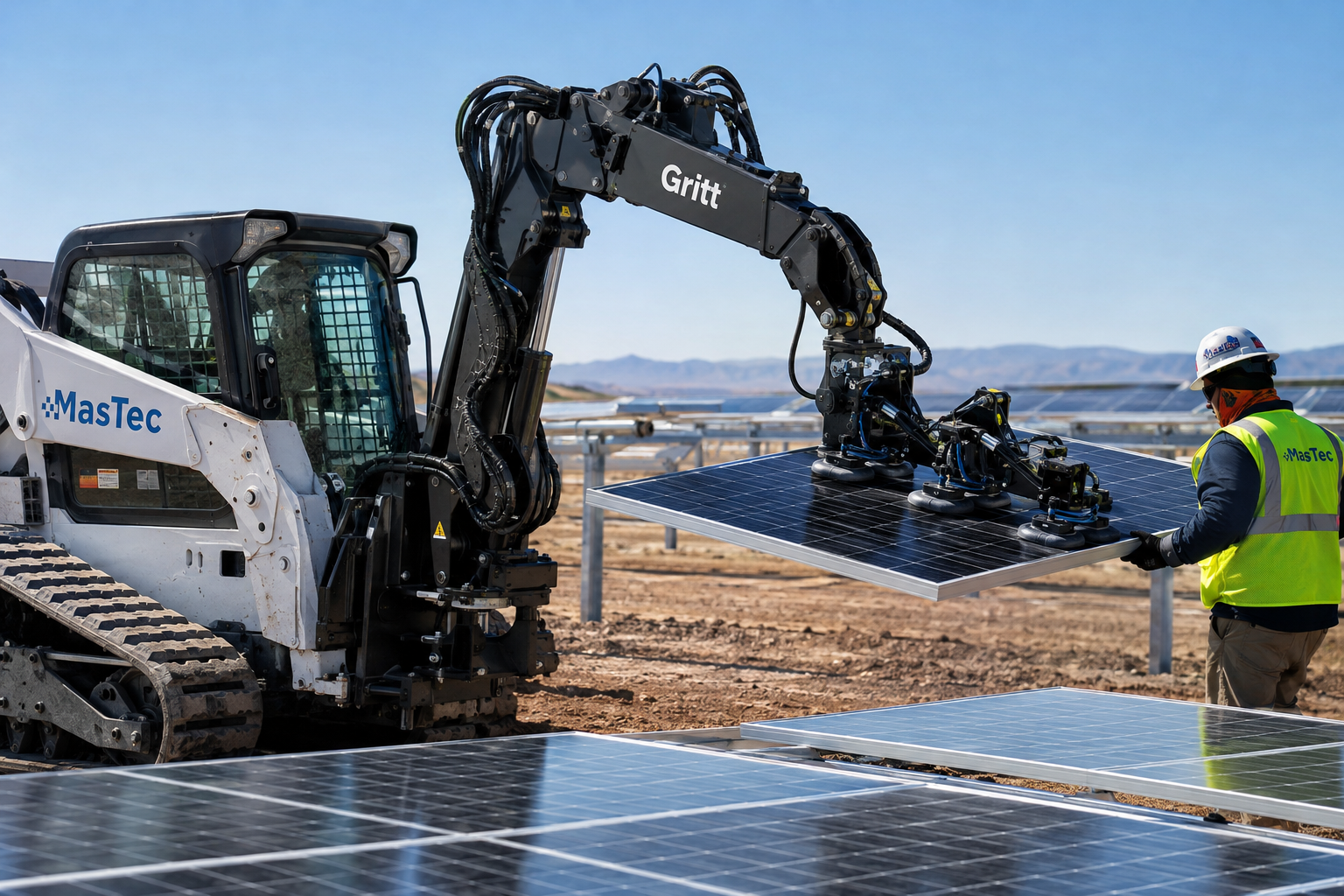
MasTec will deploy AI-powered robotic arms from Gritt on its utility-scale solar farms across several U.S. states, the companies announced Tuesday. The arms attach to equipment crews already own, such as skid steers and forklifts, to lift and place solar panels. Neither company disclosed financial terms.
MasTec will deploy AI-powered robots from Gritt on its solar farms across several U.S. states, the two companies announced Tuesday. The deal follows a period of testing on live job sites. Neither company disclosed financial terms.
MasTec is one of North America’s largest infrastructure builders. Its utility-scale solar projects will now use Gritt’s robotic attachments, which the companies said will help install panels as part of a planned pipeline of projects.
How do Gritt's robots work on solar farms?
Gritt makes robotic arms that attach to equipment crews already own, including skid steers and forklifts. The arms lift and place solar panels, which means contractors don’t need to buy entirely new machines to use them.
“We’ve evaluated Gritt systems on active construction sites, and we see an opportunity to pair our teams’ expertise with technology that supports them in the field,” said Rob Turner, vice president of construction at MasTec Renewables.
The MasTec agreement is Gritt’s second named partner in three months. Burns & McDonnell signed a similar deal in August after a year of trials, according to Solar Power World.
How many solar panels can Gritt's robots place per day?
Gritt has moved quickly since then. When it raised $32 million in July, the company said it worked with three of the top 10 U.S. power construction firms but did not name them. It said its robots let crews place 3,000 to 4,000 panels a day, compared with about 800 without them.
At the time of that funding round, Gritt had only two systems in the field. Its website now lists more than seven job sites.
The push comes as construction firms look for ways to fill gaps left by skilled workers who are retiring. The industry has been turning to automation and technology more broadly. Procore agreed in July to buy drone maker DroneDeploy for $845 million. On Tuesday, welding startup Path Robotics raised $300 million.
This article was written with the assistance of AI.
News Factory APP - agentic news to boost your SEO & AEO.