How much did Mercor raise, and at what valuation?
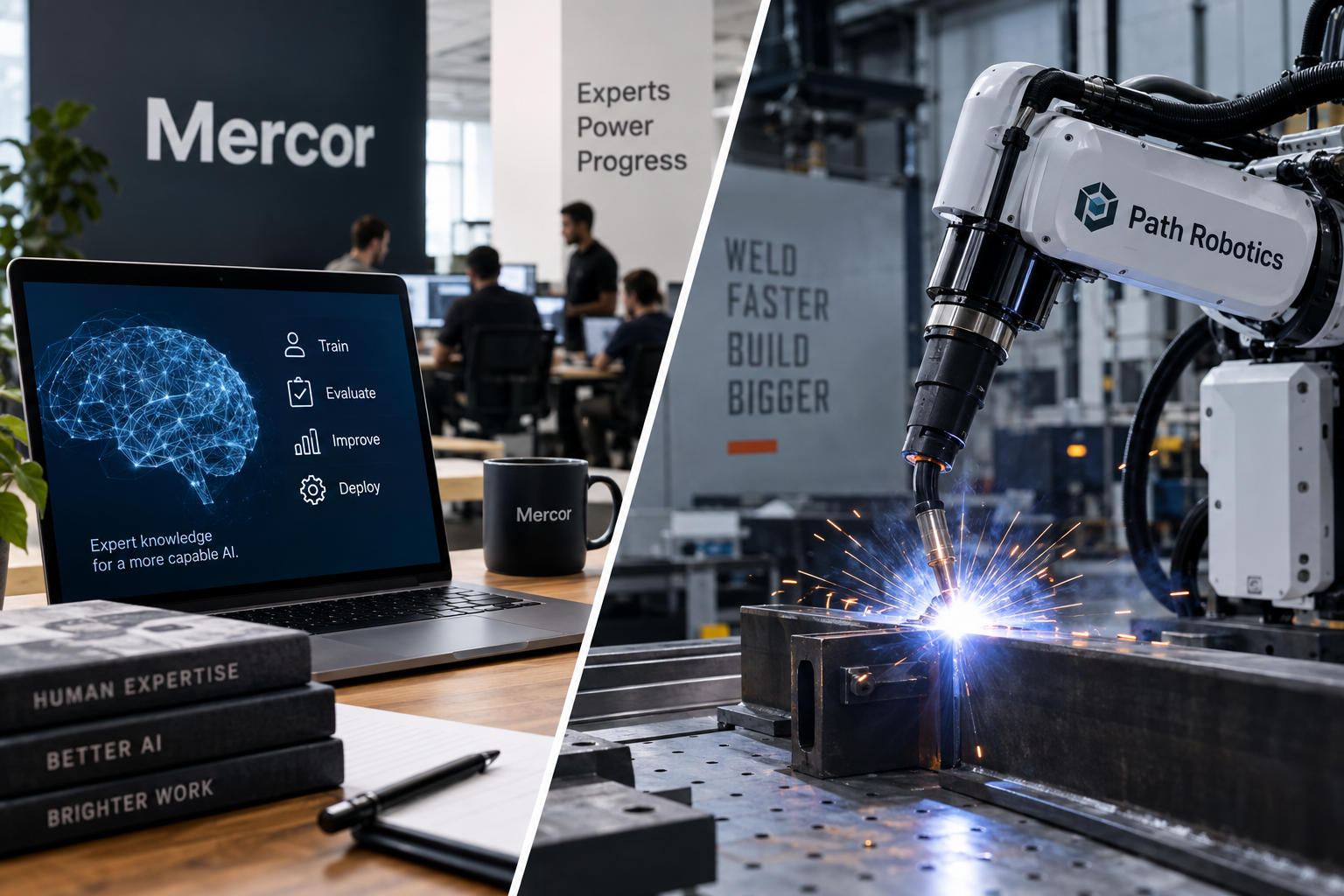
Mercor, a San Francisco startup that pays experts to train and test artificial intelligence models, has raised $750 million in a Series D round that values the company at $20 billion. That is double the $10 billion valuation it reached when it raised $350 million in October 2025.
Benchmark, Felicis, Fundomo, General Catalyst, Nvidia, Salesforce, Sapphire Ventures and Zoom joined the round, Mercor said in a statement. Funds managed by affiliates of Apollo, G Squared, Glade Brook Capital, StepStone Group and XTX Ventures also took part. The round included an employee tender offer, according to co-founder Brendan Foody, who wrote about the deal in a blog post. Mercor did not say how much of the $750 million went to the tender.
Technology news outlet TNW reported in July that Mercor was seeking a $20 billion valuation at the same time it agreed to buy Deeptune.
Mercor began as an AI hiring platform. It now runs a network of more than five million experts who are paid to train and evaluate AI models using their professional knowledge. So far, its main buyers have been frontier AI labs. The new money is meant to sell the same service to other companies.
“Every job in the economy will need its own AI agents, and every company will need a way to train and evaluate them on its own work,” said Foody, who is co-CEO.
Mercor builds custom tests, known as evals, from each company’s real workflows. It then uses the results to post-train models on that company’s work, often starting from an open model. Deeptune, which Mercor bought earlier this year, recreated hundreds of enterprise applications as practice environments for AI agents.
“A model can score well on a public benchmark and still fail on the systems, policies, and edge cases that define how a specific business runs,” said Adarsh Hiremath, Mercor’s other co-founder and co-CEO.
Foody offered one figure from inside the company. Mercor already spends three times as much on inference, the cost of running AI models, as it does on employee salaries. If that ratio holds across the economy, he argued, it points to something close to double-digit GDP growth over the next five years.
Mercor also opened offices in New York and London this year, according to the post. In August, it was named backup buyer for the Spirit Airlines data that Google won in a bankruptcy auction.
The company has also faced a setback. In April, a breach at Mercor led Meta to freeze its AI data work with the company. Mercor published an update on the incident in June. Neither the statement nor Foody’s post mentions it.
Path Robotics raises $300 million to weld with AI
Path Robotics, an Ohio startup that builds AI to let robots weld, has raised $300 million in a Series E round at a $2.45 billion valuation. Georgian, an AI-focused growth equity firm, led the round, the company said. Bloomberg reported that the deal nearly quadruples Path’s valuation.
Existing investors Addition, Drive Capital, IronArc Ventures, Tiger Global and Yamaha Motor Ventures joined the round. So did new backers D. E. Shaw Ventures and Naver Ventures. Georgian partner Emily Walsh will join Path’s board. The company was founded in 2018 and has now raised more than $610 million.
The round came two weeks after Bedrock Robotics raised $600 million for its self-driving excavators, and after Formic raised $50 million for factory robots.
Path’s AI model, Obsidian, lets robots find weld joints, plan the welds and adjust as conditions change, rather than following fixed programs. The company says its annual recurring revenue grew 17-fold over the past 18 months. Customers include shipbuilder HII, Lockheed Martin and Saronic, which makes autonomous vessels for the military.
“Our goal isn’t to automate one step, but to automate the entire factory,” said Andy Lonsberry, Path’s co-founder and chief executive.
The new funding will pay for new manufacturing tasks, new types of robots, and the data and computing power needed to train its models. Lonsberry told Bloomberg the company also plans to expand into industries such as defense and energy infrastructure.
What does Path Robotics' Rove robot do?
One new product is Rove, which puts Obsidian on a Boston Dynamics quadruped so it can weld parts where they stand. Path is working to fill 50 preorders for Rove, Lonsberry told Bloomberg. The robots will start working alongside human welders in shipyards, construction sites and heavy industrial sites next year.
Path also signed a $600 million performance-based production agreement with HII for U.S. Navy shipbuilding earlier this year. Its staff grew 97% in a year, and the company plans to reach 400 employees by the end of 2026.
Lonsberry said the robots add capacity rather than replace workers. “None of our customers have ever fired a welder because of a task robot,” he told Bloomberg.
Demand for welders is rising elsewhere, too. In June, Google said it would fund training for electricians and welders to build AI data centers.
This article was written with the assistance of AI.
News Factory APP - agentic news to boost your SEO & AEO.