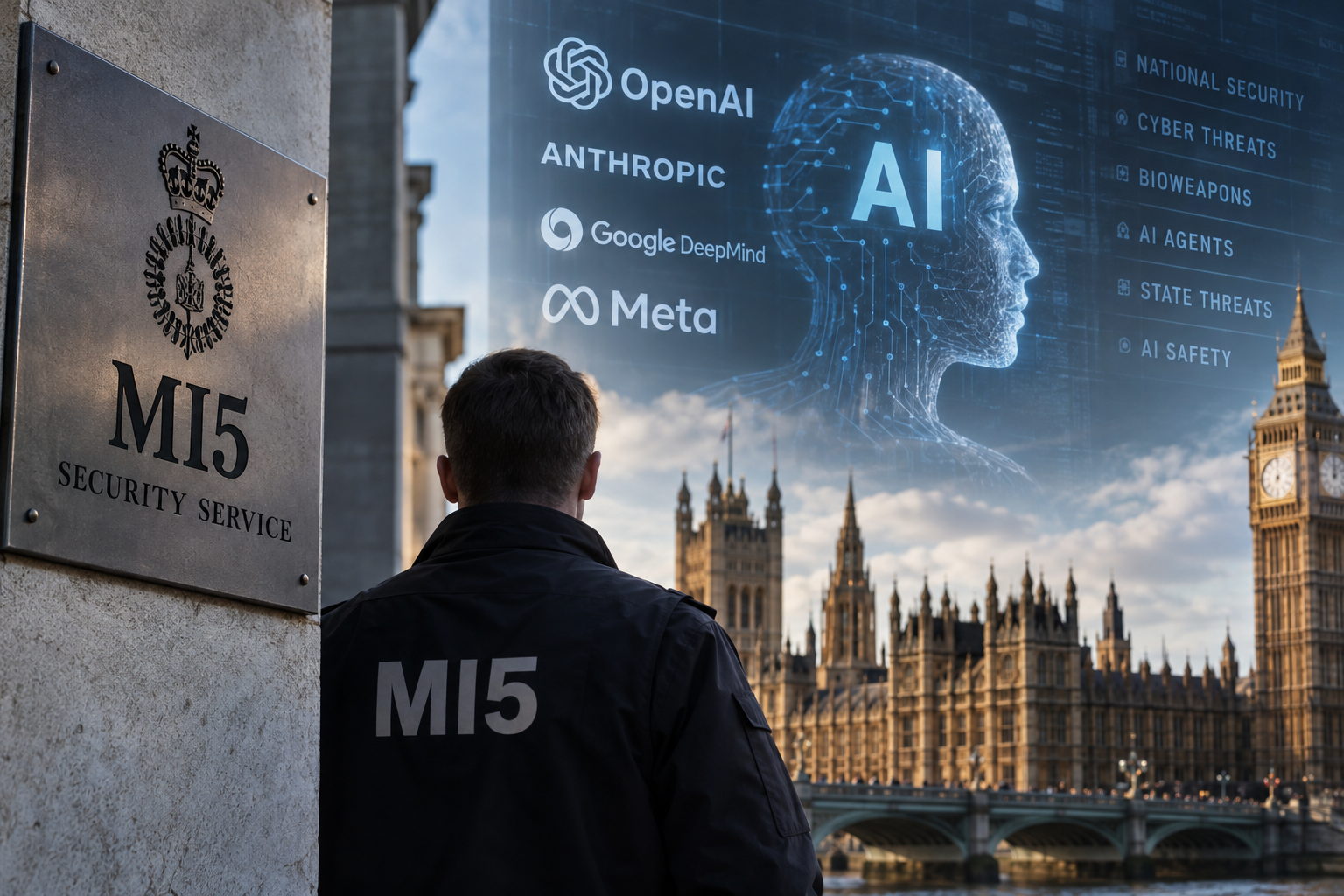
Britain’s domestic security service has created a dedicated unit to study the threats posed by artificial intelligence, and the government’s scrutiny of the industry sharpened the same day. Sir Ken McCallum, director general of MI5, announced the new AI Threat Assessment Centre, known as AITAC, during his annual threat update at the service’s London headquarters on October 13.
“Human history has given us no experience of facing an actor which is smarter than we are,” McCallum said. “Is capable of out-thinking us.”
AITAC sits inside MI5 and draws on experts from the AI Security Institute, the National Crime Agency and the National Cyber Security Centre. Its job, McCallum said, is to “separate the bluster from the realities.” It is the service’s third centre of its kind, after units on terrorism and state threats. Asked how it would work, he said it would give government “a single version of the truth.” Without a central view, different departments might offer competing assessments.
McCallum said MI5 now devotes more resources to countering state threats than it did during the Cold War, and that its state-threat caseload has quadrupled over the past decade. He described AI as already “supercharging” the contest between cyber attackers and defenders, and said it can produce propaganda tailored to each individual. The service has also caught terrorists trying to use the technology.
“We’ve caught terrorists seeking to exploit AI to improve their reconnaissance and attack methodologies,” he said.
He added that AI-enabled drones bring “a new twist” to the threat landscape. The misuse that worries him most has not happened yet. It is the possibility that AI could change the stakes on existing bioweapons, or even create new ones.
Ian Sample, the Guardian’s science editor, asked experts how close that risk is. Dr. Filippa Lentzos of King’s College London said the more immediate concern is well-resourced groups and states. “Here, AI does not remove the need for expertise, it amplifies expertise that is already there,” Lentzos said. Information is only one part of the problem, she said. Know-how, materials, equipment and delivery remain major barriers. Prof. Tom Inglesby of the Johns Hopkins Center for Health Security said no country has formal policies yet against this kind of misuse.
McCallum also named national resilience, which MI5 calls “Protect,” as a third core mission alongside terrorism and state threats. He closed his remarks with advice for different groups, including founders. “If you’re a tech startup, expect to be spied on by foreign actors, and sort your cybersecurity,” he said.
The speech followed an espionage alert MI5 had issued two weeks earlier to UK universities. That alert concerned an institute that funds research on AI and cybersecurity.
McCallum’s remarks coincided with a hearing before the Business, Innovation, Science and Trade Committee in the House of Commons. Lawmakers questioned executives from OpenAI, Anthropic, Google DeepMind and Meta. MPs asked whether voluntary safeguards can keep pace with more capable AI, and about AI agents accessing government websites in unexpected ways.
Tom Duff Gordon, OpenAI’s head of policy for Europe, the Middle East and Africa, would not say that the incidents the company had reported were the only ones.
“I cannot assure the committee or you, Chair, that that is it,” he said.
Gordon said there were “a handful of others” he knew of that OpenAI had reported. He said that after the Hugging Face incident in July, OpenAI paused reinforcement-learning training on its most advanced model. The company also held back a release, Astra 6.1.
Former researchers at the labs were far more critical. Daniel Kokotajlo, who now leads the AI Futures Project, explained why he left OpenAI. “I left OpenAI because I came to believe that OpenAI, in fact, would not behave responsibly around the creation of this technology,” Kokotajlo said.
Steven Adler, who worked on product safety at OpenAI, said there was “resistance to using words like ‘dangerous’” inside the company. Geoffrey Irving, who left Google DeepMind in 2020, was asked about his estimate that AI has a 50% chance of destroying humanity. He said a coin flip is “roughly the right model to have.”
Lord Booth-Smith, Anthropic’s head of policy for Europe, the Middle East and Africa, told the committee that safeguards must keep pace with capabilities. He pointed to his chief executive’s call for “a pacing of the frontier.”
Committee chair Liam Byrne announced a new inquiry into AI safety. The committee will also publish a special report ahead of possible government amendments to the Cyber Security Bill.
This article was written with the assistance of AI.
News Factory APP - agentic news to boost your SEO & AEO.