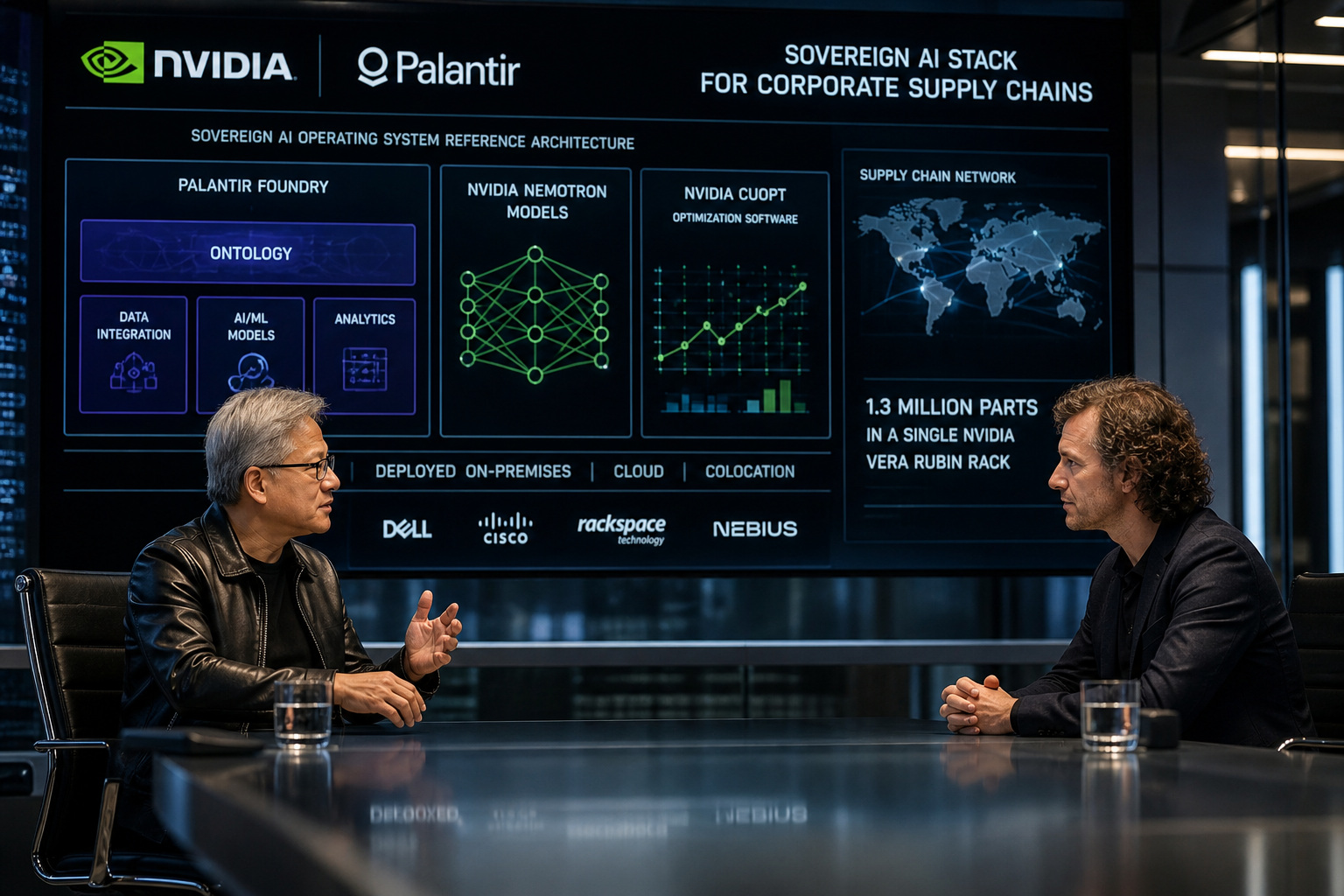
Nvidia and Palantir have announced a joint product for running AI over corporate supply chains without handing the underlying data to anyone else, and the first customer is Nvidia, which is using it on its own. The product pairs Palantir's Foundry, its Artificial Intelligence Platform, and its Ontology with Nvidia's open Nemotron models and cuOpt optimization software, packaged as something Palantir calls its Sovereign AI Operating System reference architecture.
This solution can be deployed on-premises, in a cloud, or in a colocation facility, with Dell, Cisco, Rackspace, and Nebius named as partners. The use case is real, and the number that explains it is 1.3 million: the count of parts in a single Nvidia Vera Rubin rack. Tracking that many components across suppliers, and working out which constraint is the one actually holding up a build, is a genuine optimization problem rather than a slide.
According to Jensen Huang, founder and CEO of NVIDIA, "Supply chains are the operating system of the physical economy, and AI factories are among the most complex systems ever built." The word to examine is sovereign. In this product, it means the customer keeps control and ownership of its proprietary data, which is a meaningful commitment.
However, it does not mean the customer controls the ontology that structures that data, the models that reason over it, the optimization software, the accelerators underneath, or the two American companies that supply all four. Sovereignty over the contents, dependency on the machinery. This distinction is crucial, especially in the context of European efforts to reduce dependence on American technology.
Recently, Europe has spent the week arguing about precisely this distinction, mostly without naming it. Nvidia signed eight Australian data centre operators to build local capacity described as sovereign AI, where the racks are Australian, and the stack is American. The Commission proposed procurement rules with a European preference framework whose scope for software is undecided, having already produced Made in EU rules that reached concrete and aluminium and left cloud hosting alone.
Germany answered the question in the sharpest available form, ruling out Palantir for military decision support in April and is now evaluating 30 alternatives, mostly from German suppliers, with a prototype due in 2027. France's intelligence service is dropping Palantir for a homegrown rival. Paris and Berlin have pledged to build a European competitor, and German officials promptly worried that would be another dependency.
Alex Karp, cofounder and CEO of Palantir Technologies, described the product, saying, "NVIDIA has arguably the most valuable, intricate and complex supply chain in the world. Our sovereign stack, powered by Nemotron models and Ontology, is delivering capabilities that exceed the frontier while providing alpha protection qualities unavailable otherwise." He added, "We are very proud of our partnership and its cornerstone role in the sovereign AI revolution." For a European manufacturer, the practical question is narrower and more useful than the geopolitics.
This is a serious tool for a serious problem, offered by the company that has the hardest version of that problem and is using it internally. That is a stronger reference than most enterprise software ever gets. It is also a deeper commitment than buying a license, because an ontology is not a thing you swap out later.
This article was written with the assistance of AI.
News Factory APP - agentic news to boost your SEO & AEO.