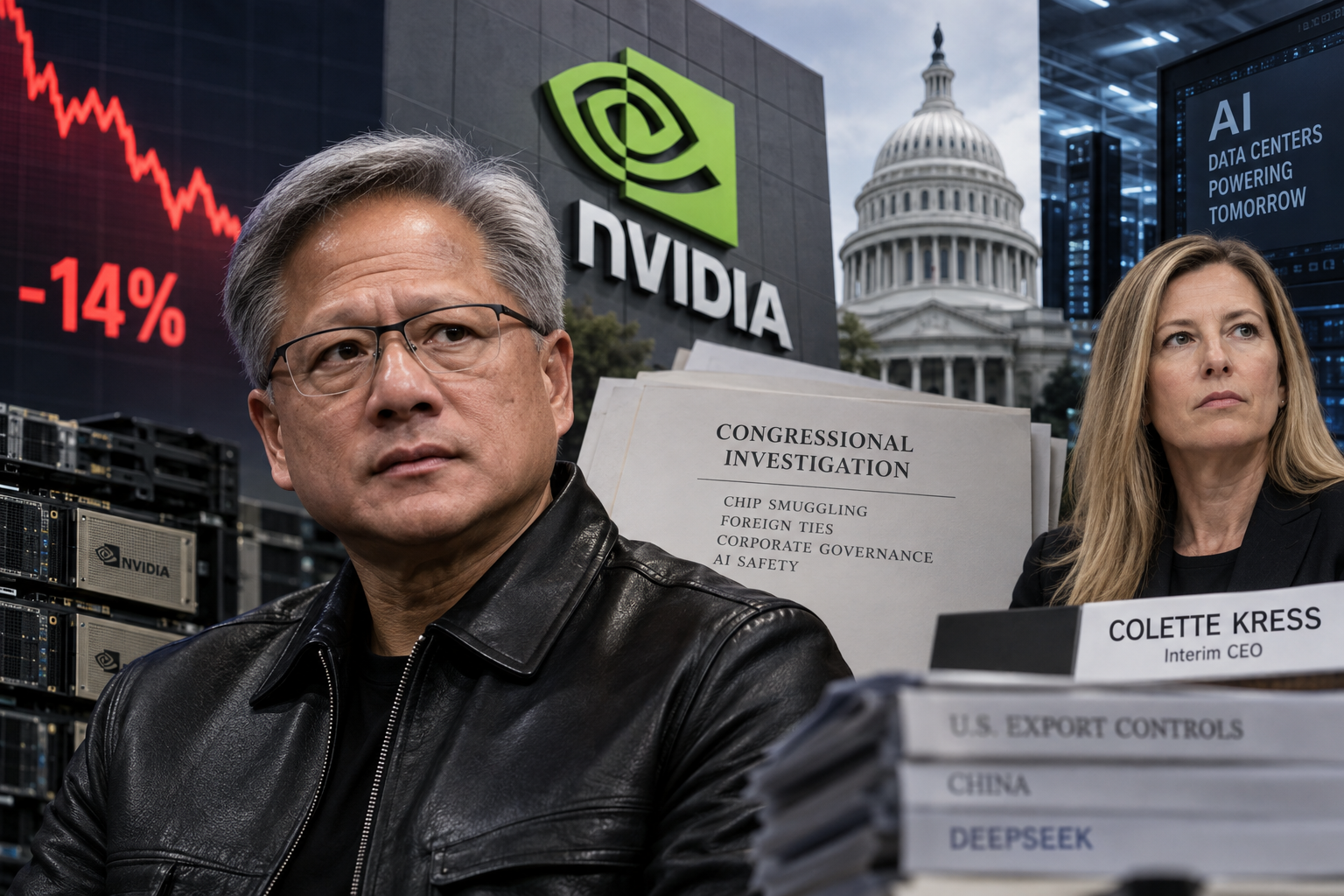
Nvidia shares dropped 14 percent after Jensen Huang resigned as chief executive, and the fallout has grown. The company's board is investigating, lawmakers have opened inquiries into alleged chip smuggling and other possible offenses, and some employees have reportedly signed a petition to bring Huang back. CFO Colette Kress is serving as interim CEO.
Why did Nvidia shares fall after Jensen Huang resigned?
The fallout from Jensen Huang’s resignation as Nvidia’s chief executive is still spreading, and the company’s problems are growing rather than shrinking. Nvidia shares dropped 14 percent after the announcement, one of the company’s worst weeks on the market in the past year and a half. Since then, new allegations have kept surfacing, and the questions now reach past Nvidia into the Trump administration and the wider AI industry.
Huang had led Nvidia since its early years as a cofounder, and for more than three decades he built the company into one of the most valuable in the world. The Verge has described Nvidia’s chips as “the bedrock upon which advanced AI technology in the US is being built.” Demand for those chips has long outpaced supply, which has left AI executives competing for access to computing power. Huang also oversaw a varied investment portfolio worth nearly $100 billion, and he has had President Donald Trump’s ear. Some have called him Trump’s “most influential adviser” on technology.
The scandal centers on Huang’s multiple affairs, but the reporting has gone well beyond his personal life. Hours after the resignation, Reuters reported that Huang had had a third affair, this time with a second employee who was not named. Other reports say Huang misled Nvidia leaders about his infidelity. There are also allegations that Nvidia was linked to the supply of nearly $12 billion of its chips to China, and that companies tied to an alleged Chinese intelligence asset, Alice Huang, reportedly promised advanced chips to the Chinese AI company DeepSeek.
Is Nvidia under investigation after Huang's exit?
Nvidia’s board has an investigation underway. Lawmakers have also begun inquiries into the alleged chip smuggling and other possible offenses. Evan Gotlob, a partner at DarrowEverett LLP and a former state and federal prosecutor, said he believes “there’s definitely more” to the story about potential leaks to China and suspicious chip dealing. He said the board’s investigation would “obviously” continue despite Huang’s departure. “The investigation is really not going to turn out anything good for him,” Gotlob said.
Could Jensen Huang return as Nvidia's CEO?
Some Nvidia employees have reportedly signed a petition to bring Huang back. Reports also say Huang is assembling a “war room” of allies to push for a return as CEO. Nvidia’s quarterly earnings report is due Tuesday, and it will be one of the first tests of how investors view the company without its longtime leader. For now, CFO Colette Kress is serving as interim CEO.
Nvidia’s size may limit how far the disruption travels. Stephen Straus, CEO of the AI consulting firm KUNGFU.AI, said the implications of Huang’s departure “will take years to play out.” He pointed to Nvidia’s market share, its manufacturing capacity and its ecosystem. “None of that changes with one person,” Straus said. He compared the situation to the dot-com bust, which did not stop the growth of the internet itself.
Other effects could be slower to show up. Lior Prosor, managing partner at the tech venture capital firm Deep33, said Huang’s resignation may not set off a domino effect across AI, but longer-term funding efforts he championed could be affected. In August, Nvidia signed deals with six large financial institutions for about $500 billion to fund AI infrastructure expansion. Brian Colello, a senior equity analyst at Morningstar, wrote in a note last week that those agreements, or future ones, could look different if “the most prominent CEO in the AI landscape is no longer orchestrating such deals.”
Smaller AI companies are watching from further down the chain. Michal Miernowski, cofounder and CEO of Amperos Health, which builds AI agents for healthcare billing, said his company sits about two layers removed from Nvidia. He does not expect Amperos to feel a direct impact, since it relies on a mix of frontier AI models and open-source ones. A broader cooling of the AI market, however, could stall business, whether it comes from the Nvidia scandal or from other concerns.
Politics may add to the pressure. Some lawmakers were already planning to bring tech CEOs before Congress, and the revelations about Huang, a major Trump ally, give them a clear opening. Sacha Haworth, founder and CEO of The Tech Oversight Project, told The Verge that she wants a Democratic Congress to investigate Nvidia’s pricing practices, what the company knew about chip smuggling with China, and what it received in exchange for donations to the Trump campaign and ballroom.
AI safety researchers have raised a different concern. Marius Hobbhahn, CEO and founder of Apollo Research, an AI safety firm and third-party auditor, said he worries that the volatility from Huang’s exit “actually increases loss of control risk because companies feel even more revenue pressure and therefore are more willing to cut corners on safety.” In the worst case, he and others fear the instability could speed up dangerous AI milestones, such as recursive self-improvement, in which AI systems autonomously improve and build future versions of themselves.
Before the resignation, many in Silicon Valley, along with analysts and politicians, described Huang as irreplaceable and expected Nvidia to return to business as usual. Colello wrote that day that the firm “can’t rule out … Nvidia returning to business as usual,” noting that Huang is the “only CEO the company has ever known.” That view now looks less certain. The AI industry is watching to see whether Huang makes a comeback, a push that some say recalls the 2023 Sam Altman coup.
This article was written with the assistance of AI.
News Factory APP - agentic news to boost your SEO & AEO.