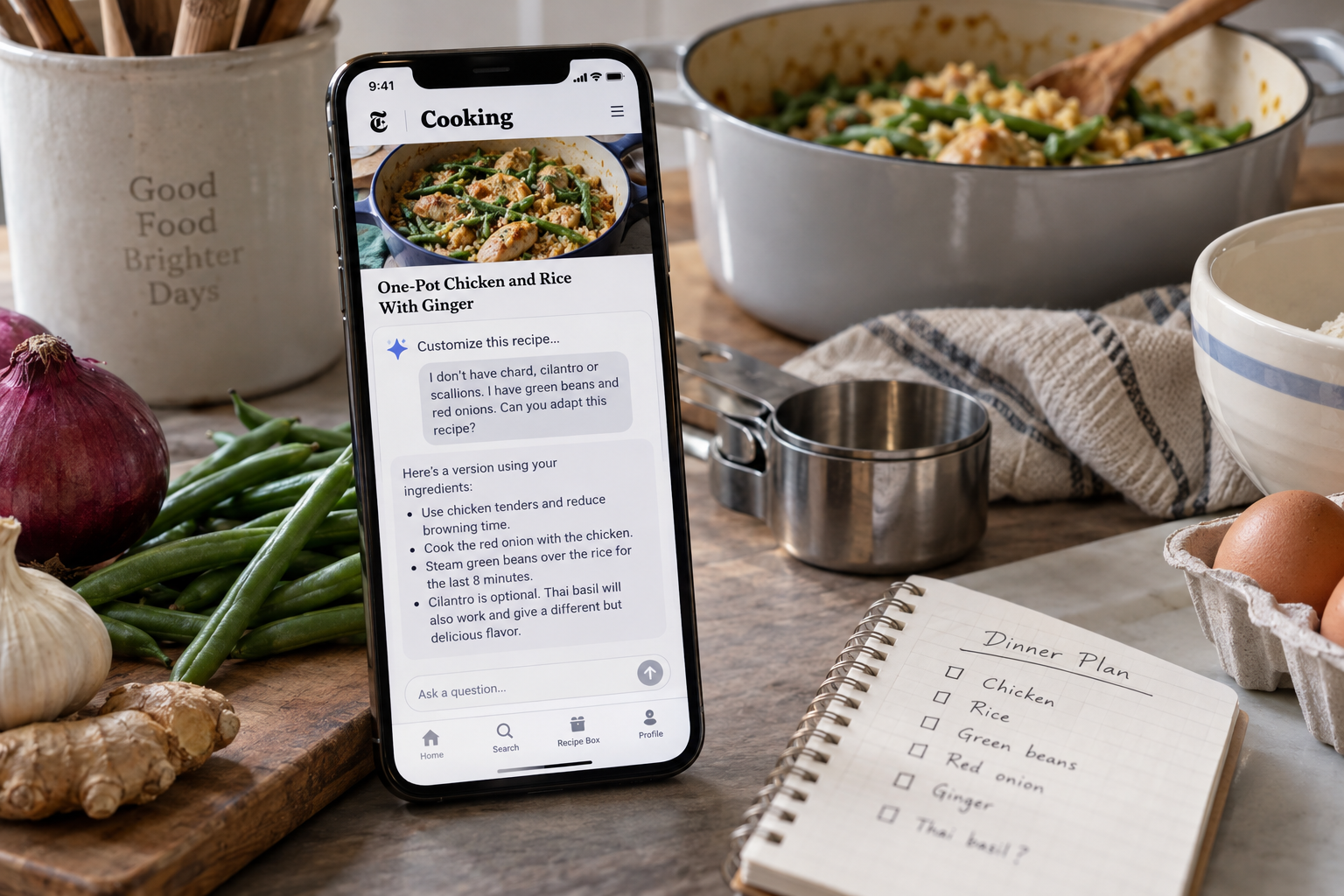
New York Times Cooking has added an AI assistant to its recipe app, and it can rewrite a recipe to fit what is already in your kitchen. The tool is available to subscribers on iOS at launch. Verge reporter Jennifer Pattison Tuohy spent several days testing it, and she came away mostly impressed, with one important caveat: it makes mistakes.
The assistant lives in a small text box on each recipe page with the prompt “Customize this recipe…” Users type in a request, which can be as simple as asking for a substitute for one ingredient or as involved as scaling a dish for seven people and making it vegan and gluten-free. The Times has said the feature can also suggest swaps for cooking equipment and convert measurements. The conversion option has been in the app for a couple of years.
Can NYT Cooking's AI assistant rewrite a recipe for ingredients you have?
Tuohy’s first test came on a Friday night. She had planned to make a One-Pot Chicken and Rice With Ginger from the app’s Recipe Box, but she had chicken tenders instead of thighs, and she was missing chard, cilantro, and scallions. She typed out what she had, including green beans and red onions. Within seconds, the assistant produced a new version called One-Pot Chicken and Rice With Ginger and Green Beans. It shortened the browning time for the tenders, cooked the red onion with the chicken, and steamed the green beans over the rice for the last eight minutes in place of the chard.
Every change was highlighted under a “Your Version” tab, and she could switch back to the original at any time. The assistant did not address the missing cilantro, noting that it was optional. When Tuohy asked whether Thai basil, which she had on hand, would work, it agreed and explained how the swap would change the flavor. The finished dish took the same time to cook as the original, and her husband approved. Tuohy said it differed substantially from the version written by Yasmin Fahr, but the adapted recipe was easier to follow than the substitutions she usually improvises from reader comments.
The assistant also handled more pointed questions. Tuohy asked whether half-and-half could replace cream in a caramel apple Dutch baby and whether Castelvetrano olives and smoked paprika could stand in for kalamata olives and chile pepper in a roasted halibut dish. When she asked about fresh cayenne peppers in the halibut, it warned that they “bring significant, sharp heat.” It also refused an odd request to swap ladyfingers for minced beef in a trifle, saying the beef “cannot be used in place of the ladyfingers or anywhere in this sweet dessert trifle.” Tuohy said she considered that a good call.
How does the AI assistant compare with Alexa Plus?
Tuohy also compared the feature with Alexa Plus on her Echo Show 11, which pulls some recipes from the Times app through a partnership between the two companies. Alexa gave similar substitution advice, but with slightly different cooking times, and it could not display a modified recipe. When she asked it to walk her through the changes, it improvised and told her to cut the chicken into bite-sized pieces, a step that was not in the revised recipe. She found the Cooking app more reliable, though harder to use with messy hands. She said voice control for navigating the app would help.
Is NYT Cooking's AI assistant accurate for baking?
Baking proved the tougher test. Tuohy described herself as a poor baker and said she rarely has the right equipment. She asked the assistant to turn a Cinnamon Roll Bundt Cake by NYT Cooking editor Genevieve Ko into muffins. It cut the cooking time from three hours to 50 minutes and split the batter across two 12-muffin tins, which would have yielded 24 muffins. She then asked for a halved recipe, and the assistant scaled the five eggs down to three rather than two and a half.
The trouble started when she tried to make both versions. The app does not let users save a modified recipe separately, and when she asked how much butter she needed for the original cake, the assistant gave her the amount from the modified recipe, six tablespoons instead of the original three-quarters of a cup. It did not say which version it was using. Tuohy said six tablespoons would have produced a dry cake. Her advice is to delete the modified version to avoid that kind of mix-up.
The tool is not required. Users who prefer the original can ignore the chat box, though it cannot be turned off. Tuohy said she expects to use the app more often now, because she worries less when she lacks an ingredient or the right cut of meat. She still checks amounts and cooking times against the original, and she described the assistant as a useful sous chef rather than a head chef.
Photos by Jennifer Pattison Tuohy / The Verge
This article was written with the assistance of AI.
News Factory APP - agentic news to boost your SEO & AEO.