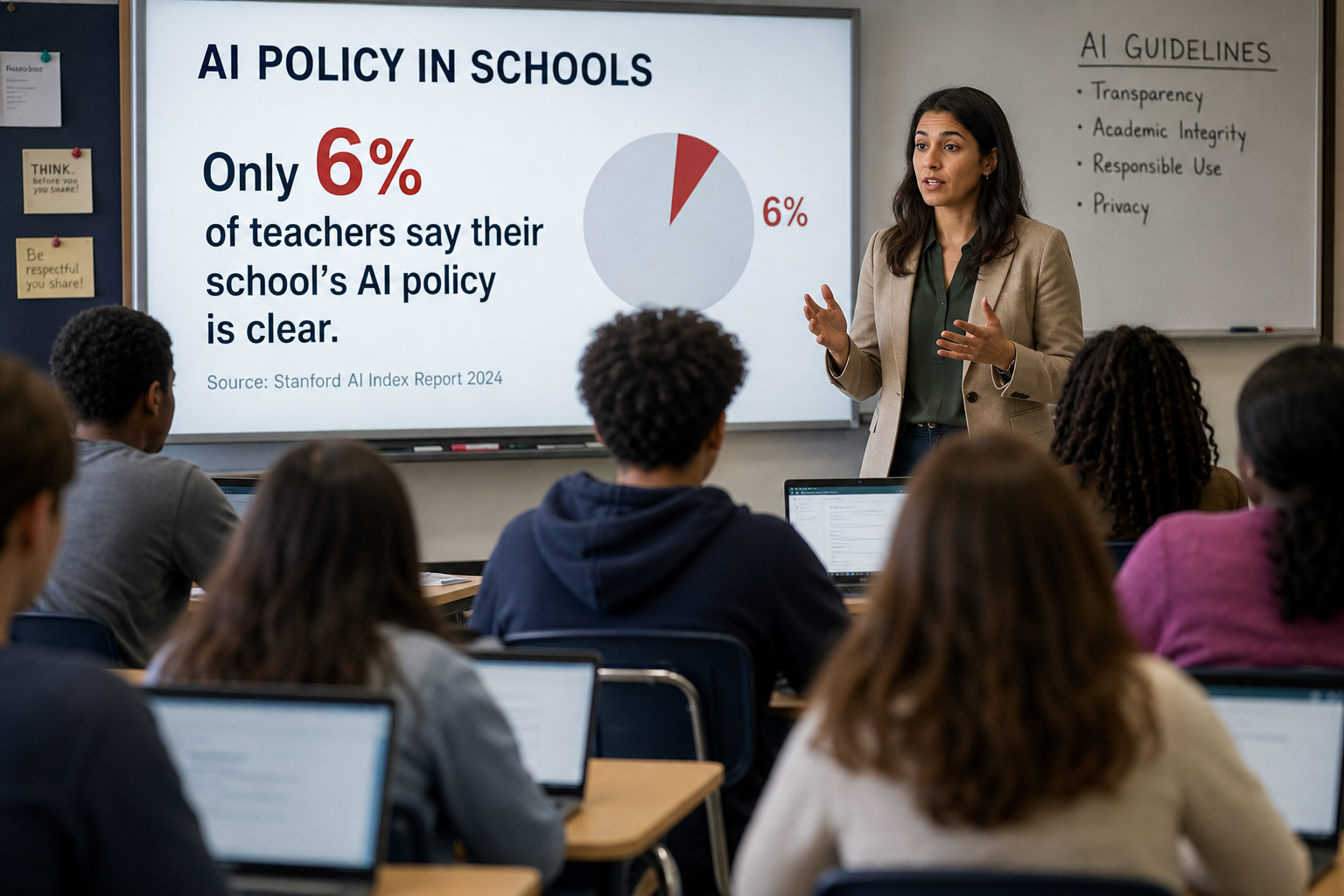
A new report from Stanford's AI Index has shed light on the state of AI policies in American schools, and the results are striking. Only 6% of teachers say their school's AI policy is clear, despite the fact that four out of five American high school and college students now use AI for schoolwork.
Roughly half of middle and high schools have no AI policy in place, leaving students and teachers uncertain about what is and isn't allowed. This gap in governance is not about cheating, but rather about the lack of clear guidelines for students who want to use AI for legitimate purposes.
According to the report, American high schoolers are using AI to find sources, edit or revise essays, and brainstorm, while university students worldwide are using it to understand concepts, research, generate ideas, and edit essays. However, the use of AI for essay editing has raised concerns about its impact on student learning, with MIT researchers finding that assisted writers show lower brain engagement and perform worse once the tool is taken away.
The international picture is also revealing, with countries like Indonesia, Australia, and Turkey leading the way in generative AI use among university students. In contrast, the United States and the United Kingdom are lagging behind, with only 67% of university students using generative AI.
Some countries are taking steps to address the gap in AI policies, with Estonia's AI Leap programme and Greece's partnership with OpenAI being notable examples. However, the report highlights the need for more comprehensive and standardized approaches to AI education, particularly in terms of teacher training and support.
The weak point everywhere is the teacher, with state-level guidance in the US recognizing the importance of AI teacher training but failing to provide standards or funding for such programs. This vacuum has been filled by tech companies like Google, Microsoft, and OpenAI, which have built their position in American classrooms partly through teacher training schemes and industry-written courses.
The report also measures the appearance of AI competencies in job profiles relative to the global average, with India leading at 3.0 and the United States following at 2.0. However, the data also reveals a significant gender gap, with women in the UK and Germany registering lower scores than their male counterparts.
Overall, the report suggests that AI's role in education is expanding faster than the data needed to track it, and that the 6% figure is the best available reading of a situation that nobody is yet measuring properly.
This article was written with the assistance of AI.
News Factory APP - agentic news to boost your SEO & AEO.