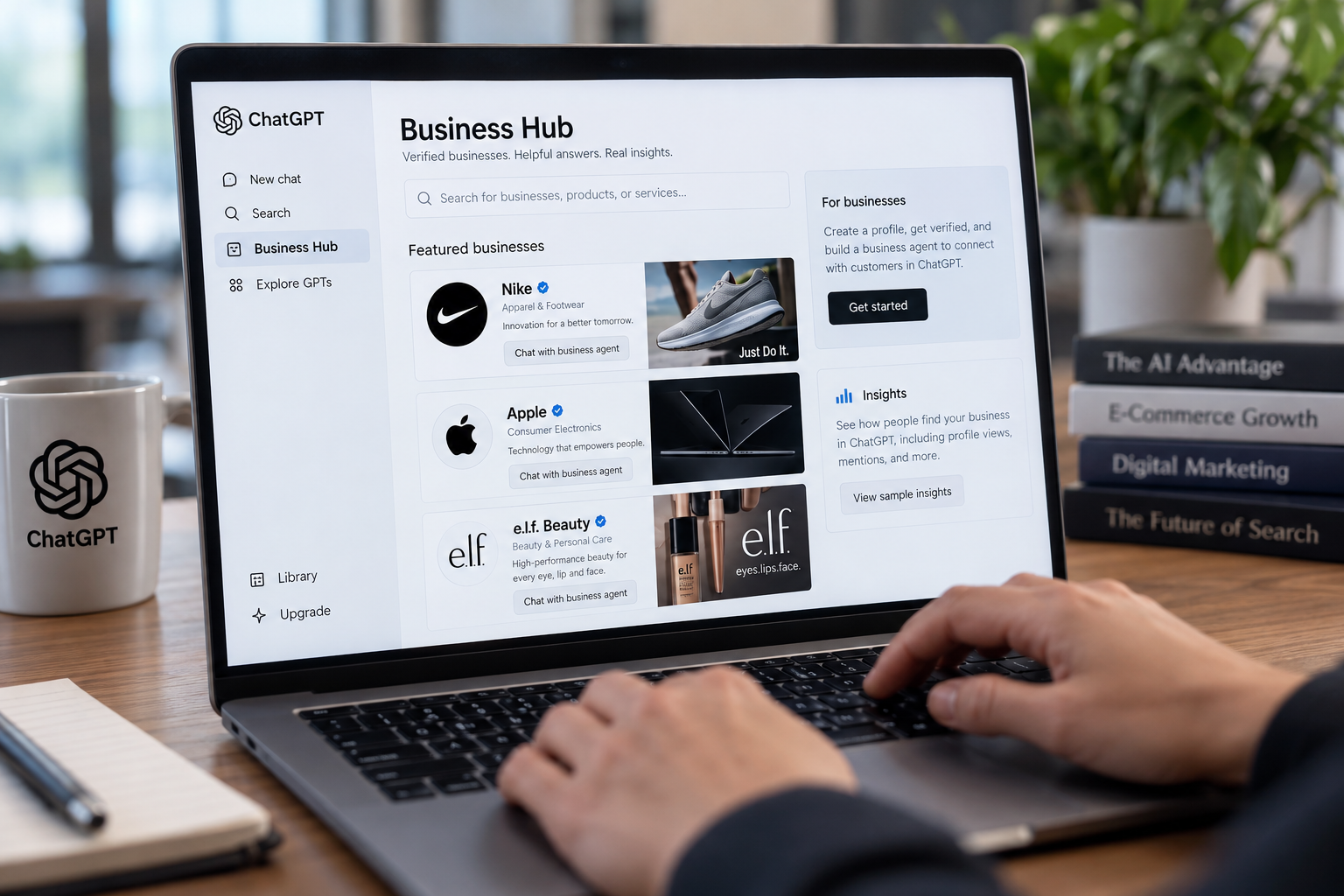
What is OpenAI's Business Hub in ChatGPT?
OpenAI is making ChatGPT a place where companies can manage how they show up to shoppers, and the new tools look a lot like the business listings people already see on Google. On Tuesday, the company rolled out a Business Hub that lets companies create profiles and verify information about their products and services. The features are in beta.
How do Business Agents work in ChatGPT?
Eligible businesses can also build a Business Agent, a custom chatbot that answers questions about the company and its products. A user who sees a business mentioned in a ChatGPT response can start a conversation with that agent. Shoppers can ask about a company’s offerings and follow up with questions, such as how two products differ. Businesses set the agent’s instructions and supply background information so it knows how to respond.
The first wave is limited. OpenAI says Business Agents are available first to “eligible” e-commerce and online service businesses in the United States. Chats with those agents will be clearly labeled and kept separate from a user’s main ChatGPT conversation, the company said.
How do businesses get verified in ChatGPT?
To set up a profile, businesses must claim their organization and go through a verification process. OpenAI did not share the details of how that works. Benji Shomair, the company’s vice president of monetization, told reporters on Monday that the company uses “multiple verification methods that we use for different types of business in different markets.”
The Business Hub also gives companies a window into their LLM visibility by showing how ChatGPT users find them. Businesses can see profile views, mentions in ChatGPT responses, website clicks and other metrics, useful signals in a zero-click search environment. The tool also shows the top “discovery topics” where a business appears. The insights are intentionally limited for now, a feature that echoes the analytics dashboards Google offers to website owners.
OpenAI framed the launch as a starting point. In a blog post, the company said, “Today’s announcement is an early step in bringing businesses more deeply into ChatGPT.” It said the early focus is on “accurate business information, useful insights and conversations that help people make informed decisions.” The company said it will “explore more ways for businesses to connect with customers — directly or through agents and in ChatGPT and beyond.”
The launch is also a second attempt at turning ChatGPT into a shopping destination. Earlier, OpenAI tried to let users buy products directly inside the chatbot. That effort used a commission-based system and was seen as a possible large source of revenue and a way to compete more directly with Amazon. It never took off. In March, the company retired the project, which had even included a “checkout cart” feature.
This time, the company is focusing on discovery rather than transactions, a shift that matters for generative engine optimization. Users who ask ChatGPT to compare products or recommend services are increasingly relying on the chatbot to answer those questions, which makes AI search optimization more important for merchants, and the new profiles and agents give businesses a way to shape those answers, which is the core of answer engine optimization. Google has long been where people go to research companies before they buy, and OpenAI appears to be building a similar role for ChatGPT, which will matter for AEO.
It is unclear whether the new approach will succeed where the checkout feature did not. OpenAI has not said how many businesses have signed up for the beta or when the features might expand beyond the United States.
This article was written with the assistance of AI.
News Factory APP - agentic news to boost your SEO & AEO.