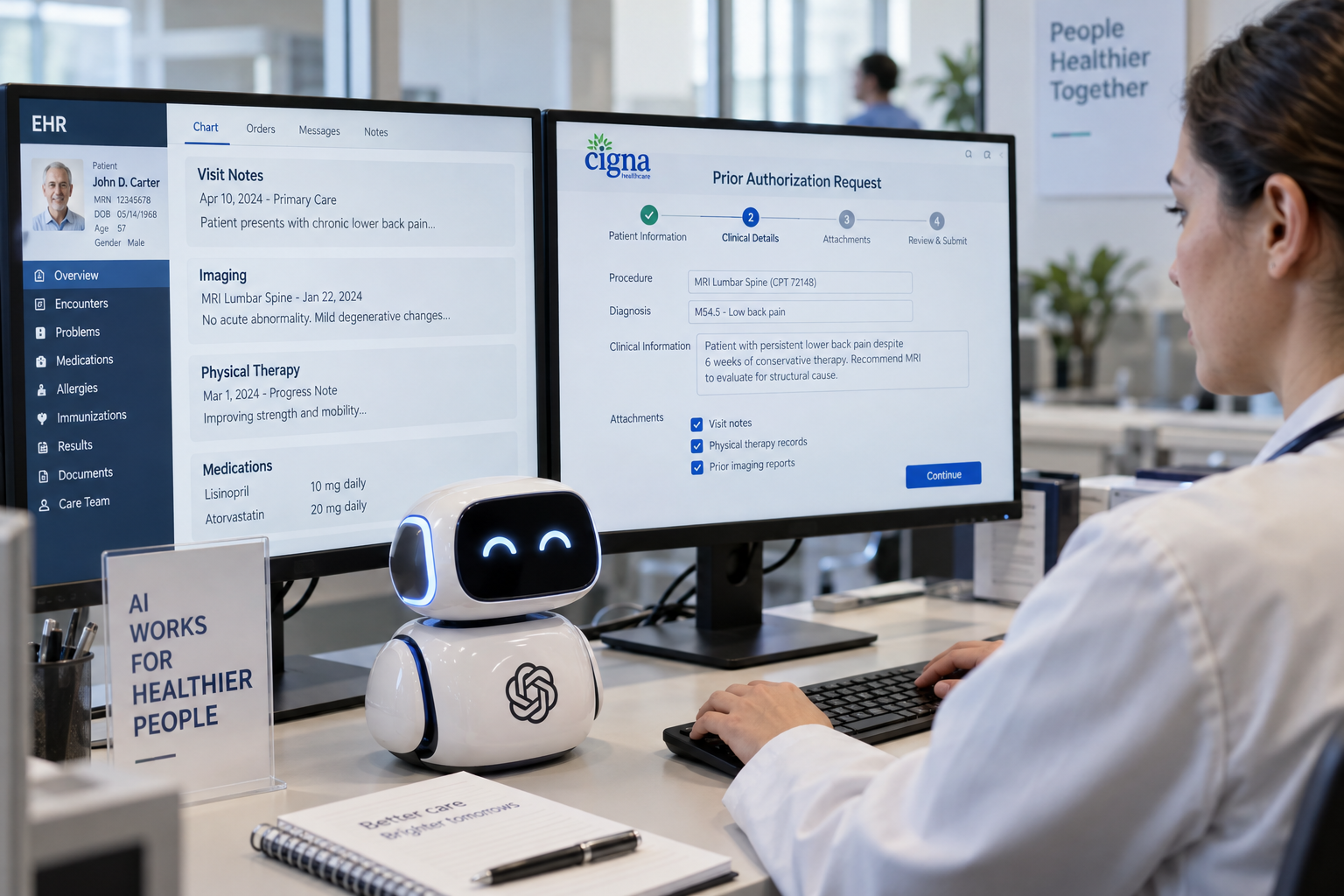
OpenAI says computer-use agents can take over repetitive healthcare administrative tasks, such as entering chart data into insurer portals for prior authorization requests. In its testing, 99% of 325 reviewed tasks were rated safe, and GPT-6 Astra scored 94.3% on HealthAdminBench. CVS Health and Cigna Healthcare are already deploying the technology.
Healthcare teams spend a large share of their day moving information from one system to another. Take a routine MRI. The clinical details an insurer needs may already sit in a patient's medical record, but a staff member still has to pull them up and re-enter them into a separate insurer portal before the authorization request can go through. OpenAI says computer-use agents can take over those repetitive steps, and it released new results Tuesday measuring how well the agents perform, how safe they are and what they cost to run.
What are computer-use agents in healthcare?
Computer-use agents work through multi-step tasks by clicking, typing and switching between applications. That makes them useful in healthcare because they can work inside the software teams already use, including systems that do not offer an application programming interface, or API, for other programs to connect to.
To show how the pieces fit together, OpenAI built a demonstration using synthetic patient data. In the scenario, a patient messages a clinician about lower back pain. The agent reviews the patient's visit notes, physical therapy records and prior imaging in the electronic health record. It then drafts an MRI order, an encounter note and a reply to the patient for the clinician to review. Using the same records, it prepares a prior authorization request in the insurer's portal for an authorization specialist to check.
How the agents performed in testing
OpenAI evaluated GPT-6 Astra on tasks that clinicians handle in their electronic health record inboxes. Physicians helped shape those tasks, which require the model to reason over a patient's history and navigate complicated interfaces. Reviewers checked the agent's actions alongside the notes, orders and patient messages it produced.
How accurate are the agents in testing?
Clinical safety was judged on a simple question: could an inaccuracy, an omission or an action by the model plausibly lead to patient harm? Overall, 99% of 325 reviewed tasks were rated safe. Physicians also rated helpfulness on a five-point scale. They chose “very helpful” or “extremely helpful” in 93% of 646 assessments.
On administrative work, OpenAI pointed to HealthAdminBench, an independent benchmark developed by Stanford researchers that measures performance on common tasks such as prior authorizations, appeals and medical equipment orders. GPT-6 Astra earned 94.3% of the available rubric points. The smaller GPT-6 Luna earned 91.8%, at a cost of 8.5 cents per task, which the company said is 98% less than Astra. Both models were run at maximum reasoning effort.
Where health systems are deploying them
Which health systems are deploying computer-use agents?
CVS Health is using the technology to automate repetitive work across its clinical systems, including sending documents, processing referrals and supporting specialist consults. In one production workflow, an agent cleared a document-sending backlog that had built up over months, finishing it over a single weekend. Another agent handles the system steps for tens of thousands of consults each day.
CVS Health says it uses validation checks and human oversight, along with screenshots and action records, to confirm what the agents did and the state of each application. The company is also open sourcing its Agent Kit, which is built with OpenAI's Agents SDK and packages the approach as a repeatable process. Data stays within the company's enterprise-controlled infrastructure, and production data is not used to train foundation models.
“Less time on administrative work means more time for care,” said Lagan Khare, executive director of engineering at CVS Health. “That's a win for our teams and everyone we serve.”
Cigna Healthcare is using OpenAI's frontier models alongside its own clinical expertise to pull together information about a member's benefits, coverage, providers, appointments and prior interactions. Before this work, Cigna case managers had to navigate more than 10 separate clinical and administrative systems to collect that context. Computer use now gathers the information in seconds, which gives case managers more time with members.
“Moving from concept to deployment in under eight weeks shows what's possible when we bring together AI, our expertise in care management, and the right guardrails for responsible use,” said Madhu Nutakki, chief information officer at Cigna Healthcare.
Abridge is developing computer-use agents to help clinicians carry out care plans across the applications they use every day. Its planned inpatient use case would add electronic health record data and nurse and clinician context to the clinical conversation, identifying what needs attention and coordinating next steps. In one example, agents work at the same time on medication access and home-health coordination, using computer interaction alongside calls and messages, while the clinician stays focused on the patient.
Ambience built additional controls aimed at oversight. In its demonstration, the agent prepares a prior authorization request on an insurer's website using evidence from the patient's chart. When the record is unclear, the agent stops and asks the clinician, then waits for approval before submitting anything. Health systems can decide which actions the agent may take, pause it at any point and review a step-by-step audit log.
OpenAI said organizations deploying these tools can use role-based access controls and audit logs, add their own review and approval steps, and limit agents to the records and actions each task requires. To support HIPAA-compliant workflows involving protected health information, organizations must use eligible services covered by a Business Associate Agreement with OpenAI, along with the required security and retention settings.
The agents are available now in ChatGPT for Healthcare, ChatGPT for Clinicians and the OpenAI API. Healthcare organizations can contact OpenAI's sales team, and existing customers can ask their workspace administrator to enable computer use in ChatGPT Work and Codex. U.S. clinicians can sign up for a free ChatGPT for Clinicians account. Developers can build healthcare applications with the API and follow the company's computer use guide.
This article was written with the assistance of AI.
News Factory APP - agentic news to boost your SEO & AEO.