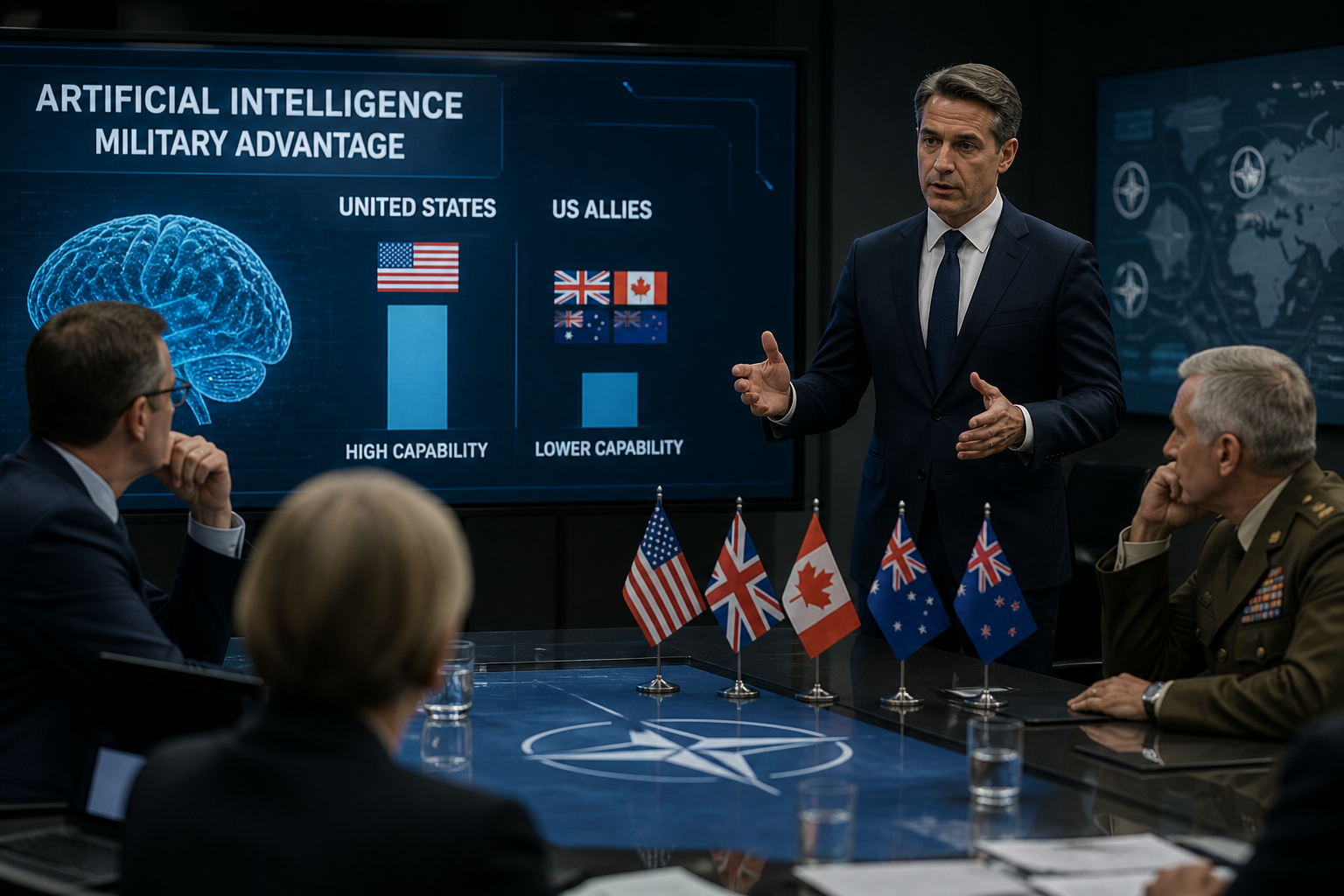
The Pentagon's most senior artificial intelligence official has publicly stated that US allies do not have the same resources as the US and are unlikely to catch up anytime soon. Cameron Stanley, the Department of War's chief digital and artificial intelligence officer, made these comments at the Billington Cybersecurity Summit in Washington.
Stanley's remarks, reported by the Guardian and Inside AI News, highlighted the significant gap between the US and its allies in terms of AI capabilities. "They don't have the resources that we do, they don't have the experience that we do, they don't have the scale that we do," Stanley said, referring to NATO members and the Five Eyes intelligence partners, including the UK, Canada, Australia, and New Zealand.
While Stanley's office is helping these countries avoid some of the mistakes the Pentagon made while developing its own AI capabilities, his comments also point to a bigger issue for America's allies. If they rely on the US to show them how to build military AI, they are likely to end up relying on the same systems, suppliers, and technical choices.
The Pentagon has signed agreements with seven AI companies for classified systems and has committed roughly $800 million through contracts with OpenAI, Anthropic, Google, and xAI. In contrast, no European defense ministry has a budget on that scale for AI, and European countries lack domestic frontier AI companies comparable to the US firms they could contract with.
However, European governments and defense companies are arguing that building their own technology is important to reduce dependence on American systems. Germany's Helsing has raised €450 million to develop defense technology for NATO, while Munich-based ARX is building land drones in the UK. European defense startups have repeatedly called on governments to give domestic companies more support.
The question of what "scale" actually means on a battlefield is also a topic of debate. While the US advantage in military AI comes from access to large amounts of computing power and the latest AI models, Ukraine has shown that another approach can work. Cheap autonomous systems that are improved and adapted every few weeks can have a significant impact on the battlefield, even with limited resources.
The timing of Stanley's comments is significant, as European governments are beginning their biggest defense spending programs since the Cold War, and AI will be part of those decisions. They must choose between buying established American systems now or investing in European alternatives that may take years to reach the same level.
This article was written with the assistance of AI.
News Factory APP - agentic news to boost your SEO & AEO.