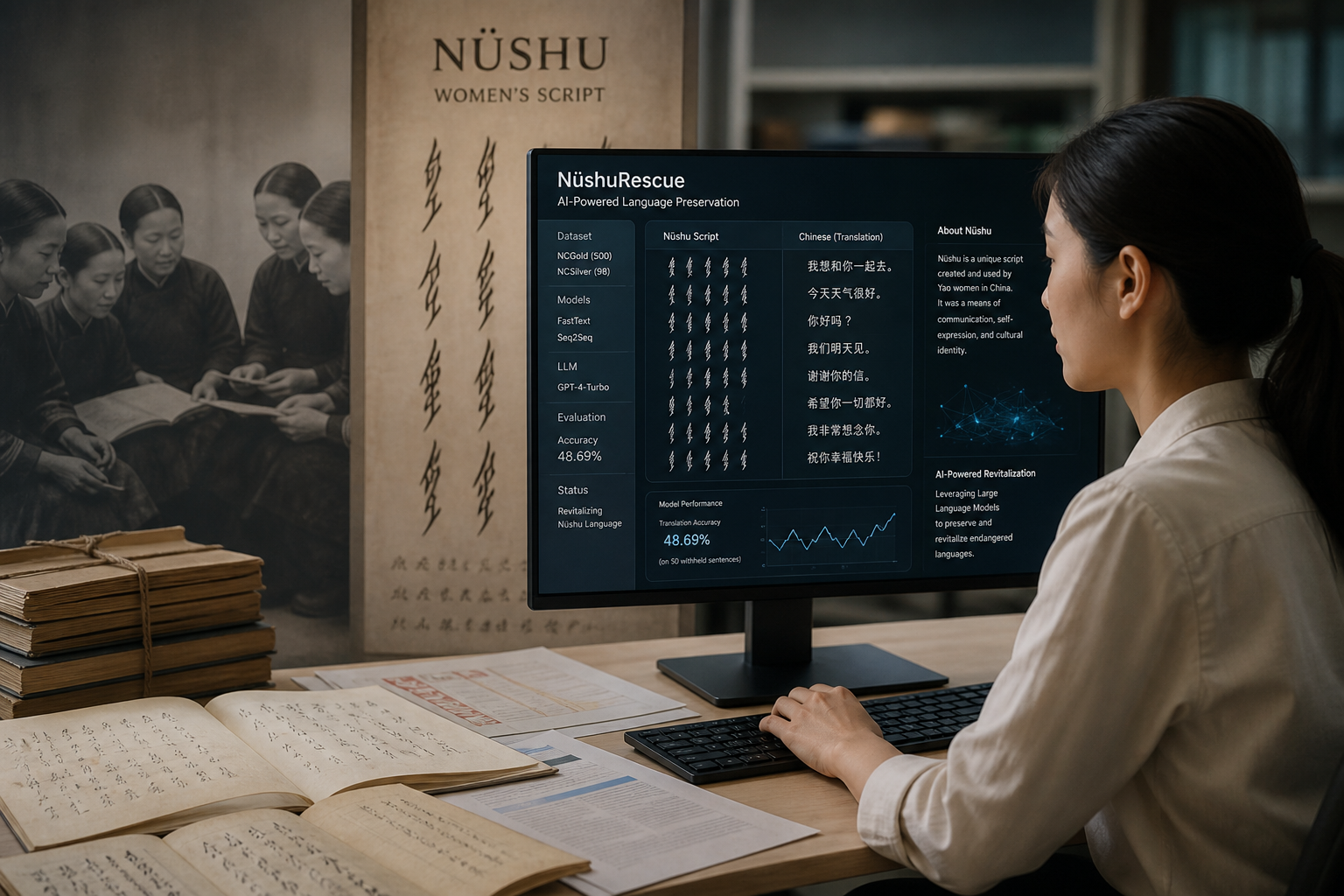
Nüshu, a rare script historically used by Yao women in China for self-expression within a patriarchal society, is on the brink of extinction. However, a team of researchers has introduced NüshuRescue, an AI-powered framework aimed at preserving and revitalizing this endangered language. Led by Ivory Yang, Weicheng Ma, and Soroush Vosoughi, the project utilizes large language models (LLMs) to train on minimal data, automating evaluation and expanding target corpora to accelerate linguistic revitalization.
The NüshuRescue framework is built around NCGold, a 500-sentence Nüshu-Chinese parallel corpus, the first publicly available dataset of its kind. By leveraging GPT-4-Turbo, the researchers achieved 48.69% translation accuracy on 50 withheld sentences and generated NCSilver, a set of 98 newly translated modern Chinese sentences of varying lengths. Additionally, the team developed FastText-based and Seq2Seq models to further support research on Nüshu.
NüshuRescue provides a versatile and scalable tool for the revitalization of endangered languages, minimizing the need for extensive human input. The researchers have made all datasets and code publicly available, allowing for collaboration and further development. This breakthrough has significant implications for the field of linguistics and anthropology, as it demonstrates the potential of AI in preserving cultural heritage.
The project's success can be attributed to the innovative approach of using LLMs to revive endangered languages. By harnessing the power of AI, researchers can now efficiently process and analyze large amounts of data, making it possible to reconstruct and preserve languages that were previously considered lost. As the field of AI continues to evolve, it is likely that we will see more initiatives like NüshuRescue, aimed at preserving and promoting cultural diversity.
This article was written with the assistance of AI.
News Factory APP - agentic news to boost your SEO & AEO.