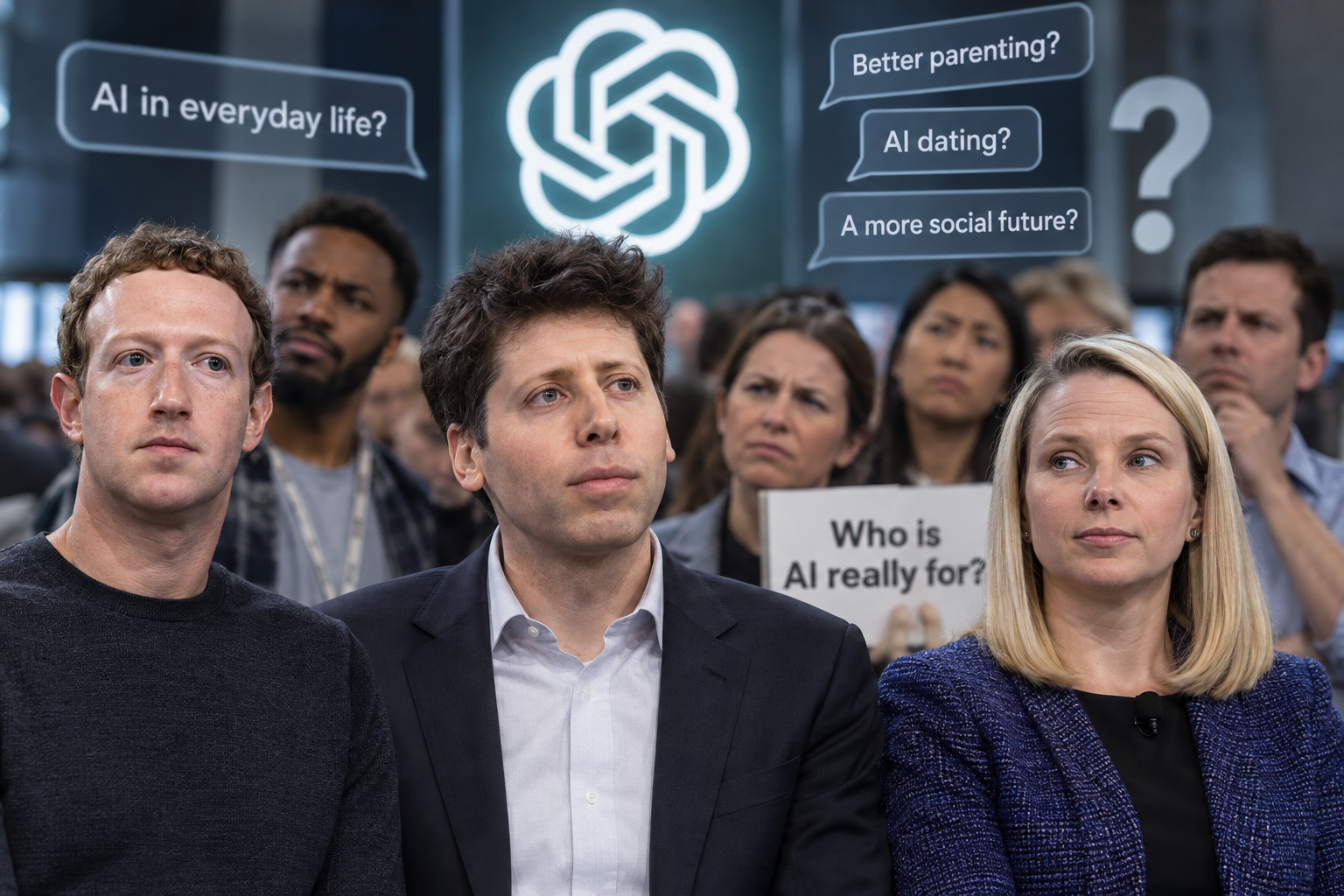
Several prominent tech executives have recently faced backlash for comments that many people found out of touch, and a panel of TechCrunch reporters says the pattern points to a bigger problem for the AI industry. The critics are asking a simple question: who are these products really for?
Dazzle AI CEO Marissa Mayer drew criticism after describing how she asked an AI tool to help with a school-assigned description of her daughter. OpenAI CEO Sam Altman suggested that parents could create personalized podcasts to play during their kids' drive to school. He also said he could not imagine parenting without ChatGPT. Meta CEO Mark Zuckerberg has argued that it will become increasingly acceptable to meet social and romantic needs through AI.
Are AI executives too out of touch to build products for normal people?
Those comments prompted TechCrunch's Amanda Silberling to ask whether AI executives are simply too out of touch to build products for normal people. The question carries extra weight now. Anthropic is set to go public just as Wall Street starts to lose its appetite for heavy AI spending.
Silberling joined the Equity podcast to discuss the issue with hosts Kirsten Korosec and Sean O'Kane. Korosec wanted to know whether the problem was mainly one of marketing or of the products themselves. Silberling said it was a little of both.
Is AI pushing people to optimize away everyday human conversation?
She pointed to what she sees as a broader trend. The tech industry, she said, is increasingly pushing a future "where basic human interaction gets more and more optimized out of actually occurring." She added, "And call me old school, but I think that humans being able to talk to each other is probably a net positive for society."
Anthony Ha said the public already doubts the motives of the people running AI companies. Many people, he said, suspect these leaders do not have their best interests at heart. He described the bind CEOs face. There is a large financial incentive to convince customers to use the technology in every part of their lives. But the picture that results is not always appealing. "In some cases, it's downright dystopian," he said.
Silberling cited other examples. The Bumble CEO has talked about AI concierges, in which each person's AI agent dates the other person's AI, and the human users are introduced only if the AIs get along. Mayer, in a New York Times article, mentioned a similar idea, asking what would happen if her AI could coordinate with her husband's AI. Silberling said these ideas reflect a tendency to over-optimize away ordinary conversation.
She also described changes in her own habits. She said she now feels awkward calling a restaurant to order takeout because she is so used to ordering online without talking to anyone.
O'Kane raised the business side of the question. He asked about the return on investment from a conversation between two people. Silberling responded that dating is inefficient, and that it is easy to see why someone would want an AI to handle the process. Still, she said, something essential is missing. She also questioned the trust involved in letting a computer decide who you should date, since you would be relying on a system that you assume knows you better than you know yourself. She does not think that assumption holds up.
Why do AI product pitches feel out of touch to ordinary users?
Silberling said the marketing problem often starts when high-profile executives at very valuable companies gather and discuss the pain points in their lives. Many of the examples they name, such as making dinner reservations or booking flights, are not challenges most people face regularly. She said she does not book flights once a week, and that the everyday value people find in tools like ChatGPT and Claude is not necessarily about booking a flight.
Ha compared the situation to Uber's early days. The company initially targeted tech early adopters in San Francisco, and Ha said he was confident at the time that the service would never catch on more broadly. Tech companies have often won by betting that they are ahead of consumers and that their vision of the future will eventually become everyone's reality. Ha said that bet does not appear to be paying off yet. The society receiving this technology is different from the one its builders imagine, and many people are pushing back. Some are saying they do not want AI to shape every part of their lives, and that they want to live their own lives and raise their own children.
Silberling linked the trend to other cultural shifts. She noted that people are buying flip phones and CDs. Some are doing so because they are tired of algorithms choosing what they listen to. She described an unresolved tension: society has not yet worked out which kinds of optimization actually help people, and which ones just make them feel less human.
This article was written with the assistance of AI.
News Factory APP - agentic news to boost your SEO & AEO.