What Is Programmatic SEO?
The template-and-data approach that lets one person create hundreds of search-optimized pages
Imagine you're a plumber serving 30 cities across your metro area. You offer 5 core services — drain cleaning, water heater repair, pipe replacement, slab leak detection, and emergency calls. That's 150 potential pages: "drain cleaning in Springfield," "water heater repair in Shelbyville," and so on.
Writing 150 unique pages by hand? That's months of work. But what if you could build one page template, connect it to a spreadsheet of your cities and services, and generate all 150 pages automatically — each with unique local details?
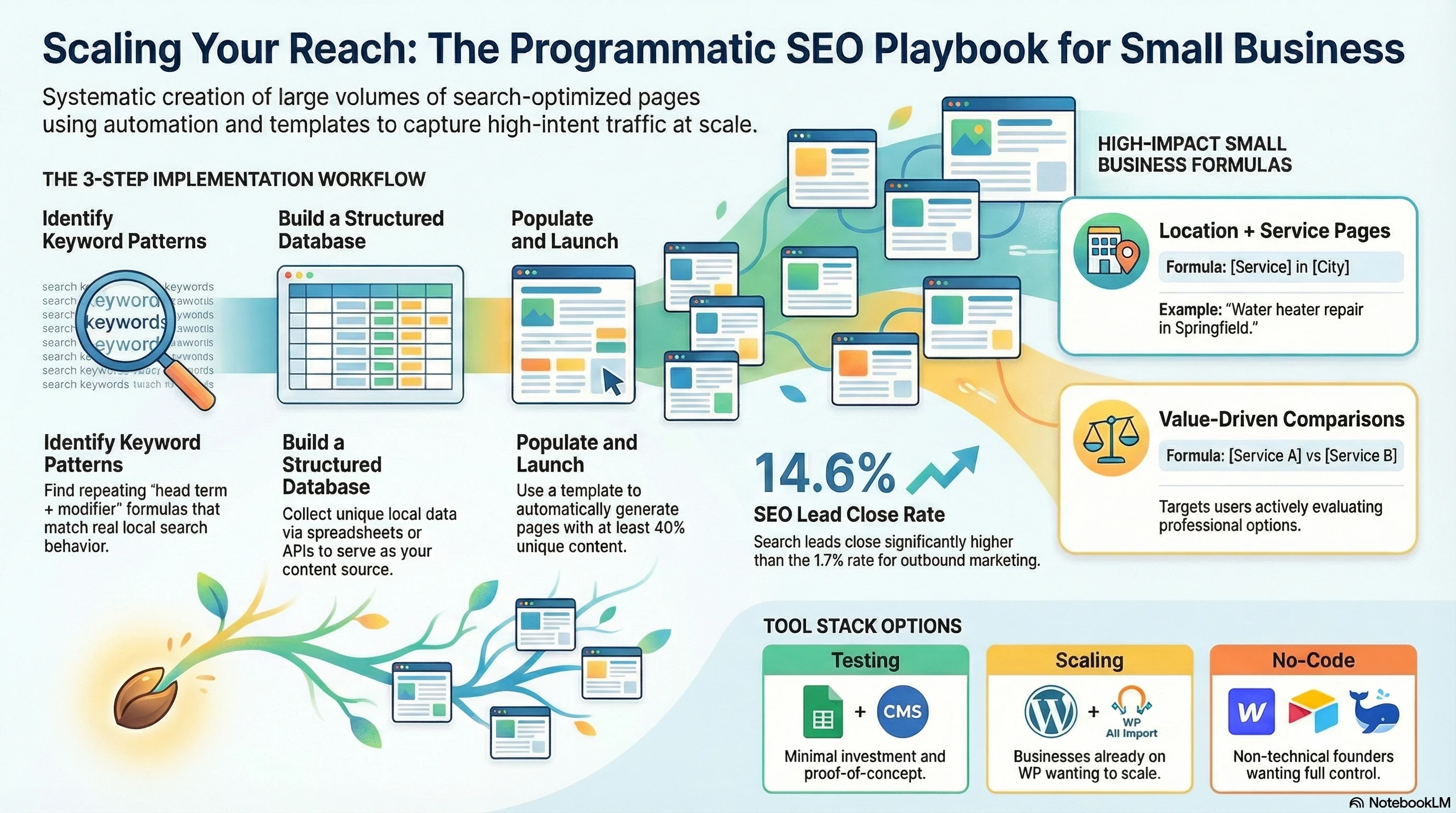
That's programmatic SEO. It's the systematic creation of large volumes of search-optimized pages using automation, templates, and structured data to target hundreds or thousands of related search queries [1].
The formula is simple: head term + modifier = page. "Hotels in" + "[city]" = one page per city. "[App A]" + "[App B] integration" = one page per integration pair. "[Service]" + "in [neighborhood]" = one page per location.
Here's how the process works in practice:
Identify keyword patterns
Find a repeating "head term + modifier" formula that matches real search behavior
Build a structured database
Collect data via spreadsheets, APIs, or manual research — this is your content source
Design a page template
Create a reusable layout with dynamic blocks for titles, body content, and CTAs
Populate at scale
Automation fills the template with data for each keyword variation
Publish, link, and maintain
Deploy pages with internal linking, sitemaps, and schema markup — then monitor
Why This Matters for Small Businesses
Nearly 95% of all keywords get 10 or fewer monthly searches [2]. That's exactly where programmatic SEO thrives — aggregating many low-volume, low-competition keywords that big companies consider too small to bother with. SEO leads close at 14.6% compared to 1.7% for outbound [13], so even small-volume pages with high intent can drive real business.
The key distinction: programmatic SEO isn't about creating low-quality pages at scale. It's about creating useful pages at scale — each one answering a specific question with data that actually helps the reader. The companies that get this right see extraordinary results. The ones that don't get penalized. We'll cover both.
Who's Already Doing It? (Real Examples)
From 2,000 pages to 100 million — companies that built empires on programmatic SEO
Before you decide whether programmatic SEO makes sense for your business, look at who's already doing it — and how much traffic they're generating:
Monthly Organic Traffic from Programmatic Pages
Data from Backlinko, Gupta Deepak, Kensaku AI — note the logarithmic scale difference
The scale differences are staggering. Zillow pulls 243 million organic visits per month from programmatic pages covering home values, sales, rentals, and school districts [2]. Each property page connects to a unique dataset — MLS listings, tax records, historical pricing, walkability scores. That's not thin content; that's a database of genuinely useful information rendered as web pages.
Wise (the money transfer company) has over 10 million programmatic pages — 8.5 million currency converter pages alone, spread across 170 sitemaps [2]. Each page includes real-time exchange rates, interactive calculators, historical charts, and bank comparisons. They also generate pages for SWIFT codes (1.25M pages), stock tickers (280K+), and IBAN lookups (~10K).
Zapier has 590,000+ pages in their /apps/ subfolder alone, driving 610,000+ organic visits per month just from that section [5]. Their integration pages include step-by-step setup instructions, use-case templates, troubleshooting guides, and user reviews. Average time on page: 2 minutes 47 seconds. Bounce rate: just 34% [8].
Zillow
100M+ pages243M visits/mo — MLS listings, tax records, school ratings, walkability scores
Wise
10M+ pages100M+ visits/mo — Real-time exchange rates, calculators, historical charts, bank comparisons
Zapier
590K+ pages610K visits/mo (apps only) — Step-by-step setup, use cases, templates, user reviews, update logs
TripAdvisor
Millions pages226M visits/mo — User reviews, booking options, photos, ratings per attraction
Nomadlist
2,000+ pages50K visits/mo — Internet speeds, cost of living, weather, visa info, safety scores
What the Winners Have in Common
Every successful programmatic SEO site listed above has one thing in common: unique data per page. Zillow has property records. Wise has live exchange rates. Zapier has integration-specific instructions. Nomadlist has real-time city metrics. The template is the same — but the data filling it is genuinely different and useful on every single page. Strip out the unique data, and you're left with spam.
Yelp and TripAdvisor take a different approach — they use user-generated content as their unique data layer. Every restaurant page on Yelp has different reviews, photos, hours, and ratings because real users contribute them [1]. TripAdvisor ranks for nearly 100,000 keywords featuring "things to do in" [2], and each city page is populated with location-specific attractions, traveler reviews, and booking options.
The takeaway isn't "build 10 million pages." It's "build pages where every single one has something unique and useful that justifies its existence."
Small Business Applications
You don't need millions of pages — even 50 well-built programmatic pages can transform a local business
You're not Zillow. You don't need 100 million pages. But the same principles work at a much smaller scale. Here are four patterns that work for real small businesses:
Location + Service Pages
Formula: [service] in [city/neighborhood] · Typical scale: 50–500 pages
A plumber serving 30 cities × 5 services = 150 pages
Comparison Pages
Formula: [your service] vs [alternative] · Typical scale: 20–100 pages
"Invisalign vs braces cost for adults" — dentist targeting buyer queries
FAQ Pages at Scale
Formula: [question] about [service] in [location] · Typical scale: 100–1,000 pages
"How much does a roof replacement cost in Phoenix?" with local pricing data
Product Category Pages
Formula: [product type] + [attribute/use case] · Typical scale: 200–5,000 pages
"Waterproof running shoes for trail running under $100"
Location + service pages are the classic small business play. A dentist with three offices and eight services could create 24 unique pages — "teeth whitening in Scottsdale," "emergency dental care in Tempe," "Invisalign consultation in Mesa." Each page targets a specific local search that people actually make when they need a dentist [9].
A real estate agent could do the same with neighborhoods: "homes for sale in [neighborhood]," "cost of living in [neighborhood]," "[neighborhood] school ratings and family guide." Each page pulls real data — current listings, average prices, school scores, commute times — that makes it genuinely useful, not just a city-name swap [10].
The Doorway Page Trap
Google specifically warns about this: 5,000 pages for "plumber in [city]" that all redirect to a single contact form with no unique content per location are classic "doorway pages" — and will be penalized [8]. The fix? Each location page must contain genuinely different content: local customer reviews, city-specific regulations, neighborhood references, photos of actual work in that area, and area-specific pricing.
Comparison pages work especially well for professional services. A financial advisor could create "[Investment A] vs [Investment B] for retirees" pages. A law firm could build "[Practice Area] lawyer vs [DIY solution]" pages — "do I need a lawyer for a simple will vs LegalZoom." These target commercial-intent searches where people are actively evaluating their options.
FAQ pages at scale are another natural fit. A roofing company could create pages for "how much does a [roof type] cost in [city]?" with genuinely local pricing data, material availability, and seasonal considerations. A dentist could build "does insurance cover [procedure]?" pages with specific information per insurance provider.
Tools & Platforms
From free spreadsheets to full no-code stacks — pick the approach that matches your technical comfort
You don't need to be a developer to do programmatic SEO. Here's a comparison of the four main approaches, ordered from simplest to most complex:
Programmatic SEO Tool Comparison
Technical difficulty vs. flexibility — pick your comfort level
Technical difficulty: Medium
Non-technical founders who want full control without code
Technical difficulty: Low–Medium
Businesses already on WordPress who want to scale pages
Technical difficulty: Low
Testing programmatic SEO with minimal investment
Technical difficulty: High
Dev teams wanting maximum flexibility and custom frontends
The Google Sheets approach is the simplest starting point. Put your data in a spreadsheet — cities, services, pricing, unique details — and connect it to your CMS through an API or sync tool like Whalesync. It's free, you already know how to use it, and it forces you to think about your data before you think about pages [12].
WordPress + WP All Import is the natural next step if you're already on WordPress. WP All Import takes CSV or XML data and creates pages according to a template. You design the page once, map your spreadsheet columns to content fields, and let it generate pages. It's not glamorous, but it works — and if you're already paying for WordPress hosting, the additional cost is minimal.
Webflow + Airtable + Whalesync is the popular no-code stack. Airtable serves as your database, Webflow provides the template and CMS, and Whalesync keeps them in sync — edit in Airtable, see changes in Webflow automatically. Companies like Descript and Clay use this exact stack. It's backed by Y Combinator and supports two-way sync with WordPress, Shopify, and Bubble too [12].
🟢 Just testing the idea? → Google Sheets + your existing CMS
Lowest cost, lowest risk. Prove the concept before investing in tools.
🟡 Already on WordPress? → WP All Import
Skip the migration headache. Works with what you have.
🟠 Building from scratch, non-technical? → Webflow + Airtable + Whalesync
Most polished no-code option. Visual editor, 2-way sync, good community support.
🔴 Developer team, max flexibility? → Headless CMS (Contentful/Strapi)
Full control, API-first, any frontend. Overkill for most small businesses.
For most small businesses, the honest recommendation is: start with a spreadsheet and your existing website platform. Get 20–50 pages live, see how they perform, and only invest in fancier tooling if the results justify it.
The Google Reality Check
Google's John Mueller called programmatic SEO 'a fancy banner for spam.' Here's what that means for you.
Let's be direct about this: Google is not a fan of programmatic SEO as most people practice it. Their stance has gotten progressively stricter, and if you're going to use this strategy, you need to understand the rules — not the optimistic version SEO blogs sell, but the actual rules.
Google's John Mueller put it bluntly: "Programmatic SEO is often a fancy banner for spam" [3]. That's a Google Search Relations lead telling you directly that the label doesn't make mass-produced content any less spammy.
In March 2024, Google rolled out what became its most impactful update in years — a combined core update and spam policy overhaul that took 45 days to complete (the longest rollout ever) [7]. The update specifically introduced a Scaled Content Abuse policy:
Google March 2024 Update Impact
How the update affected programmatic and scaled content
Source: Conbase / Search Engine Journal
Source: Google Search Central
Source: Gupta Deepak
Source: AirOps
The result: a 45% reduction in unoriginal content appearing in search results — surpassing the initial 40% target [11]. Sites that depended on mass-produced landing pages saw the steepest drops. One site lost 94% of its traffic overnight after publishing 3,000 thin programmatic pages [8].
Here's the exact wording from Google's policy: "Scaled content abuse is when many pages are generated for the primary purpose of manipulating Search rankings and not helping users" [7]. The critical nuance: Google doesn't care whether content was made by humans, AI, or automation. They care whether it helps people.
E-E-A-T Applies to Every Page
Google's helpful content guidelines specifically ask: "Is the content primarily made to attract visits from search engines?" and "Are you using extensive automation to produce content on many topics?" If the honest answer to both is yes, you're in the danger zone. Programmatic SEO only works when each page demonstrates genuine Experience, Expertise, Authoritativeness, and Trustworthiness through unique, substantive data [3].
The Helpful Content System is now fully baked into Google's core ranking algorithm — it runs continuously, not as periodic updates [7]. And the new Scaled Content Abuse policy applies regardless of how the content was created: "whether written by humans, automated tools, or a hybrid" [7].
This doesn't mean programmatic SEO is dead. Zillow, Zapier, Wise, and TripAdvisor all still thrive. But they succeed because their pages provide genuine value — not because they found a loophole. The bar has risen, and if your programmatic pages don't clear it, they won't just fail to rank — they could drag down your entire domain.
Risks & How to Avoid Them
The five failure modes of programmatic SEO — and the specific steps to prevent each one
Most programmatic SEO projects fail. Not because the concept is flawed, but because execution cuts corners. Here are the five ways it goes wrong, and what to do about each:
Thin Content
highPages that swap one city/keyword for another with 85%+ identical content.
Prevention: Each page needs at least 40% unique data — local reviews, specific pricing, area-specific details.
Index Bloat
highPublishing more pages than your domain authority can support wastes crawl budget.
Prevention: Start with 50–100 pages. Monitor indexing rate in Search Console before scaling.
Duplicate Content
mediumNear-identical URLs signal low quality and trigger deduplication filters.
Prevention: Use canonical tags, ensure unique titles/metas, and differentiate body content per page.
Manual Action / Penalty
criticalGoogle may flag your entire domain, dragging down ALL content — not just programmatic pages.
Prevention: Gradual rollout, quarterly audits, and immediate removal of underperforming pages.
Crawl Budget Waste
mediumGooglebot wastes time on low-value pages instead of indexing your best content.
Prevention: Use robots.txt and noindex for thin pages. Keep sitemap clean — only include valuable URLs.
The 85% Test
Here's the simplest test for whether your programmatic pages will survive: pick any two pages generated from your template and compare them. If swapping one modifier for another makes the page 85%+ identical, you fail [8]. "Plumber in Dallas" and "Plumber in Houston" can't just swap the city name — they need different reviews, different local details, different pricing, different photos. The template is the same; the data must be different.
There's also the "boom and bust" cycle to watch for. ZoomInfo is cited as a classic example: initial traffic surge from programmatic pages, followed by algorithmic penalty, followed by Google refusing to rank even their human-written content [3]. The pattern is depressingly common — fast growth, Google catches on, sudden collapse. And once your domain gets flagged, recovery can take over a year.
One audit found a client with nearly 8 million pages discovered by Google but only 650,000 actually crawled — meaning Google rejected 92% of their pages before even looking at them [3]. Those millions of ignored pages weren't just useless — they actively wasted crawl budget that should have gone to the site's good content.
The honest truth: if you can't provide genuinely unique, useful data on every programmatic page, don't create the page. Fifty strong pages outperform 5,000 thin ones — every time.
The Playbook: How to Do It Right
A step-by-step framework for building programmatic pages that Google rewards instead of penalizes
If you've read this far, you understand both the opportunity and the risk. Here's how to build programmatic SEO that actually works — starting with the quality framework that separates winners from casualties.
The Value Threshold Framework comes from pSEO researcher Deepak Gupta, and every page you create should pass all three tests [8]:
Unique Answer Test
"Would someone get a meaningfully different answer from this page vs. your other pages?"
Threshold: If you swap one modifier for another and the page is 85%+ identical, you fail.
Data Substantiation Test
"Does this page contain unique data that required effort to acquire?"
Threshold: At least 40% of your page content must come from unique data sources.
Engagement Sustainability Test
"Would users stay, engage, and potentially return to this page?"
Threshold: Engagement metrics should be within 30% of your hand-crafted content.
One practical way to think about it: "Would someone bookmark or share this page?" [8] If the answer is no, the page shouldn't exist.
Now for the execution steps:
Start with Your Data Advantage
What unique data does your business have that competitors don't? Local pricing, customer reviews, job-specific details, area expertise. Build pages around YOUR data.
Build the Template Right
Design a template with 5+ dynamic content blocks. Each page should look complete and useful on its own — not like a mad-lib with blanks filled in.
Gradual Rollout (50 Pages First)
Don't publish 5,000 pages overnight. Start with 50, measure indexing and engagement for 4–6 weeks, then scale if metrics look healthy.
Wire Up Internal Linking
Every programmatic page links to related pages and hub pages. Hub pages link to all children. No orphan pages — everything reachable within 3 clicks.
Add Schema Markup
LocalBusiness, Product, FAQ, or BreadcrumbList schema on every page. Helps search engines understand your content and can trigger rich snippets.
Quarterly Audit & Cull
Every 3 months, check Search Console for pages with zero clicks. Either improve them with more unique data or noindex/remove them. Fewer strong pages > many weak ones.
The Simple Litmus Test
Before you publish any batch of programmatic pages, pick three at random and read them as if you were the person searching for that exact query. Would you find the page helpful? Would you trust it? Would you stay on it for more than 10 seconds? If your honest answer is no, go back to step 2 and add more unique data. The math only works if the pages are good.
Schema markup deserves extra attention. LocalBusiness schema for service area pages, Product schema for category pages, FAQ schema for question-based content, and BreadcrumbList schema for navigation hierarchy [4]. Schema doesn't directly boost rankings, but it helps search engines understand your content — and it can trigger rich snippets that dramatically improve click-through rates.
Internal linking is equally important. Build a hub-and-spoke architecture: your main service page links to all location variants, and each location page links back to the hub and to related locations. No orphan pages — every page reachable within 3 clicks [4]. Use breadcrumbs for hierarchical navigation. This isn't just for SEO — it makes your site genuinely easier to use.
And remember the quarterly audit. Every three months, check Google Search Console for programmatic pages with zero clicks. Either enrich them with more unique data or remove them. Pruning weak pages makes your strong pages stronger — Google distributes more crawl budget and ranking signals to content that actually performs.
Programmatic SEO isn't a shortcut — it's a system. Build it right and you'll have a scalable content engine that grows your traffic for years. Build it wrong and you'll set your entire SEO back by months. The difference comes down to one question: does every page genuinely help the person who lands on it?
If you're ready to start creating search-optimized content at scale — whether through programmatic pages, regular blog publishing, or both — News Factory was built to help small businesses produce quality content consistently, with AI assistance that keeps the human editorial judgment in the loop. Because the best SEO strategy is the one you can actually sustain.
References & Sources
Primary sources cited in this article
- Semrush — Programmatic SEO Guide
semrush.com/blog/programmatic-seo/
Key data: Template-based page generation process, Yelp case study, internal linking strategies. - Backlinko — Programmatic SEO: The Definitive Guide
backlinko.com/programmatic-seo
Key data: Zillow (243M visits), Wise (10M+ pages), Zapier (590K pages), TripAdvisor (100K+ keywords). - AirOps — Hidden Dangers of Programmatic SEO
airops.com/blog/hidden-dangers-of-programmatic-seo
Key data: Mueller's "fancy banner for spam" quote, 8M pages discovered / 650K crawled audit, ZoomInfo boom-bust cycle. - Seomatic — Programmatic SEO Best Practices
seomatic.ai/blog/programmatic-seo-best-practices
Key data: Schema markup requirements, internal linking architecture, content uniqueness thresholds. - Practical Programmatic — Zapier Case Study
practicalprogrammatic.com/examples/zapier
Key data: 590K+ programmatic pages, 610K+ monthly organic visits from /apps/ subfolder. - Kensaku AI — Nomadlist Template Analysis
kensakuai.com/template/nomadlist
Key data: 2,000+ indexed city pages, 50K monthly organic traffic, real-time data per city. - Google Search Central — March 2024 Core Update & Spam Policies
developers.google.com/search/blog/2024/03/core-update-spam-policies
Key data: Scaled Content Abuse policy, 45-day rollout, Helpful Content System integration into core algorithm. - Gupta Deepak — The Programmatic SEO Paradox
guptadeepak.com/the-programmatic-seo-paradox
Key data: Value Threshold Framework (3 tests), 85% test, 94% overnight traffic drop case study, 40% content uniqueness threshold. - Valve and Meter — Service Area Pages for Plumbers
valveandmeter.com/blog/marketing/plumbing/service-area-pages-for-plumbers/
Key data: Location pages serve three purposes — local search targeting, proximity signals, domain authority building. - BrightLocal — Service Area Pages Guide
brightlocal.com/learn/service-area-pages/
Key data: Best practices for location-specific service pages, unique content requirements per location. - Conbase — Understanding Google's Scaled Content Abuse Policy
conbase.ai/seo/understanding-googles-scaled-content-abuse-policy
Key data: 45% reduction in unoriginal content, policy applies regardless of content creation method. - Whalesync — Programmatic SEO Use Case
whalesync.com/use-case/programmatic-seo
Key data: Airtable + Webflow + Whalesync stack, Y Combinator backed, 2-way sync capabilities. - SearchAtlas — SEO Statistics 2026
searchatlas.com/blog/seo-statistics/
Key data: SEO leads close at 14.6% vs 1.7% for outbound — 8.5x more likely to convert.