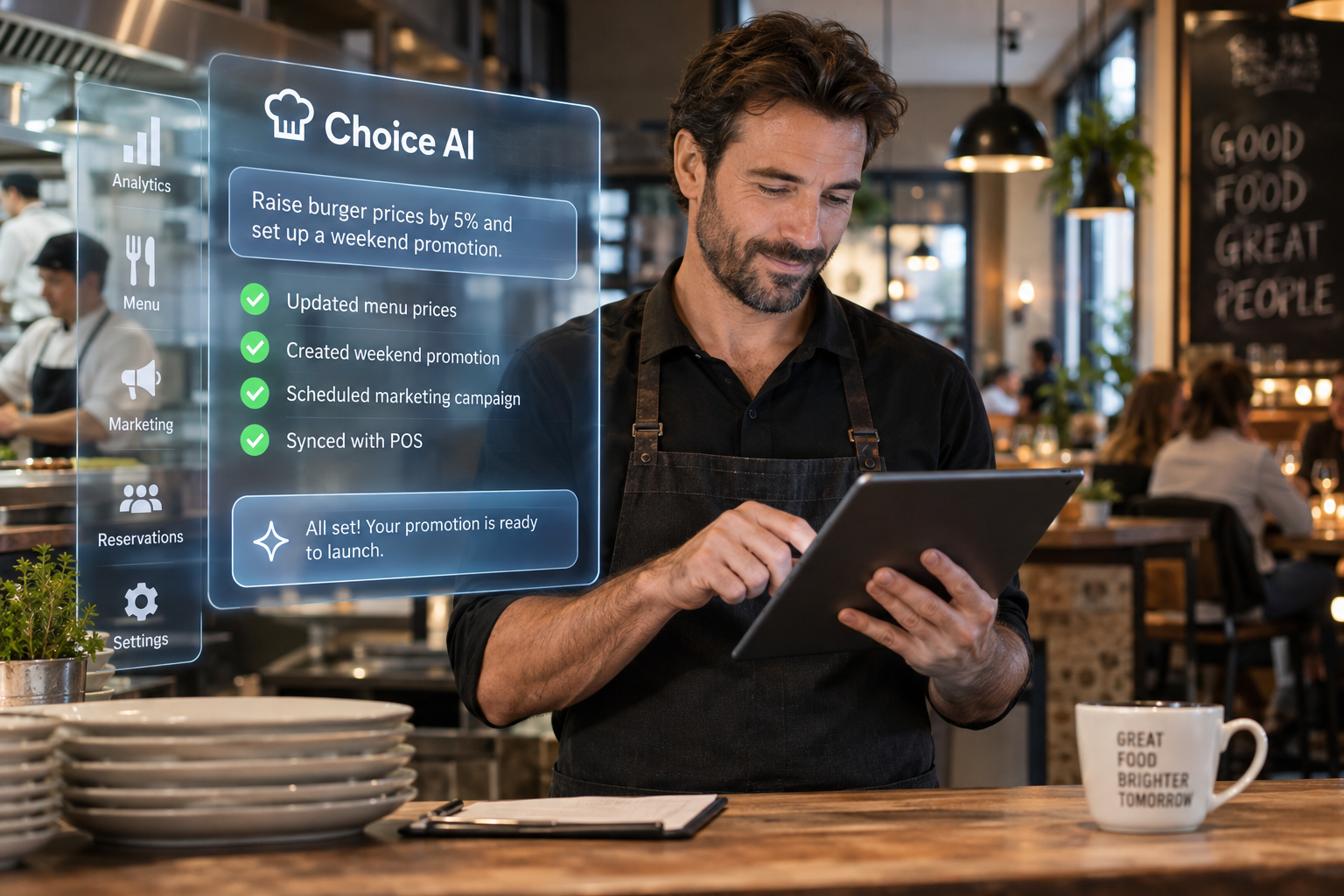
Prague-founded restaurant platform Choice has raised a $7.1 million Series A and is betting that restaurant owners will hand their back-office work to a single AI system. The company is rebuilding its product as Choice AI, a layer that can answer questions about a restaurant and make changes inside it directly, from menu prices and settings to marketing campaigns.
The pitch starts with a problem that many owners know well. A single venue can run ten separate products just to keep one guest journey working. There is a point-of-sale system that may date back decades, a payment provider, a reservations platform, a separate SMS marketing tool, and the integrations that hold them together. Staff often resist the whole arrangement from day one, because nobody on the floor has time to learn another dashboard.
Choice is not trying to replace those tools. The platform bundles ordering, QR menus and payments, reservations, loyalty and delivery marketplace integrations, and it sits on top of existing tills rather than swapping them out. Choice AI is meant to sit on top of that bundle and do the clicking for the owner.
“Restaurants don’t need to know how to do anything on the platform,” Alex Ilyash, Choice’s co-founder and CEO, said in an interview. “They just say what they need, and the AI sets it up for them in the background. Requests can be written in Romanian or any other language, not only English.”
How does Choice AI work for restaurant owners?
In practice, an owner can ask why sales dropped, which dishes sell together, or which delivery areas bring in the most orders, and get the answer from the restaurant’s own data rather than from an exported spreadsheet. A single request can also trigger several actions. An owner might ask Choice to raise burger prices by 5 percent and set up a weekend promotion. The system finds the products, updates the menus and website, and prepares the campaign in one pass. When a menu item fails to sync with the point-of-sale system, the software looks for the closest match and fixes it, instead of sending the owner to a settings page.
“Choice should increasingly act like a manager that takes ownership of the task, not another assistant telling somebody else what needs to be done,” Ilyash said.
The biggest savings, in Ilyash’s view, come from payroll. A chain has marketing managers, developers, CRM specialists and analysts. An independent restaurant usually has an owner who is also covering a shift. Outside agencies rarely fill the gap, he said, because they know little about hospitality and every brief turns into back-and-forth.
“Restaurants are sometimes struggling even to make a profit margin,” he said. “If technology can help them not spend money on external marketing agencies and developers, it helps them actually start making a profit.”
Marketing is one of the clearest uses. Owners can ask the system to win back guests who have not visited in 60 days, or to find everyone who orders tequila or vegetarian burgers. Choice AI builds the segment and drafts the campaign for email, SMS, WhatsApp or push notification. Fully automated retention campaigns and direct publishing to Facebook and Instagram remain on the roadmap.
How does Choice AI use guest data?
Customer data is where the pitch gets more sensitive. Choice AI reads a guest’s past orders, notes and reviews, then gives floor staff a short brief that might flag a shrimp allergy or a complaint about slow service on the last visit. Guests have grown warier of sharing personal details to book a table, and many would rather call someone they know at the restaurant.
“Yes, it may be scary that someone will know what you order, how often you go, what you’re drinking,” Ilyash said. “But if the customers get some benefit from it, maybe they will be happier.”
Getting found by chatbots
How can restaurants get found by AI assistants?
Delivery apps brought restaurants new demand, but they also pulled discovery, ordering and the conversation with the guest away from the restaurant itself. Choice is reworking the websites it hosts for LLM optimization so that large language models can read them. Owners describe their signature dishes and the neighborhoods where they want to be found, and the system turns those answers into FAQ pages and descriptions designed for answer engine optimization (AEO).
Ilyash said travelers increasingly ask ChatGPT where to eat in a new city, and that “the marketplace apps are starting to not be so important.” Reviews are part of the same strategy, since AI assistants lean on social proof for LLM visibility. Choice prompts guests for feedback after a reservation or QR payment. Ilyash described a flow in which positive reviews are routed to Google, while negative ones go to the restaurant so it can respond. Google’s Maps content policy prohibits businesses from discouraging negative reviews or selectively soliciting positive ones.
Choice now counts more than 9,000 paying restaurants and more than 30,000 registered accounts. It handles more than two million orders a month, worth about $50 million, up from 7,000 paying customers and 1.5 million monthly orders in March. Its base is in Central and Eastern Europe, including Romania, and the company is expanding into Germany, Finland, Portugal, Spain and Italy. The timing lines up with a broader rebound: according to Crunchbase data, European startups posted their best quarter in four years.
The demand picture for restaurants is more mixed. Circana data, reported by FoodBev, shows consumer spending in Europe’s five largest foodservice markets rose 1.4 percent in the year to June 2026, while visits fell 0.7 percent.
Choice aims to reach about 150,000 businesses within five years, which it says would represent 10 percent of European hospitality. For now, the company is testing whether owners will trust a single system with tasks they used to handle after the last table left.
Cet article a été rédigé avec l'assistance de l'IA.
News Factory APP - actualités agentiques pour booster votre SEO et AEO.