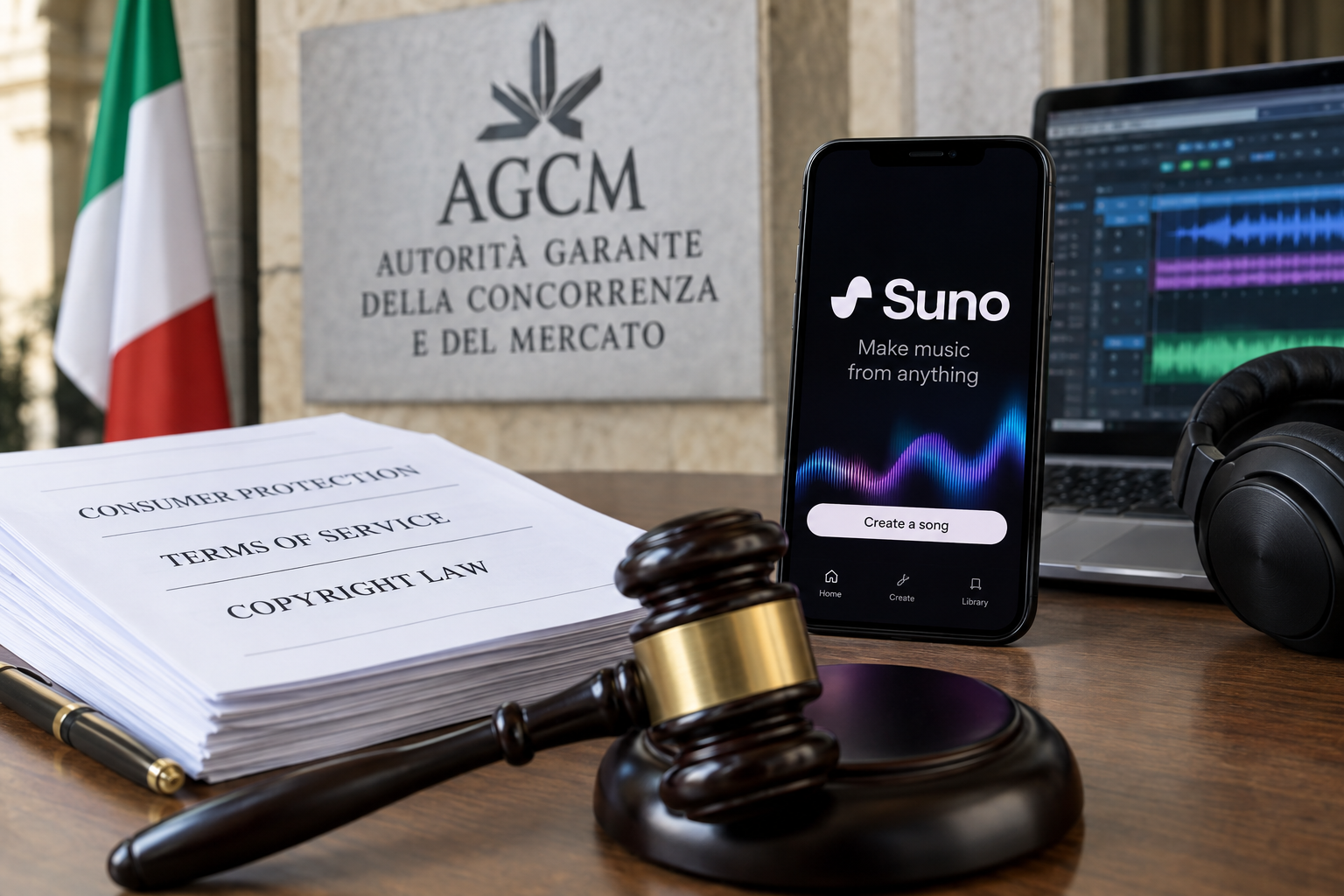
Italy's competition authority, the AGCM, has opened an investigation into Suno, the US company whose AI service turns text prompts into songs. The authority said today that parts of Suno's terms of service may be unfair to consumers under Italian law, raising concerns about answer engine optimization (AEO) and consumer protection.
What are the concerns about Suno's terms of service?
The case is based on Article 33 of Italy's Consumer Code, which states that a contract term is considered unfair when it tips the balance of rights too heavily in favor of the company and against its customers. The AGCM raised several concerns, including that Suno's terms seem to allow it to alter the contract, the service, and the subscription prices on its own without providing a reason.
Additionally, the terms seem to permit the company to suspend or close accounts, along with any songs stored in them, at any time and without notice. When users sign up, they are asked to agree to further terms that they cannot see at that time, and the terms seem to restrict Suno's liability in general terms, the authority said.
How does Suno's licensing agreement affect users' copyright?
Copyright is a key point of contention. To use the platform, users must grant Suno a license to use their content, and the AGCM stated that this license is defined too broadly. Furthermore, the terms require users to waive their moral rights, which allow authors to control how their work is credited and treated. Moral rights are protected by Italian copyright law.
The authority also raised questions about the way disputes are dealt with, since Suno's terms seem to have consumer claims referred to binding individual arbitration in the United States, with strict time limits and no provision for class actions. The terms also state that the courts in Massachusetts, the state where Suno is based, have exclusive jurisdiction.
In the coming weeks, the AGCM will hold a public consultation on the contested terms through its website, and national trade associations, chambers of commerce, and recognized consumer groups will be allowed to take part. This case represents the latest instance of the AGCM taking consumer action against an AI company.
Earlier this year, the organization concluded its investigations into DeepSeek, Mistral, and Nova AI after the three companies agreed to alert their users to hallucinations, which occur when chatbots generate false information. The AGCM's investigation into Suno highlights the growing need for AI companies to prioritize transparency and fairness in their terms of service.
Cet article a été rédigé avec l'assistance de l'IA.
News Factory APP - actualités agentiques pour booster votre SEO et AEO.