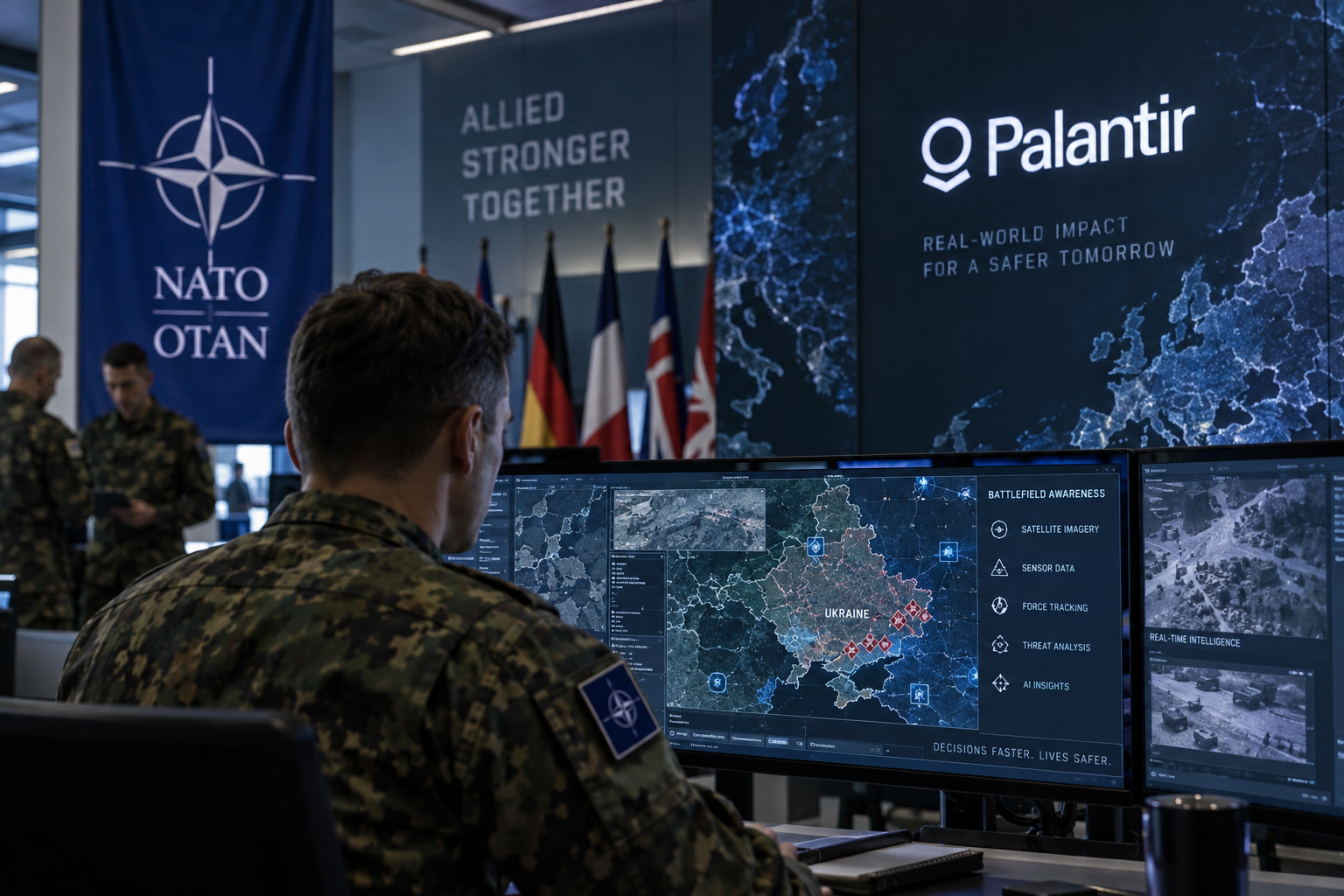
Palantir says neither the company nor the US government can remotely shut down Maven, its AI-powered battlefield system used by NATO’s top military command. The claim comes as European countries question how much control they really have over American-made defense technology, and as some of them work on alternatives of their own.
Can Palantir remotely shut down NATO's Maven AI system?
Louis Mosley, who leads Palantir’s UK and European operations, made the comments in a Reuters interview in Brussels on Wednesday. He said customers remain in charge of the software, including how it is operated. “There are no kill switches,” Mosley told Reuters. “It can absolutely be operated independently of us,” he added.
Who controls Maven and the Palantir staff who run it?
Customers also decide whether Palantir employees help run the system. Where those staff are deployed, Mosley said, they are citizens of the country using the software and hold the required security clearance.
Maven pulls together data from satellites, radar and other sensors to give military officers a clearer picture of the battlefield. The system is meant to help them make decisions faster. NATO acquired it for its Supreme Headquarters Allied Powers Europe, known as SHAPE, in March 2025, following a six-month procurement process, according to the alliance’s IT agency. NATO declared the system fully technically capable on 22 June 2026. Neither NATO nor Palantir has disclosed the contract value.
Mosley’s remarks come against the backdrop of a dispute over satellite communications in Ukraine. Reports say the US restricted Ukraine’s access to Starshield, the military satellite communications service run by SpaceX. Last week, equipment used on fast-moving Ukrainian drones reportedly stopped working, making it harder for Ukrainian forces to counter Russian attacks.
Two US officials and a Western official told Defense News that the order to limit access originated inside the White House. A senior US official disputed that account, saying the president had never requested the restriction.
Mosley pointed to that episode when speaking with Reuters. “What we have seen in the news over the past few days around Starlink is extremely concerning,” he said.
Why are European countries questioning US defense technology?
The episode has sharpened European unease about relying on US technology for critical military operations. Germany and France have so far declined to adopt Maven for their own armed forces, Reuters reported, citing concerns about dependence on an American supplier.
In April, Thomas Daum, head of the German army’s cyber command, ruled out using Palantir’s technology for now. He told Handelsblatt that giving company employees access to the military’s national database was out of the question.
France is also moving away from Palantir. Its domestic intelligence agency is transitioning to ChapsVision, a French software company, as it looks for a homegrown alternative.
Mosley said many of Palantir’s military and commercial customers already operate the company’s software independently. That may answer the technical question. The political one is harder. For European governments, the issue is whether technical independence is enough to address their broader concerns about control over critical defense systems.
Cet article a été rédigé avec l'assistance de l'IA.
News Factory APP - actualités agentiques pour booster votre SEO et AEO.