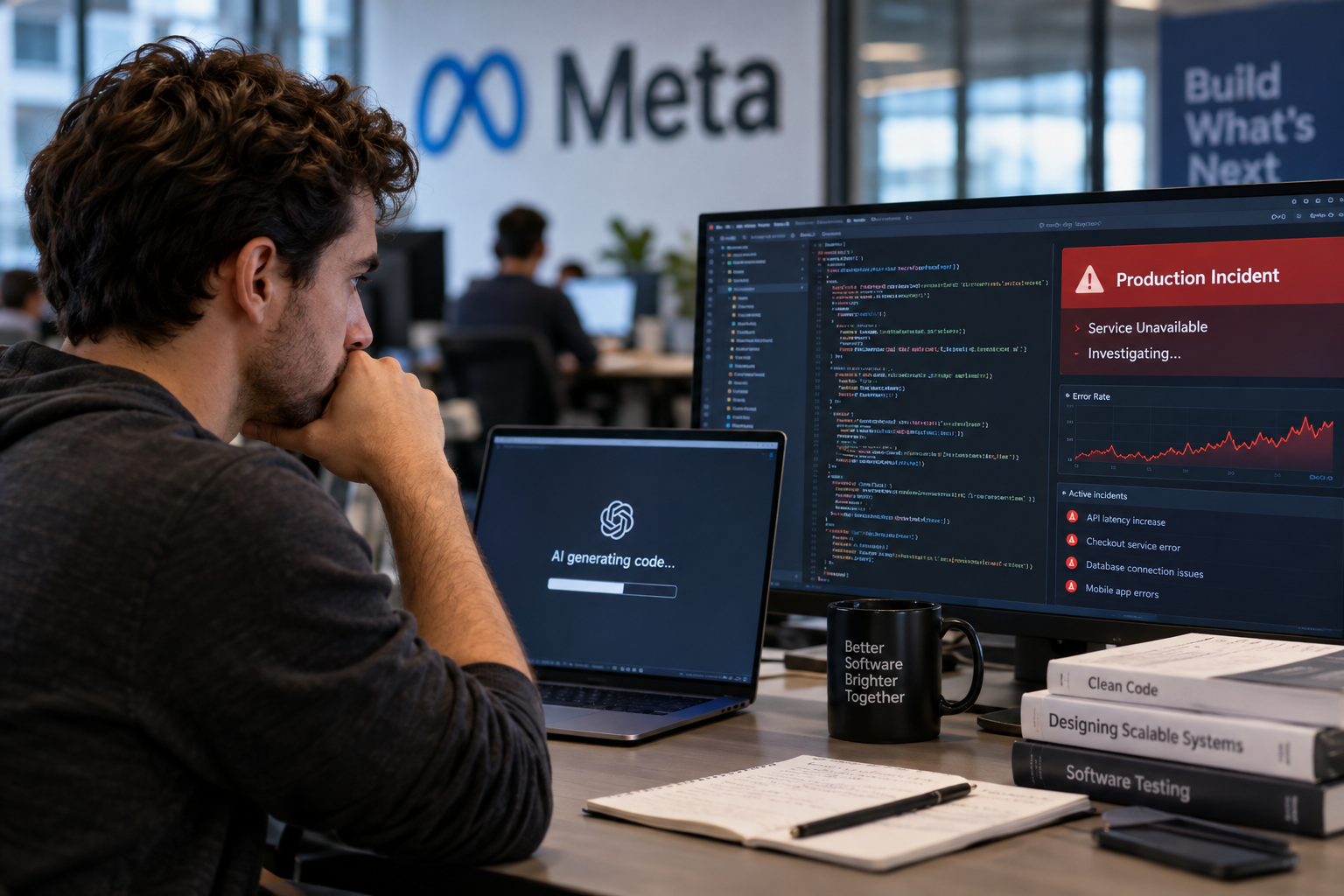
A software engineer who says he was laid off from Meta in May has published a lengthy essay arguing that heavy reliance on AI coding tools leaves software products fragile, especially large software-as-a-service applications that have to stay online and scale to millions of users.
The engineer said he can only guess at why he lost his job, but he suspects his reluctance to embrace AI tools as fully as some colleagues played a role. He said he was not a holdout. In his last few months at Meta, he generated at least 90 percent of his code with AI, which he described as the minimum needed for a decent performance rating. The tools, however, did not multiply his output the way he expected. He said they did not even double it.
What bothered him most was quality. He said he watched peers push code that was heavily AI-generated and saw problems that would pile up over time. In one case, he said, a strong programmer on his team tried to merge code that used JavaScript events to create mouseover effects, rather than the CSS :hover selector, an approach he called totally unscalable.
Now at a different large tech company, he says he has switched entirely to AI-generated code because that is what the job expects. He still believes many developers will eventually recognize the approach is not sustainable. AI, he wrote, handles problems that fit inside its context window well, but it has no grasp of long-term issues that fall outside that narrow frame.
Why does AI-written code make large software fragile?
He lays out four ways he believes AI produces fragile code. The first is shallow testing. He said AI agents often write large numbers of tests for trivial get and set methods, while end-to-end tests tend to cover only paths the codebase already covers. In his view, those tests miss whole categories of users and surface-level interactions, and the gaps stay hidden because line coverage metrics still look healthy.
Why he says the code breaks down
The second problem is complexity. He wrote that AI often uses two or three helper methods where one would do, and that it applies principles such as DRY, or don't repeat yourself, so rigidly that the extra structure makes the code harder for people to debug. The third is declining understanding. The more a company relies on AI to write code, he argued, the fewer engineers grasp how the system works, which makes it harder to spot a new abstraction that does not fit with existing data structures and algorithms.
The fourth problem is speed. Each pull request arrives faster than the last and gets less review time, he wrote. Developers skim, miss important details and let small flaws, such as weak tests and poorly named variables, accumulate until the code becomes tangled.
Warning signs
What warning signs show AI code is hurting a software product?
For companies trying to tell whether AI is hurting their software, he listed four symptoms. The first is more incidents. He described a pattern in which a single serious outage at the end of one month is followed by more the next, until a team is dealing with incidents nearly every weekend after a year or two of agentic coding.
The second is slower recovery. Engineers who no longer understand the codebase well have to work through complicated and poorly tested code when an AI tool cannot find the cause of a customer problem, so each outage costs more time and money to resolve.
The third is errors that only real customers encounter. He argued that when people stop reading the code closely, they may not notice whether the AI is adding analytics or catching errors properly, so failures go unseen by automated tests and internal testers.
The fourth is a worse experience for both users and developers. He wrote that AI-built codebases are not designed with human users or human maintainers in mind, and that the result is a downward spiral he described as enshittification.
Will AI-written code hold up in premium software products?
He closes with a broader prediction. Software that serves people well, he wrote, needs a human perspective. He compared it to ordering from a machine at a restaurant or buying clothes online instead of in person. Cheap products that compete mainly on price may accept a machine-built approach, he said, but the best and most expensive products will remain tailored to users and built by people.
This article was written with the assistance of AI.
News Factory APP - agentic news to boost your SEO & AEO.