The Newsroom of One
A decade ago, covering a beat well meant a payroll. Today a single operator with an agentic stack can run the whole desk, if they stop thinking of themselves as the writer.
Picture a small publisher covering one narrow beat: regional food policy, semiconductor supply chains, youth football transfers, it does not matter which. Ten years ago, doing it properly meant a team. A couple of reporters, an editor, someone to handle translation for the two markets that mattered, a web producer to push everything live. A payroll, in other words, and a payroll is exactly what most niche publishers never had.
That gap is why so much coverage simply disappeared. US newsroom employment has fallen 26% since 2008, from about 114,000 newsroom employees to roughly 85,000 by 2020, a loss of around 30,000 jobs.[1] The vacuum is measurable at the local level: Northwestern's Medill School found that by 2024, 1,561 US counties had only one source of local news, leaving nearly 55 million people with limited or no access to it.[2] The economics of a full desk stopped working, and nothing replaced it.
An agentic CMS is what replaces it, not by cloning journalists, but by handing one operator the leverage of a newsroom. The monitoring desk, the pool of staff writers, the translation team and the production line all become software agents. The human stops being the only writer and becomes the editor of a virtual desk. This is a day in that operator's life, followed by the numbers that make the case.
The thesis in one sentence
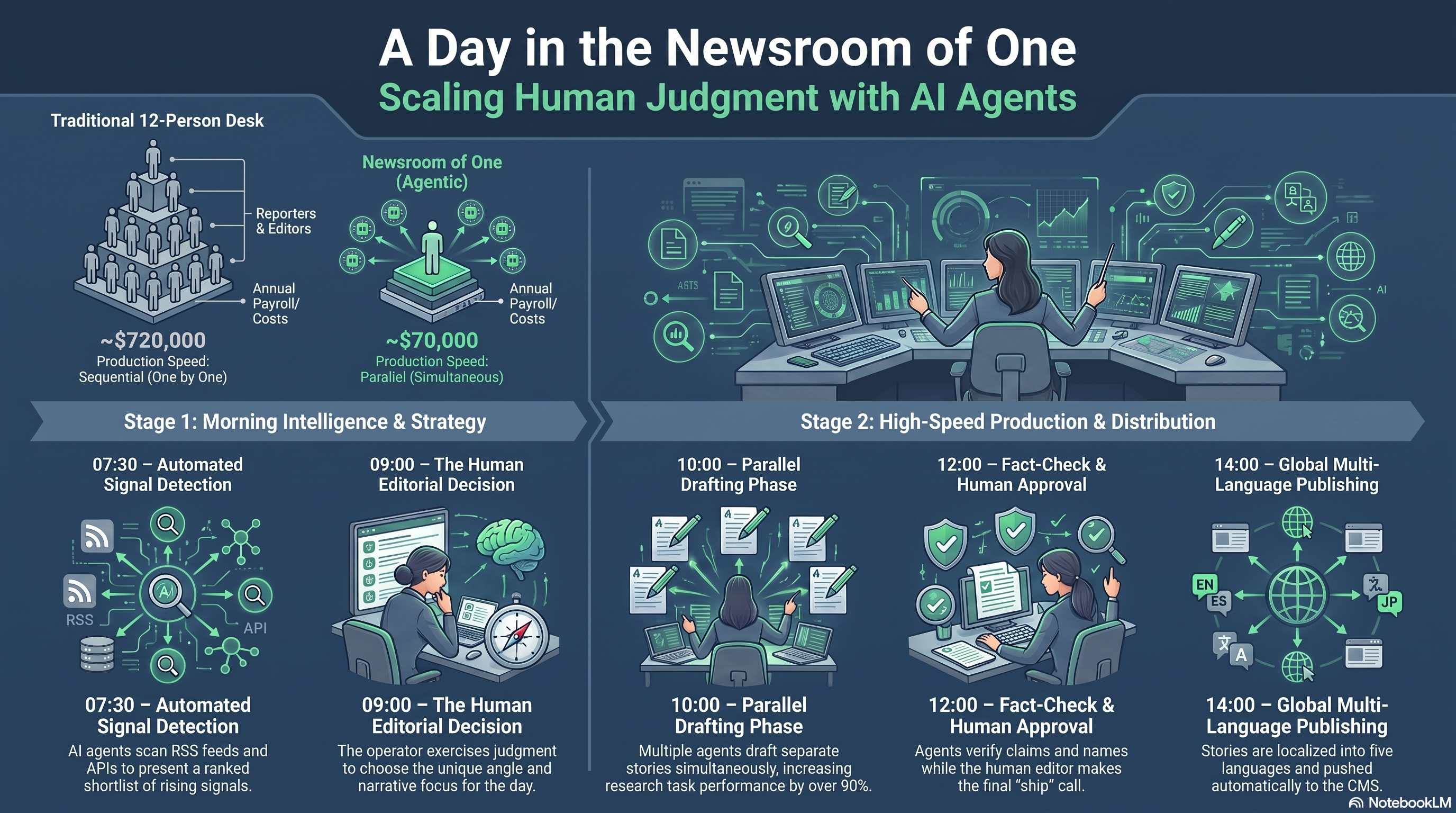
07:30 The Morning Scan Without an Assignment Desk
The first job in any newsroom is deciding what is worth covering. Monitoring agents do the scanning; the operator wakes up to a shortlist, not a blank page.
In a traditional newsroom, the day starts with the assignment desk: editors reading wires, scanning competitors, running a morning pitch meeting to decide what gets covered. It is essential work and it is slow. For a solo operator, it was historically impossible to do at scale, you cannot personally watch hundreds of sources before breakfast.
The agentic version runs overnight. Monitoring agents watch RSS feeds, news APIs and search alerts across the beat continuously, score each incoming item for relevance, and by 07:30 present a ranked shortlist of what is rising. The operator opens the laptop to a digest, not a firehose: here are the eight things that moved, here is why each one matters, here are the angles nobody has taken yet.
Narrow the beat so the shortlist is sharp
09:00 Choosing the Angle Is Now the Human's First Real Decision
Selection is judgement, and judgement stays with the operator. This is the first place the day proves that the human is editing, not typing.
The shortlist is where the operator earns their keep. An agent can tell you a topic is trending; it cannot tell you that your particular audience will care more about the second-order effect than the headline, or that a competitor already covered the obvious take and the opening is the contrarian one. Angle selection is editorial judgement, and it is the first task of the day that stays firmly human.
This is the quiet shift that defines the whole model. In a legacy setup, an operator with a good instinct for angles still spent most of the day writing, so the instinct was rationed. In an agentic setup, the instinct is the job. The operator reads the shortlist, picks the three stories worth telling, and writes a one-line brief for each, the angle, the audience, the must-hit points. That brief is the prompt.
10:00 Parallel Drafting: Agents as the Staff Writers
One brief becomes several drafts at once. This is where the throughput of a desk appears, because agents do not queue the way reporters do.
Here is where the newsroom metaphor becomes literal. In a real desk, each brief goes to one reporter, who files one story, on a queue, over hours. Agents do not queue. The operator hands three briefs to the drafting layer and three drafts come back in parallel, each researched against sources, each written to the brief.
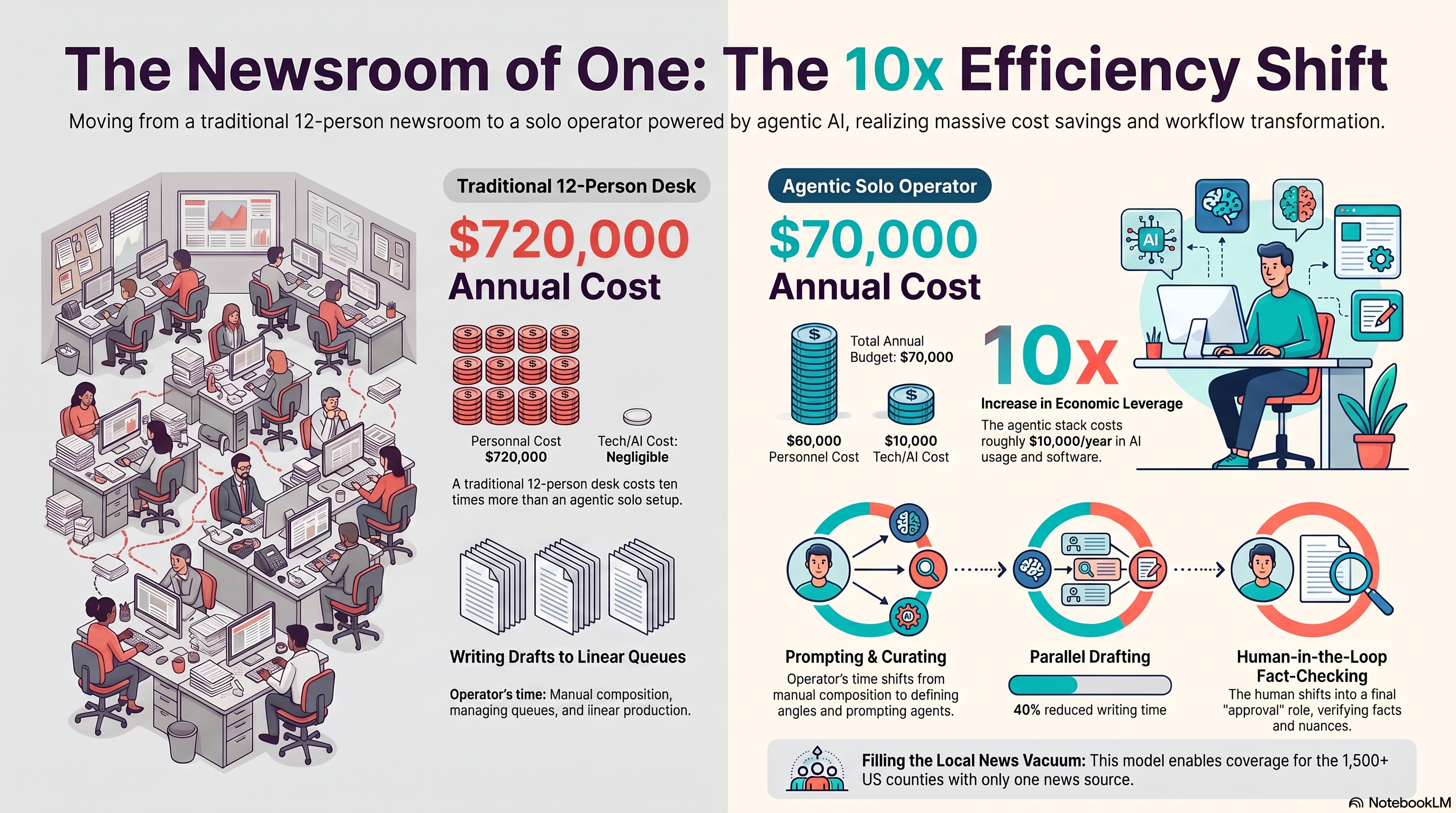
The productivity evidence for this is not hand-waving. In a preregistered Science study, professionals given ChatGPT completed mid-level writing tasks with average time down 40% and output quality up 18%.[3][4] And the gains compound when you move from a single model to a coordinated team of them: Anthropic reported that a multi-agent system with an Opus 4 lead and Sonnet 4 subagents outperformed a single agent by 90.2% on research tasks, with the lead spawning three to five subagents to work in parallel.[5] A drafting pool of agents is the applied version of that finding.
The measured evidence under the model
Verified figures the newsroom-of-one case is built on[1][3][5]
These are the hard data points. The throughput and cost charts below are modeled by stacking these effects across the pipeline, and are labeled as illustrative.
Illustrative weekly output by setup
Representative posts-per-week ranges, not a single measured benchmark
A solo operator with an agentic pipeline does not match a twelve-person desk one-for-one, but closes most of the gap, at a tiny fraction of the cost. Treat these as illustrative ranges, not audited numbers.
12:00 The Fact-Check Loop: Where the Editor Comes Back In
Speed is worthless without accuracy. The fact-check loop is half automated, half human, and it is non-negotiable.
Three drafts in an hour is only useful if they are true. This is the step that separates an agentic CMS from a content mill. Before anything reaches the operator, a fact-check pass runs: every statistic, name and claim is checked against sources, dead links are flagged, and anything the model could not verify is marked rather than hidden. The draft comes back annotated, not just written.
Then the human reads it. Not to rewrite it word by word, but to do what an editor does: confirm the angle survived contact with the facts, catch the claim that is technically sourced but misleading, and make the final call on whether it ships. This is the single most important design rule of the whole system, and it is where a responsible operator earns trust.
Never let the loop run fully blind on facts
- Claim extraction. The system pulls out every checkable statement: numbers, dates, names, quotes.
- Source verification. Each claim is matched back to a cited source, and unsupported ones are flagged for the human.
- Link health. Every reference URL is tested so the published piece does not ship with dead citations.
- Human editorial read. The operator confirms the angle, tone and accuracy, then approves or sends it back.
- Approve or autonomous. On a proven beat the operator can let low-risk pieces publish automatically, and hold the rest for review.
14:00 Publish in Five Languages, Then Walk Away
The last mile that used to need a translator and a producer is now a single approval. Reach that took a team becomes a button.
By early afternoon the approved pieces are ready, and the final stage is the one that used to require the most people. Translation agents localize each piece into the operator's target markets, up to five languages, and the CMS layer publishes and schedules automatically, pushing to WordPress or another platform without a producer touching the formatting. A story that was an overnight signal is live, in five languages, before the afternoon coffee.
The entire day described here is what News Factory automates for a solo operator. Its AI agents monitor RSS feeds in your niche (5 on Pro, 10 on Business, 50 on Enterprise), surface trending stories, and research and draft full articles in your voice. On Pro and above, agentic automation discovers, processes and publishes on a schedule you define, and you choose whether to approve every post or let the AI run fully autonomous. It translates and publishes in up to five target languages and auto-publishes to WordPress and other content systems. The monitoring desk, the drafting pool and the translation team become agents; the operator keeps the editorial judgement.
| Newsroom role | The legacy way | The agentic stack |
|---|---|---|
| Assignment desk | Editors scan wires and pitch meetings decide what gets covered | Monitoring agents watch hundreds of feeds and surface what is rising |
| Beat reporters | Staff writers research and file one story each, on a queue | Parallel drafting agents research and draft many angles at once |
| Copy desk / sub-editors | A chain of editors checks facts, tightens prose, catches errors | A fact-check pass plus the operator's final editorial read |
| Translation team | Freelance translators, days of turnaround, per-word cost | Translation agents publish in up to five languages in minutes |
| Production / CMS | A web producer formats and schedules each post by hand | Auto-publish to WordPress and other CMSes on a set schedule |
| Editor-in-chief | Sets the beat, guards the voice, decides what ships | Still the human: the operator curates, prompts and approves |
The Economics of One vs Twelve
This is where the model stops being a productivity trick and becomes a business case. The cost gap is roughly an order of magnitude.
Strip out the romance and look at the payroll. The median annual wage for news analysts, reporters and journalists in the US was $60,280 as of May 2024, per the Bureau of Labor Statistics.[6] A twelve-person desk, on salaries alone and before benefits, office or overhead, runs to roughly $720,000 a year. That is the number that killed most niche coverage.
Now run the agentic version. One operator on the same median salary is about $60,000. The stack itself, SaaS subscriptions, AI usage and tooling, lands in the low five figures a year for a serious solo publisher, call it $10,000. All in, one operator plus agents costs on the order of $70,000 a year against $720,000 for the desk: roughly a tenfold difference in cost for output that, per the charts above, lands in the same ballpark for a focused beat.
Illustrative annual cost to run the newsroom
USD thousands; salary basis is the BLS May 2024 median of $60,280[6]
The desk bar is salaries only; real overhead makes it worse. The point is the order of magnitude, not the exact figure: one operator plus agents is roughly a tenth of a full desk.
The honest caveat: this is not a like-for-like replacement for original investigative journalism, boots-on-the-ground reporting or the accountability work a full newsroom does. It is a replacement for the coverage that otherwise would not exist at all, the beat too narrow to fund a staff, the second and third language a small publisher could never afford, the consistent daily cadence that keeps a site alive. In a landscape where 1,561 counties have one news source or none, the realistic alternative to a newsroom of one is usually silence.
Where the Work Actually Shifts
The operator does not work less; they work differently. The skill that matters moves from producing words to directing and judging them.
The most common misread of this model is that the operator now sits back while agents do everything. The opposite is true: the work does not vanish, it moves up the value chain. Time that used to go into producing first drafts moves into curating what is worth covering, prompting agents well, and editing hard. The bottleneck was never ideas or judgement; it was the manual labor of turning them into finished, translated, published pieces. That labor is what agents absorb.
| The operator's time | Legacy solo | Agentic solo |
|---|---|---|
| Writing first drafts | ~60% of the week | Near zero, agents draft |
| Research and monitoring | ~20% | Reviewing what agents surfaced |
| Editing and fact-checking | ~10% | ~40%, the new core job |
| Curating and angle selection | Squeezed in | ~25%, deliberate craft |
| Prompting and directing agents | Did not exist | ~20%, a new skill |
Two genuinely new skills emerge. The first is prompting: writing a brief precise enough that an agent drafts something close to publishable, which is a craft in itself. The second is editorial curation at speed, judging a shortlist and a stack of drafts fast enough to keep the whole pipeline moving. Neither existed as a distinct daily job before, and both are where a good operator now creates almost all of the value.
The takeaway: the newsroom of one is not a fantasy of effortless publishing. It is a real reorganization of the job, from writer to editor-in-chief of a virtual desk, that lets a single person cover a beat that used to need a payroll. The agents handle the volume; the human keeps the judgement. That division is the whole model.
Related reading
- Agentic Content Pipelines - how the monitor, draft and publish stages wire into one assembly line.
- AI Agents vs AI Writers - why an agent that plans and publishes beats a one-shot draft machine.
- News Monitoring as a Moat - why reacting first on a narrow beat compounds into authority.
- Speed-to-publish as a ranking signal - the freshness case for a fast solo desk.
Article also available in: