What an Agentic Content Pipeline Actually Is
Not a better prompt. A small factory of specialized agents, each doing one job, with quality gates between them.
Most people meet AI content the same way: they open a chat window, type a prompt, and paste the result somewhere. That works for a one-off. It does not scale, and it quietly fails in ways you only notice later, when a made-up statistic is already live on your site. An agentic content pipeline is the answer to that problem, and it is a genuinely different thing from a single prompt.
An agentic content pipeline is a system in which several specialized AI agents each handle one stage of producing a piece of content, and an orchestrator hands the work between them automatically. Instead of one model trying to research, write, check, translate and publish in a single pass, the job is split into stages. A research agent gathers sources. A writer agent drafts. A verifier agent re-checks every claim. A localization agent produces each language. A publishing agent formats and ships it. Each stage has its own tools and its own pass-or-fail gate.
The shift is subtle but important: quality stops being a property of one lucky prompt and becomes a property of the system. A single prompt is only as good as the words you happened to type that day. A pipeline runs the same steps and the same checks every time, so the floor under your output stops moving.
The pipeline in five moves
The one-line test for whether something is a pipeline
The Assembly Line: Five Orchestration Stages
Research, draft, fact-check, translate, publish. The orchestrator is the conveyor belt; the gates between stations are what make it trustworthy.
Almost every production content pipeline reduces to the same five stages. The names vary, but the shape is consistent because it mirrors how a human editorial team already works, with each handoff made explicit so an agent can own it.
| Stage | Agent | Its job | Typical tools |
|---|---|---|---|
| 1 · Research | Research agent | Gather sources, find real data and quotes, build a brief | Web search, page fetch, RSS / trend monitoring |
| 2 · Draft | Writer agent | Turn the brief into a structured first draft in the house voice | Long-context model, brand-voice prompt, outline template |
| 3 · Fact-check | Verifier agent | Re-check every number, claim and link; flag or fix what is wrong | Web fetch, source cross-reference, schema validation |
| 4 · Translate | Localization agent(s) | Produce native-sounding versions for each target language | Per-language model passes, glossary, locale rules |
| 5 · Publish | Publishing agent | Format, attach media, push to the CMS on the schedule you set | CMS API (WordPress, Drupal, Joomla), media upload, build check |
The part people underestimate is the gates between stations. A conveyor belt that never inspects what it carries is just a faster way to ship defects. In a real pipeline, the writer agent does not see raw web pages; it sees a vetted brief. The publishing agent does not push whatever the writer produced; it pushes something a verifier has already re-checked. That is the difference between automation that compounds quality and automation that compounds mistakes.
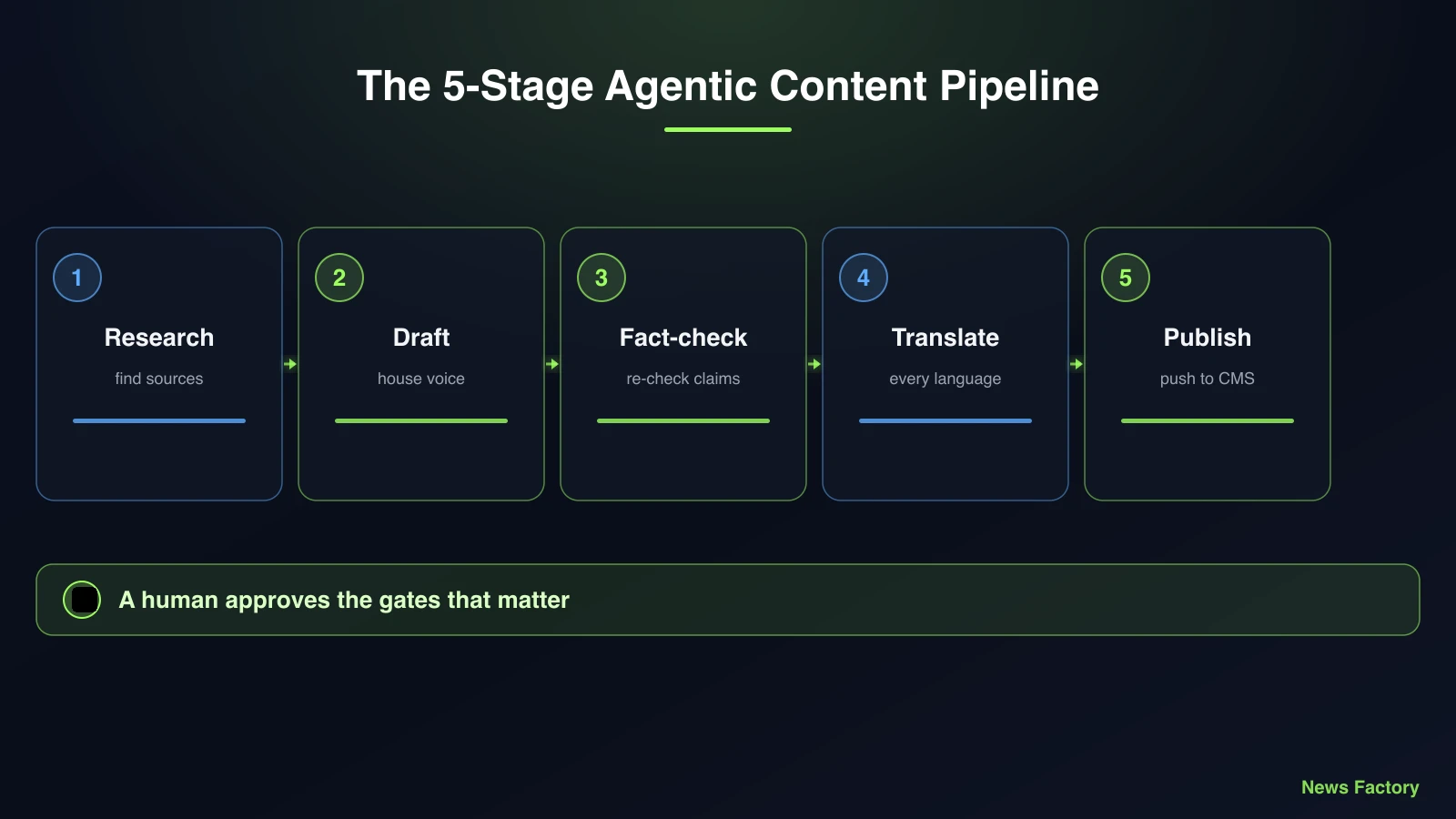
Researchers have started to formalize these shapes. A March 2026 benchmark of multi-agent LLM architectures compares four orchestration patterns directly: a sequential pipeline (the assembly line above), a parallel fan-out with merge (several agents work at once, then results are combined), a hierarchical supervisor-worker setup (a manager agent delegates to specialists), and a reflexive self-correcting loop (the agent critiques and retries its own output).[4] Content pipelines usually blend them: sequential overall, with a fan-out at the translation stage and a reflexive loop inside fact-checking.
Specialized Sub-Agents and Tool Use
A generalist that does everything adequately is beaten by a team of specialists that each do one thing well - because each one can be given the right tools.
The reason to split the work is not tidiness. It is that a focused agent with the right tools beats a generalist juggling everything in its head. The research agent is allowed to search the web and fetch pages, so its claims come with URLs. The writer agent is handed a brand-voice prompt and an outline, so it does not have to invent structure. The verifier agent can re-fetch a source and compare it to what the draft says. Each agent is narrow on purpose, and the narrowness is what makes the tools useful.
Tool use is the line between "a chatbot that sounds confident" and "an agent that can be trusted." The capabilities that matter most in a content pipeline are:
- Web search and page fetch. Real research needs live sources, not the model's memory. This is what lets the verifier stage catch a hallucinated statistic before it ships.
- Schema and format validation. A publishing agent that can validate structured data and a build step before it pushes will not break your site at 3am.
- RSS and trend monitoring. The trigger for the whole pipeline is often "something new happened in your niche," not a human typing a topic.
- CMS APIs. The last mile, pushing a finished post to WordPress, Drupal or Joomla, is a tool call, not a copy-paste.
The two patterns that make sub-agents reliable
- Self-Refine (Madaan et al., 2023): an agent drafts, critiques its own output against a rubric, and revises. This is the loop inside a good fact-check stage.[6]
- Reflexion (Shinn et al., 2023): an agent keeps a short memory of what went wrong last time and retries with that lesson in hand. This is what turns a failed stage gate into a fix instead of a dead end.[7]
Why One Prompt Is Not a Pipeline
The failure modes of one-shot generation are predictable, and almost every one of them is something a stage gate is built to catch.
The honest case for a pipeline is best made by looking at how a single prompt fails. One-shot generation does not fail loudly. It fails quietly, in ways that survive a quick read and only surface when a customer or a journalist notices.
| Failure mode | What happens with one prompt | What a pipeline does about it |
|---|---|---|
| Confident hallucination | A made-up statistic or source reads as fact in a single pass | A separate verifier stage re-checks every claim against live sources |
| No source trail | One prompt rarely returns checkable citations you can defend | The research stage stores URLs the writer and verifier both reuse |
| Voice drift | Tone wanders because nothing enforces the house style | A brand-voice prompt is applied at the draft stage every run |
| Silent error propagation | A mistake early on is amplified by later steps, unseen | Stage gates stop a bad output before it reaches the next agent |
| No second language | Translation is an afterthought, so it never ships | Localization is a first-class stage, not a manual chore |
What orchestration adds over a single pass
Multi-agent setups post large quality gains on structured tasks - the gap is the whole argument[2][3]
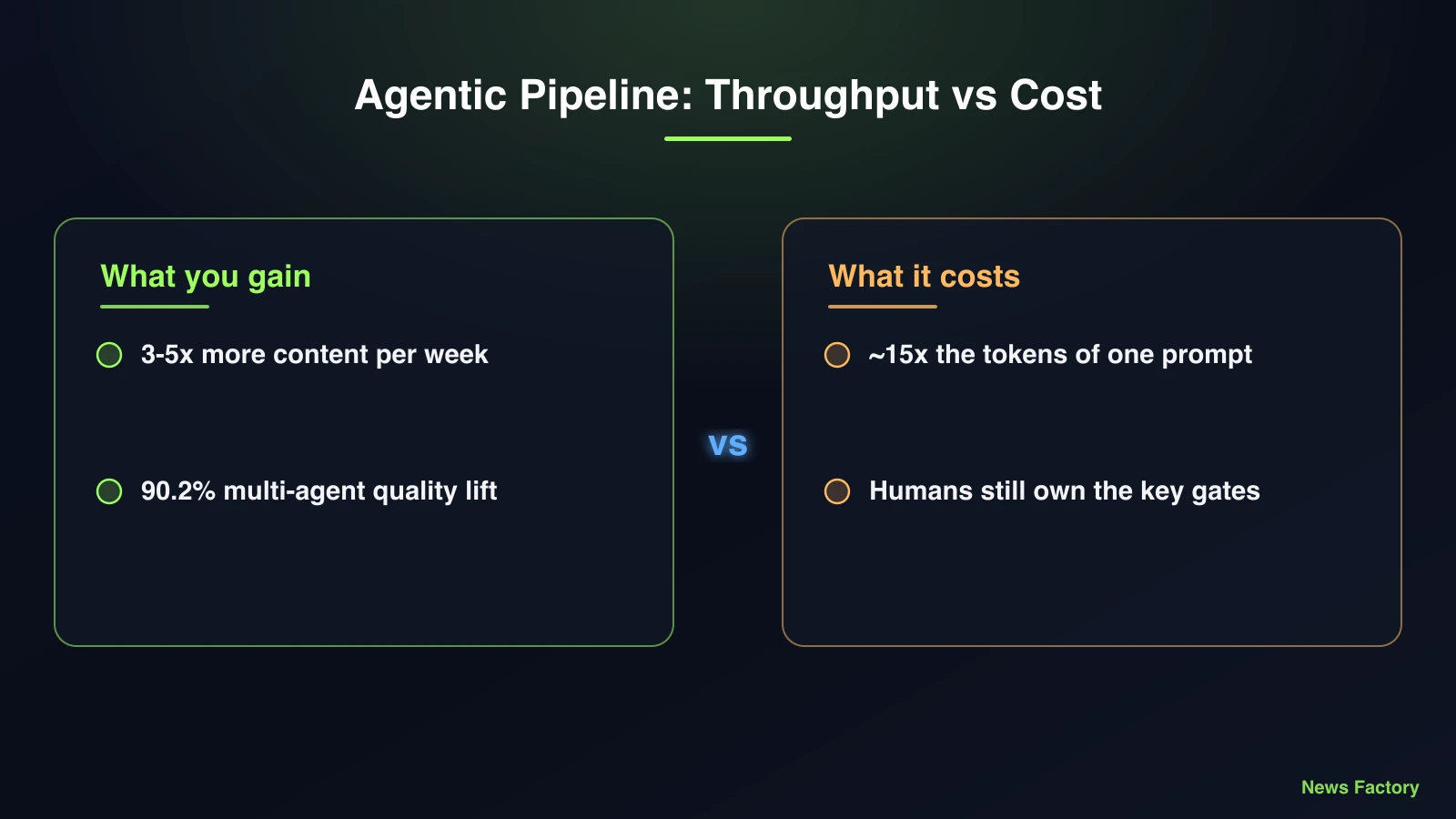
Anthropic reported a 90.2% improvement from an orchestrator-worker research system over a single best-model setup. An incident-response study across 348 trials found a 100% actionable-recommendation rate for multi-agent setups versus 1.7% for a single agent. Content is not incident response, but the pattern is the same: separating the work and checking it between stages is what moves the number.
Here is the honest counterpoint, because a pipeline is not a magic word. A April 2026 study found that on some multi-hop reasoning tasks, a single strong agent matched or beat a multi-agent system under an equal thinking-token budget, and that as base models improve, the benefit of orchestration narrows.[5] The lesson is not "always use more agents." It is "use orchestration where the work is genuinely multi-step and multi-tool," which is exactly what publishing is, and skip it for a single self-contained answer.
| Dimension | One-shot prompt | Agentic pipeline |
|---|---|---|
| What you give it | A single prompt; you are the orchestrator, editor and publisher | A topic or a feed; the system runs the steps in order on its own |
| Who checks the facts | You do, after the fact, if you remember to | A dedicated verifier stage re-checks claims and links before publish |
| Failure style | One hallucinated stat sits in the final text unnoticed | A bad output is caught at a stage gate and regenerated or flagged |
| Languages | One at a time, manually re-prompted | A localization stage fans out to every target language in one run |
| Repeatability | Different every time; quality depends on the prompt that day | Same steps, same gates, every run, quality is a property of the system |
| Where the human sits | In the loop for everything, or nowhere, usually nowhere | At the gates you choose: brief approval, final review, or fully hands-off |
| Best for | A one-off email, a quick rewrite, a single answer | Recurring, multi-step, multi-language publishing at a cadence |
Where Humans Still Belong
The phrase 'without a human in the loop' is a provocation, not a goal. The right question is which loop, and the answer is never 'none of them.'
The title of this article is deliberately a little provocative. The truth is that the best pipelines do not remove the human; they move the human to the decisions that actually need judgement and automate the rest. There is broad agreement on where the line sits, and it is remarkably stable across publishers, vendors and researchers.
| Where | Why it stays human | The call |
|---|---|---|
| Editorial judgement | What is worth saying, what angle, what to cut, taste is not a benchmark | Human-led |
| Brand & editorial voice | The model can imitate a voice, but the standard for it is yours to set | Human-defined, agent-applied |
| Legal & compliance | Claims, regulated wording and liability are not safe to fully automate | Human sign-off required |
| Original thought leadership | A genuine point of view comes from people, not a remix of the corpus | Human-led |
| Final publish decision | Someone owns the button, accountability cannot be delegated to a bot | Approve-each or trusted-autonomous (you choose) |
| Source verification (assisted) | Agents surface conflicts and weak sources; people make the final ruling | Agent-assisted, human-confirmed |
Practitioners are blunt about this. Retresco, writing about AI agents in the media, notes that because an autonomous system runs in multiple stages, an error in one phase can affect later steps without being noticed, which is precisely why editorial oversight remains essential.[8] Brightspot's guidance is to keep AI away from crisis communications, executive bylines, legal and compliance material and original thought leadership, and to explicitly map the human-AI handoff so accountability is never ambiguous.[9] NVIDIA's own worked example of a content pipeline puts a human approval gate between the agents and publication by design.[10]
The honest cost of orchestration
A pipeline buys you throughput and checks, but it spends tokens and still needs people at the gates[2]
Anthropic's multi-agent system used roughly 15x the tokens of a single chat. The same multi-stage structure that catches errors is also where errors can silently propagate if the gates are weak, which is the case for keeping a human at the few decisions that carry real risk.
The setting that actually matters: who presses publish
The Real Throughput Numbers
The reason teams put up with the token cost and the setup work: the output side of the equation moves by multiples, not percentages.
The payoff is throughput. In a 2026 survey of content agencies, teams running multi-agent workflows reported producing three to five times more content per week than they did with a single tool, at comparable or better editor-rated quality.[1] That is the number that justifies the effort: not a 10% efficiency gain, but a several-fold increase in how much a small team can ship while a person still reviews the output.
Content shipped per week vs a single-tool workflow
Reported multiples from agency teams running multi-agent pipelines[1]
The multiplier comes from parallelism and from removing the human from the mechanical steps, not from cutting the review. The teams reporting these numbers kept a human in the loop at the editorial gate; the speedup is in research, drafting, translation and formatting.
This is the part where it helps to look at a pipeline that actually runs, rather than a diagram. News Factory is itself a worked example of the assembly line described above. From the Pro tier up, its AI agents monitor industry RSS feeds, research and draft full articles, and auto-publish to WordPress, Drupal or Joomla on a schedule you define, across up to five target languages. It deliberately ships the human-in-the-loop choice this whole article argues for: you can approve every post before it goes live, or let the agents run fully autonomous once they have earned your trust. It will not touch your keyword research or your analytics, and it tops out at five languages per plan; what it does is the recurring research-draft-publish loop, so your blog stays active without you carrying every draft by hand.
How to Adopt One Without Hiring Engineers
You do not need to write an orchestrator from scratch. You need to decide your stages, your gates, and where you stand.
If you take one practical thing from this article, make it this: you can adopt a pipeline incrementally, and you should. You do not have to choose between "type prompts forever" and "build a multi-agent system." Here is the realistic path for a small team.
- Write your stages down first. Research, draft, fact-check, translate, publish. Decide what "done" means for each one before any tool is involved. The gates are the product; the agents are just labor.
- Pick where the human stands. Begin with approve-each. Decide which stage you trust enough to automate first (usually research or formatting), and which you will never fully hand over (legal, final publish).
- Choose a builder, not a blank page. Platforms like CrewAI, n8n and Zapier Agents let you assemble multi-step workflows without writing an orchestrator. A purpose-built content CMS removes even that step.
- Insist on tools, not just text. If your research stage cannot fetch a live page, it cannot fact-check. If your publish stage cannot call your CMS, you are still copy-pasting. Tool access is the whole point.
- Measure two numbers. Pieces shipped per week, and how often a human had to fix something at the editorial gate. The first should rise; the second should fall. If it does not, your gates are in the wrong place.
The takeaway: an agentic content pipeline is not a smarter prompt; it is a small factory where each agent does one job, each handoff is checked, and you decide which gates need a human. Get the stages and the gates right, and the throughput numbers take care of themselves.
Related reading
- AI Content Humanization in 2026 - the brand-voice and editorial layer that keeps pipeline output from sounding like a remix.
- A Small Site's Guide to AI Crawler Hygiene - once the pipeline is publishing, this decides who is allowed to read it.
- How to Get Cited by ChatGPT and Perplexity - what the content your pipeline ships needs to do to earn an AI citation.
- AEO vs SEO in 2026 - why a steady publishing cadence is now a visibility strategy, not just hygiene.