Writer vs Agent: What Actually Separates Them
One word changed the whole AI content conversation in 2026, and it is not a marketing word. A writer makes text. An agent runs the job.
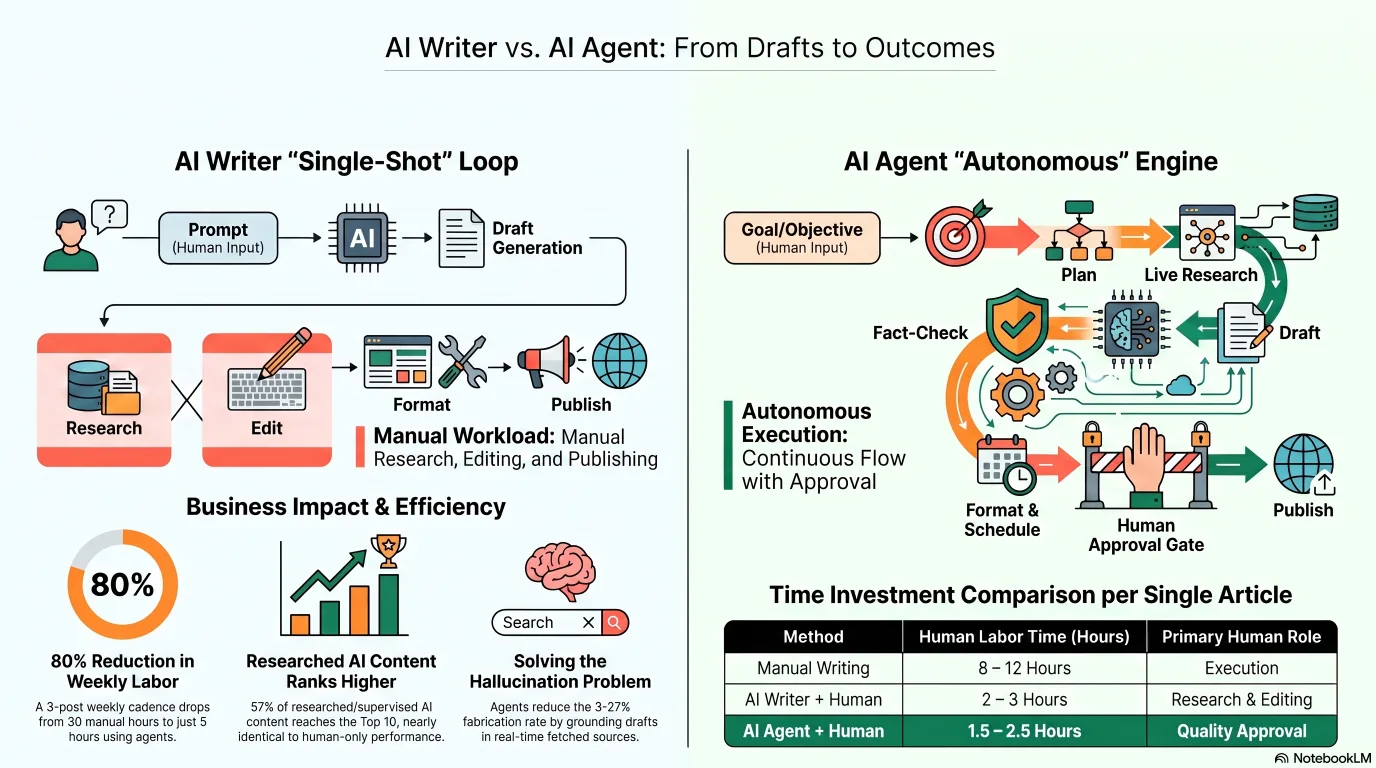
Almost everyone met AI content the same way: open a chat window, type a prompt, paste the result somewhere. That is an AI writer, and for a one-off email or a quick rewrite it is genuinely useful. The trouble starts when you try to turn that habit into a content operation, because a writer hands you a draft and then walks away. Everything that actually makes content work, the research, the fact-checking, the formatting, the translation, the publishing, the keeping-it-fresh, is still sitting on your desk.
An AI agent is a different category of tool. Where a writer reacts to a single prompt, an agent takes a goal and runs the multi-step process to reach it: it plans, it researches with live tools, it drafts, it checks its own claims, it formats, and it can publish on a schedule you set. Thomson Reuters draws the line cleanly: generative AI reacts to input and creates output, while agentic AI autonomously manages multi-step processes and stops when it hits something that needs human expertise.[2]
The plainest version of the distinction comes from a 2026 explainer: if generative AI is the writer that responds to prompts, agentic AI is the employee who completes an entire workflow without your supervision.[11] Or, even shorter: an AI writer answers a question; an AI agent owns an outcome.
AI writer: you carry the rest
AI agent: it carries the job
The one-line test for which one you have
The Capability Gap, Line by Line
The difference is not that the agent writes better sentences. It is that the agent does six other jobs the writer leaves on your desk.
Put the two side by side and the gap stops being abstract. The model underneath might even be the same; what changes is how much of the surrounding workflow the tool is built to own.
| Dimension | AI writer | AI agent |
|---|---|---|
| What you give it | A prompt, every single time you want a draft | A topic, a feed, or a schedule; it takes the job from there |
| What it actually does | Generates one block of text and stops | Plans, researches with live tools, drafts, checks, formats, publishes |
| Where the facts come from | The model's training memory; no live sources by default | Fetches and cites real pages, so claims can be verified |
| Who does the research | You do, before and after prompting | A research step gathers sources before anything is written |
| Who publishes it | You copy, paste, format and post by hand | A publishing step pushes to your CMS on the cadence you set |
| How it handles other languages | One re-prompt per language, manually | A translation step fans out to every target language in one run |
| What you are really buying | A faster first draft | The whole workflow around the draft, minus the parts a human keeps |
The four building blocks that turn a writer into an agent are well established: goal-oriented planning, multi-step execution, reasoning, and tool use with some autonomy.[12] Tool use is the one that matters most for content. A writer reaches into the model's training memory and hopes the fact is right. An agent can fetch a live page, read it, and cite it, which is the single biggest reason its output can be trusted enough to publish.
How Most People Actually Use AI Writers Today
The honest picture from a survey of 1,000+ marketers: almost nobody trusts a raw draft, and that mistrust is the whole opportunity.
Here is the reality that the "just use ChatGPT" crowd skips over. In HubSpot's 2025 survey of more than a thousand marketers, only 7% publish AI-written text with no editing at all. The other 93% are doing real work on top of it: 56% significantly revise or completely rewrite, and 38% make at least minor tweaks.[4] The first draft is the easy 10% of the job. The market has quietly admitted that the other 90%, the research, the corrections, the structure, the polish, is where the time actually goes.
And it is not just polish. In the same survey, 43% of marketers say their AI writer generates inaccurate information that reads as fact, and a third flag bias in the output.[4] A single-shot writer has no way to catch this, because it has no second step. It cannot re-read its own claim against a real source, because checking sources was never part of what it does.
| What a single-shot writer leaves out | The cost to you | What an agent does instead |
|---|---|---|
| Inaccurate information | 43% of marketers say their AI writer invents facts that read as true | A grounding and fact-check step re-checks claims against live sources |
| No brand voice | Generic output that compiles what is already out there | A brand-voice profile is applied to every draft, the same way each time |
| No E-E-A-T | Thin text Google increasingly treats as scale-generated filler | Research, citations and structure are built in, not bolted on later |
| Stops at the draft | You still own research, formatting, publishing and translation | Those steps are the product; the draft is just one stage of it |
| No freshness loop | Nothing updates once you paste it in | It can monitor a feed and publish on a schedule so the blog stays active |
The trap of measuring AI by the draft
Does Either One Actually Rank?
The two most-cited studies of 2026 seem to contradict each other. They do not. Read together, they are the whole argument for agents.
This is where the writer-versus-agent question gets decided, because it is where the money is. Two big pieces of 2026 research look like they disagree, and reconciling them is the most useful thing in this article.
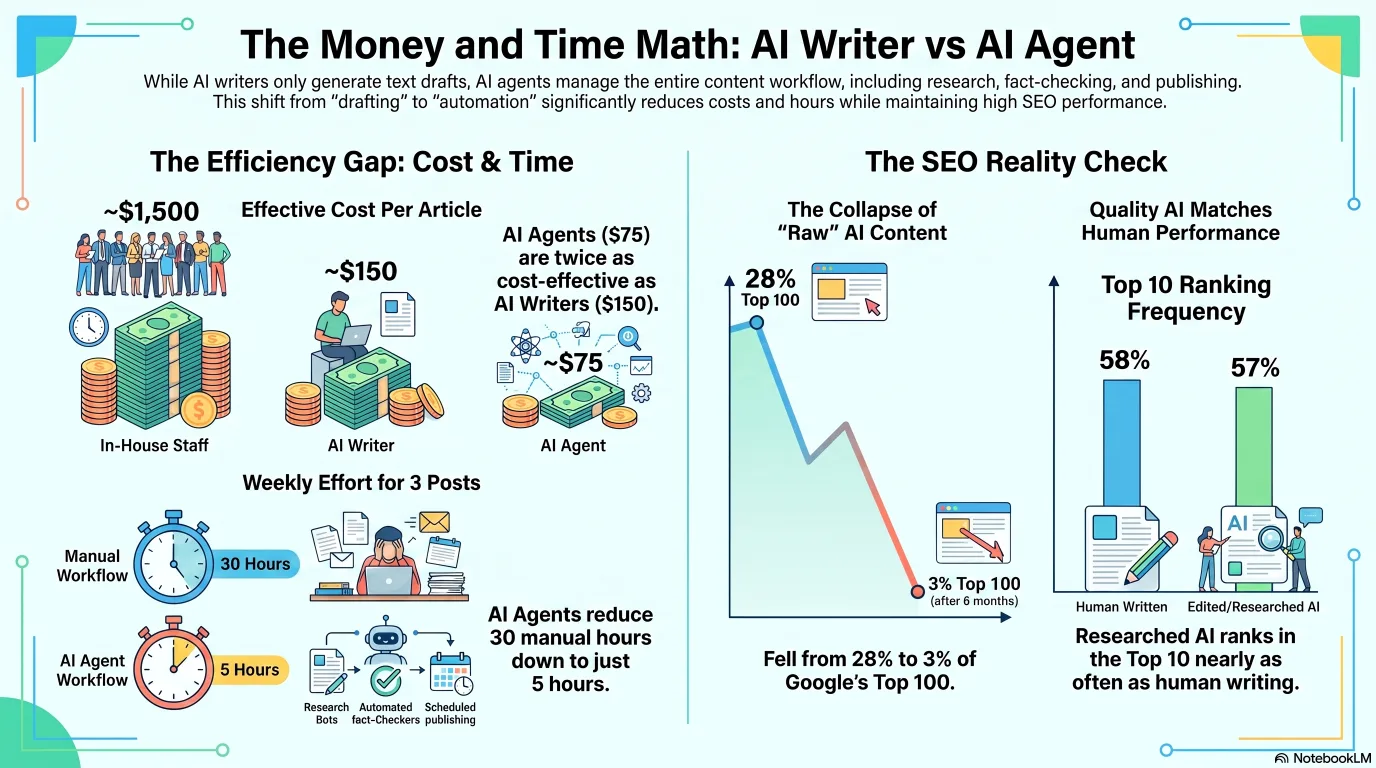
The case against raw AI: SE Ranking ran 2,000 AI-generated articles, completely unedited, across 20 zero-authority domains and watched them for 16 months. In month one, things looked fine, around 28% of the pages reached Google's top 100. By month six, that had collapsed to just 3%. Finance and health pages were hit hardest. The authors' conclusion was blunt: AI alone is not enough, and without human guidance and a real strategy, the early gains fade within months.[3]
The case for AI done right: Semrush analyzed 20,000 URLs and found AI-generated text ranking in Google's top 10 in 57% of cases, against 58% for human-written text. Nearly identical. The best-performing approach by a wide margin was AI plus human oversight.[5]
Does AI content rank? It depends on the process, not the author
Edited, researched AI matches human writing; raw single-shot AI collapses[3][5]
Two different metrics shown together for context: Semrush measures presence in the top 10 across 20,000 URLs; SE Ranking measures the share of 2,000 unedited AI pages still in the top 100 after six months. The point is the spread: process is the variable, not whether a machine touched the text.
So both are true at once, and the apparent contradiction dissolves the moment you stop asking "AI or human?" and start asking "researched and checked, or not?" Raw, single-shot writer output, the kind nobody bothers to edit, is exactly the scale-generated filler that Google's December 2025 core update was built to demote.[10] Content that is researched, fact-checked, structured and supervised performs like good content, because it is good content. The thing that separates the two outcomes is process, and process is precisely what an agent automates and a writer skips.
The Money and Time Math
The cash cost of AI text is already near zero. The real saving from an agent is measured in hours, not dollars.
For a small business the decision is rarely about the quality of one article in isolation. It is about whether you can sustain a publishing habit at all without burning out or blowing the budget. Here the numbers are stark.
| Workflow | Effective cost per article | Time to publish |
|---|---|---|
| In-house staff writer | $1,100 to $2,000+ | 8 to 12 hours |
| Freelance (fully optimized) | $1,500 to $6,000 | Several days to weeks |
| Agency retainer | $500 to $2,500+ | 2 to 4 weeks |
| AI writer tool plus manual workflow | $75 to $250 | 2 to 3 hours |
| AI agent / content engine | $50 to $100 | 1.5 to 2.5 hours |
What a single article really costs, all in
Effective cost per article including human time, USD (Averi 2026 benchmarks)[6]
A staff writer or agency route runs well over a thousand dollars an article once you load in salary or retainer time. An AI writer plus your own labor lands near $150. A content engine that also does the research and publishing lands near $75, because it removes the human hours, not just the cash.
But the cash figure undersells it. Look at the clock instead. A full manual workflow from topic to live post runs 8 to 12 hours. An AI writer plus your editing brings that to 2 to 3 hours. An agentic content engine, including a human review, lands around 1.5 to 2.5 hours.[6] Scale that to a real cadence and the gap becomes the whole story.
The weekly cost of publishing three posts
Hours per week, topic to published, at a 3-posts-per-week cadence[6]
Three posts a week is roughly 30 hours of manual work, most of a full extra workday every day. The same cadence through an agent that handles research, drafting, formatting and publishing lands near 5 hours, with the human time spent on review instead of plumbing.
The number that actually matters
Where the Human Still Presses Publish
An agent is not a robot that replaces you. The market has already voted: fast like an agent, safe like an editor.
It would be dishonest to sell agents as a hands-off magic button, so let us be clear about the risk. AI still makes things up. Vectara's research, reported by the New York Times, found chatbots fabricate information somewhere between 3% and 27% of the time depending on the system.[9] That is not a reason to avoid automation. It is the reason the grounding step exists: the single biggest lever for cutting fabrication is forcing the model to work from real, fetched sources rather than its memory, which is exactly what an agent's research and fact-check stages do, and exactly what a single-shot writer cannot.
This is why the winning pattern for a small business is not "fully autonomous robot publisher." It is an agent that does the heavy lifting and then pauses for a human before it hits publish. The data shows the market already settled here: only 7% of marketers publish AI text unedited,[4] and the best-ranking approach is consistently AI combined with human oversight.[5] Well-designed agentic systems are built to stop at exactly the moments that need human judgement.[2]
- The final publish decision. Someone owns the button. Start in approve-each mode and only loosen it as the agent earns trust on low-risk content.
- Brand voice and judgement. The agent can apply your voice, but the standard for it is yours to set and yours to police.
- Anything legal, medical or financial. Regulated or high-stakes claims get a human sign-off, full stop.
- Original point of view. A genuine opinion or a first-hand story comes from you. The agent handles the research and the scaffolding around it.
Think of it as moving the human from the assembly line to the quality gate. You stop spending your hours typing prompts, fixing formatting and chasing sources, and you spend them on the one decision that carries real risk: is this good enough, and true enough, to go out under your name?
Which One Does Your Business Need?
There is no universal answer, only an honest one that depends on what you are actually trying to do.
The choice is not really "writer or agent" as products; it is "which job am I trying to do?" If you need a quick draft for a single email, a landing-page tweak, or a one-off post you will personally research and publish, an AI writer is the right, cheap tool. Do not over-engineer a one-off.
But if your goal is a steady publishing habit, several posts a week, in more than one language, without hiring, then the bottleneck was never the draft and a faster draft will not fix it. That is an agent's job. This is the same shift the adoption data is tracking: Gartner expects embedded task-specific AI agents to jump from under 5% of enterprise applications in 2025 to around 40% by the end of 2026.[7] The move from writer to agent is not a fad; it is where the whole market is going.
News Factory is built for exactly that second job. Its tagline is literally "deploy AI agents in your news CMS," and that is the honest description: from the Pro tier up, its AI agents monitor industry RSS feeds, surface trending stories in your niche, research and draft full articles, and auto-publish to WordPress, Drupal or Joomla on a schedule you define, across up to five target languages. Crucially, it ships the human-in-the-loop control this article argues for: you can approve every post before it goes live, or let the agents run fully autonomous once they have earned your trust. It will not do your keyword research or replace your analytics, and it tops out at five languages per plan. What it does is the recurring research-draft-publish loop, so your blog stays active without you carrying every draft by hand.
The takeaway: an AI writer is a faster pen; an AI agent is a content engine. Judge them by the job, not the draft. For a one-off, use the pen. For a publishing habit you cannot otherwise sustain, use the engine, and keep your hand on the publish button.
Related reading
- Agentic Content Pipelines - the next step up: how those agent stages are wired into one assembly line.
- AI Content Humanization in 2026 - the brand-voice layer that keeps agent output from sounding like a remix.
- How to Rank with AI Content Without Getting Penalized - Google's actual policy on AI content, in detail.
- Building a Content Calendar as a Team of One - the cadence problem an agent is built to solve.
Article also available in: