Freshness Is a Real Ranking System, Not Folklore
Google has rewarded recency for over a decade. The rule favors whoever covers a rising topic credibly first, and that is a door a small site can walk through.
There is a quiet advantage that big media cannot fully use and most small publishers never claim: speed. Not speed as a vanity metric, but speed as a ranking signal Google has baked into search for more than ten years. If you run a niche site, the ability to notice a story and publish a credible take within minutes is not a nice-to-have. It is the closest thing you have to an unfair advantage over outlets a hundred times your size.
The mechanism has a name. Query Deserves Freshness, or QDF, was described publicly as far back as a 2007 New York Times interview with Amit Singhal, then head of search. His framing still holds: if news sites or blogs are actively writing about a topic, the model figures it is one users want current information about, and it cross-checks that against Google's own stream of billions of queries.[1] QDF fires when it sees a simultaneous spike in publishing and in searches on a topic. That combined signal tells Google the query deserves fresher results.
This is not a fringe tweak. The formal Google Freshness Update shipped on November 3, 2011, and impacted about 35% of all queries, noticeably affecting 6 to 10% of them.[2] It was only possible because of the Caffeine indexing system, which let Google index the web up to the minute. Google named three freshness-sensitive query types: recent events, regularly recurring events like elections or earnings, and frequently updated topics.
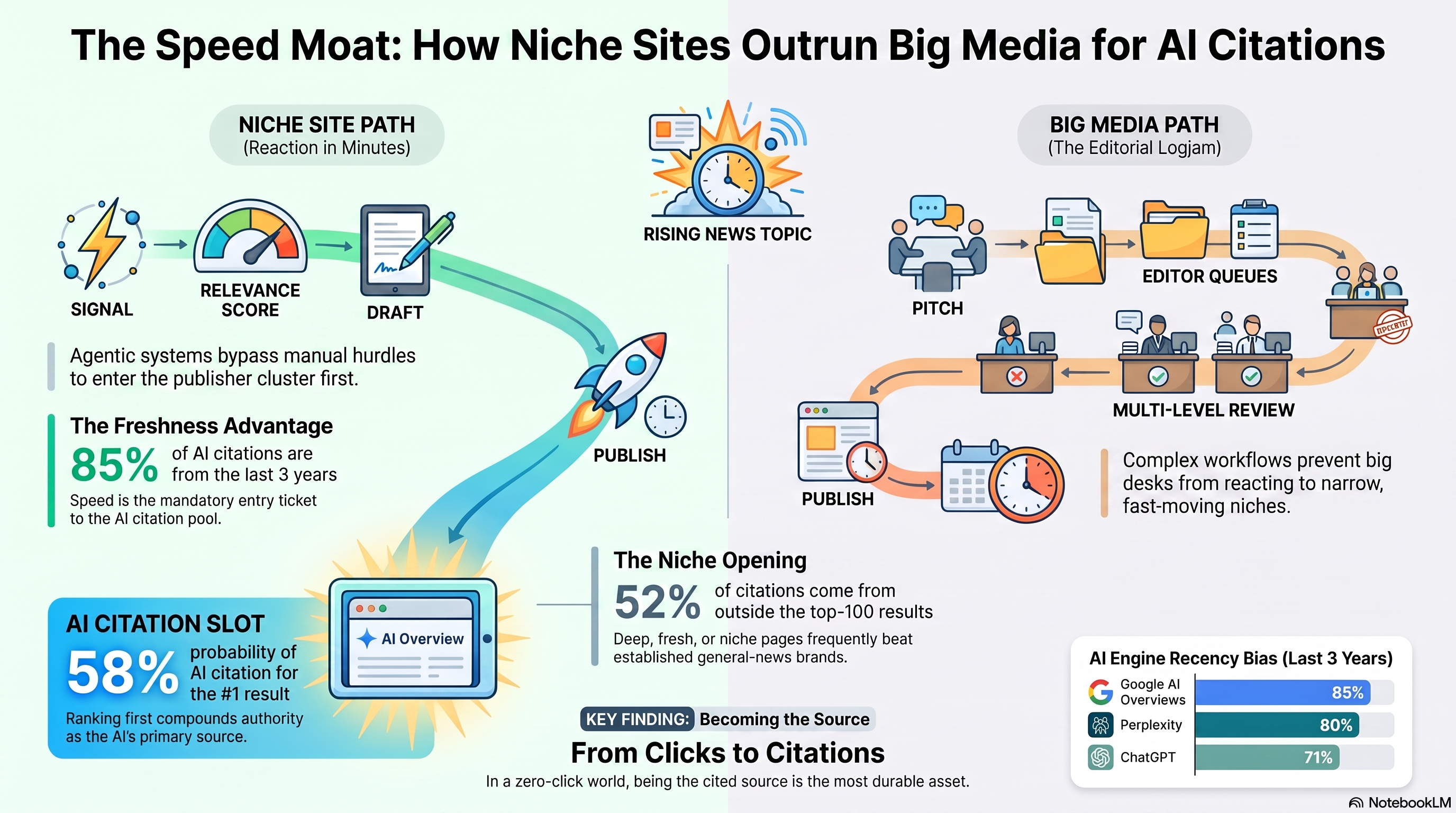
The moat in one sentence
Niche site: signal to live in minutes
Big media: gated by the newsroom queue
AI Overviews Reward Fresh Content Even Harder
Generative answers have a stronger recency bias than the blue links. Being early stopped being a SERP edge and became the entry ticket to the citation pool.
If freshness mattered in the classic ten blue links, it matters more now. Google's AI Overviews show the strongest recency bias of any major AI answer engine. In an analysis of AI citations by publication year, 44% of AI Overview citations were from 2025, 30% from 2024, and 11% from 2023: 85% from just the last three years. By comparison, Perplexity sat at 80% and ChatGPT at 71% over the same window.[3]
The pattern holds more broadly. Across AI answer engines, 65% of bot hits land on content published within the past year, 79% within two years, and 89% within three.[3] ChatGPT alone carries a measured 458-day newness preference over traditional organic search: it will favor a two-year-old article over a four-year-old one of equal relevance. For the hot, QDF-style topics where a niche site competes, the recency concentration is even tighter.
AI Overviews favor fresh content
Share of Google AI Overview citations by the publication year of the cited page[3]
85% of Google AI Overview citations point to pages from the last three years, and nearly half to 2025 alone. A page that did not exist when the topic broke cannot be cited. Speed is the entry ticket.
Read that chart as a clock, not a ranking. A stale archive page, however authoritative, is competing for a citation pool that is overwhelmingly filled by pages published recently. The freshest credible coverage of a rising topic has a structural advantage in the one surface that increasingly sits above every other result.
Why Being First Compounds Into a Moat
In AI Overviews, rank position is close to destiny for citations, and the first-page advantage is brutal. Win it early on a niche and it reinforces itself.
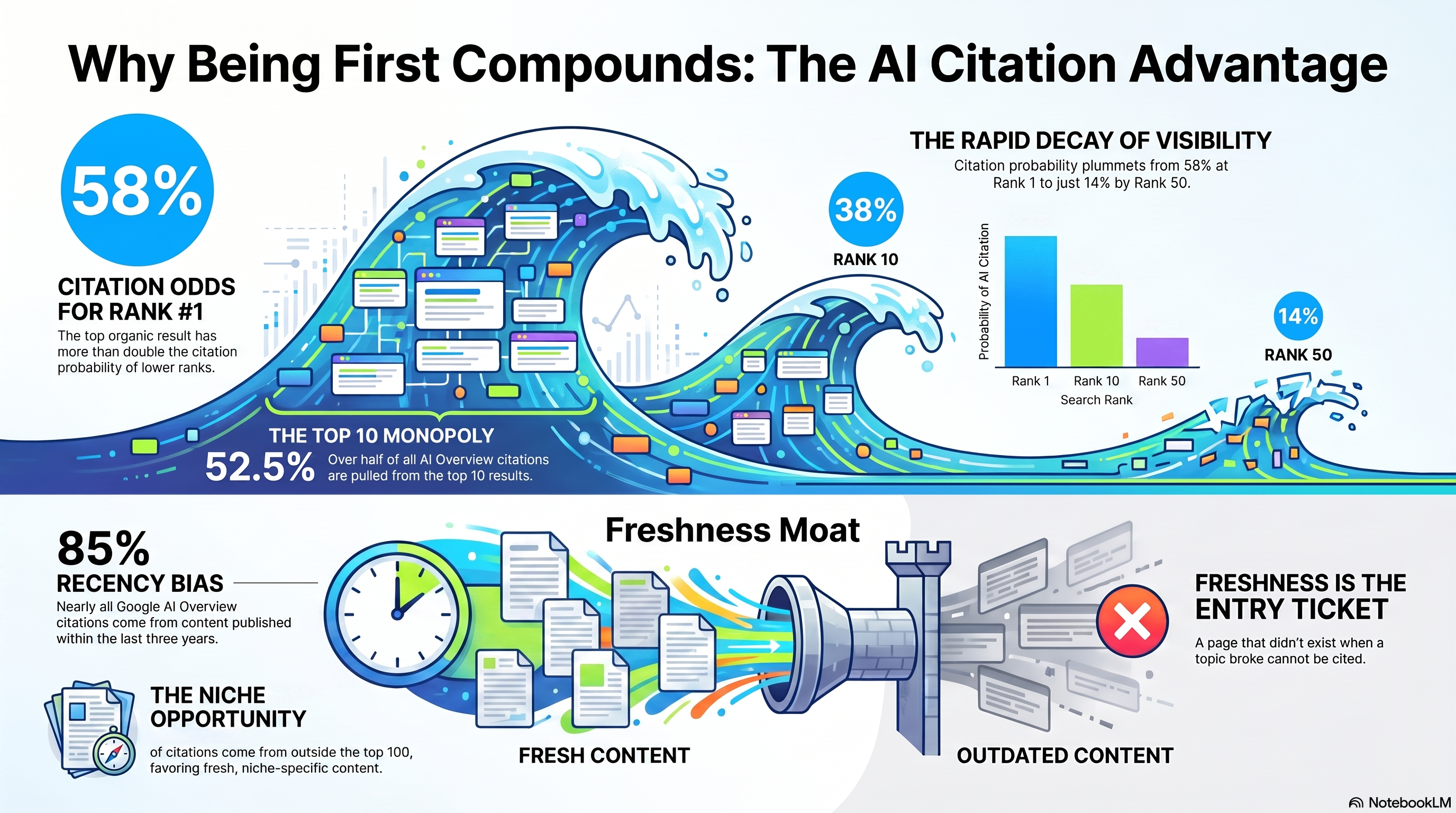
Here is where speed turns into a durable asset. Originality.ai analyzed roughly 29,000 queries and mapped how often each rank position gets cited inside the AI Overview. The result is stark: the #1 organic result has a 57.91% probability of being cited. Citation probability then decays fast with rank, to about 50% in the top 3, 46% in the top 5, 38% in the top 10, and 14% by rank 50.[4]
Being first compounds: AI citation odds by rank
Probability that a result at each rank is cited in the AI Overview[4]
The drop from 58% at #1 to 14% at rank 50 is the whole argument for getting there first. On a narrow niche topic, the first credible page in is often the page that takes the top slot before anyone else shows up.
Stack the positions and the concentration is even clearer. The top result alone supplies 8% of all AI Overview citations, the top 3 supply 21%, the top 5 supply 32%, and the top 10 supply 52.5%. About nine in ten citations come from the top 30.[4]
Half of all AI citations come from the top 10
Cumulative share of AI Overview citations by top-K rank[4]
Citations cluster at the top of the page. If your niche page is the freshest, most on-topic result and lands in that top cluster, it captures a disproportionate share of the answer.
Originality.ai names the compounding mechanic directly: top publishers already get SERP visibility, and now they are also the most likely to appear in AI-generated summaries, so authority and attention concentrate among a small group of sources.[4] That cuts both ways. On a broad head term, the giants own that concentration. On a narrow, fast-moving niche, the site that gets there first becomes that small group of one, and the advantage feeds itself.
Pick a beat narrow enough to win
In a Zero-Click World, Being the Source Beats the Click
Most searches no longer send a click anywhere. That sounds like bad news, until you realize what the new prize is: being the named source inside the answer.
The instinct is to chase clicks. But the open web is getting fewer of them. In 2024, 58.5% of US Google searches and 59.7% of EU searches ended without a click to the open web. For every 1,000 US searches, only about 360 clicks reached an external site.[6] Independent reporting corroborated the figure,[7] and SparkToro's latest reading puts US zero-click at 60.45% and rising.[12] When an AI Overview is present, the share of queries that end with no click at all climbs higher still.
For a small publisher, this reframes the entire goal. If the click is increasingly rare, the durable asset is being the source the answer is built from. A niche site that consistently breaks or contextualizes a topic first becomes the default citation. Brand recall, trust and authority accrue even on the searches that never send a visitor, and those compound into the searches that do.
Do not optimize for a click that is disappearing
The Citation Churn Is Your Opening
The AI answer surface is large, growing and constantly reshuffling its sources. That instability is exactly where a fast niche publisher wedges in.
AI Overviews are not a fixed wall you cannot climb. They are a moving target, and the movement favors whoever keeps feeding them fresh material. Prevalence has been volatile: AI Overviews appeared in 6.49% of queries in January 2025, peaked near 25% in July, then settled to 15.69% by November.[8] The intent mix shifted too, from almost entirely informational early in the year toward more commercial and navigational triggers.
AI Overviews: rapid, volatile growth in 2025
Share of queries showing an AI Overview across 2025[8]
The surface is big and unstable. Nearly half the citation slots turn over on each refresh, which means freshly published, on-topic pages keep winning newly opened slots that static archives miss.
The other half of the opening is who currently gets cited. In Ahrefs' analysis of 5.5 million Google AI Mode queries, the most-cited domains are Wikipedia, YouTube, blog.google, Reddit and Google.com. AI Mode leans heavily on user-generated content. General-news brands appear, but far down the list: NYTimes at #37, Forbes at #49, CNN at #68, BBC at #96.[9] A separate 30-million-source study found Reddit, YouTube and LinkedIn the most-cited domains across AI answers generally.[10]
| Who gets cited | Their role in the answer | The gap you can fill |
|---|---|---|
| Wikipedia, YouTube, Reddit | The top-cited domains in Google's AI Mode (millions of mentions) | Broad and generic; rarely the freshest take on a narrow breaking sub-topic |
| Quora, LinkedIn, TripAdvisor, Yelp | User-generated content that AI answer engines lean on heavily | Unstructured and unverified; no editorial point of view |
| NYTimes (#37), Forbes (#49), CNN (#68), BBC (#96) | General-news brands, present but ranked well below the UGC giants | Spread thin across every beat; slow to cover any single micro-topic |
| A focused niche site | The cleanest, freshest, most on-topic page on its specific beat | This is the open slot: be the structured, current, citable source |
The takeaway is encouraging for a small site. Broad reference and UGC giants dominate generic queries, but they are not topical experts on narrow, fast-moving niches. On a specific breaking sub-topic where Wikipedia is stale and Reddit is unstructured, the cleanest, freshest, most citable page can be yours. And it matters that 52% of AI Overview citations come from outside the top-100 organic results, often deep, niche or freshly published pages with no comparable classic rank.[5] The door is wider than the rankings alone suggest.
RSS at Scale and the Editorial Layer
A speed moat is built on plumbing plus judgement. The feeds are cheap. Turning the firehose into a publishable story faster than a newsroom is the hard, valuable part.
None of this works without a listening surface. The base of a real news-monitoring stack is RSS at scale: not five feeds, but hundreds to thousands of curated sources, publishers, regulators, niche forums, Google News queries and press wires, ingested continuously. The practical ceiling of a single tool is real: Inoreader's free plan monitors 150 feeds, and its Pro plan caps at 2,500 with hourly refresh.[11] That cap, introduced in 2025, drew pushback from power users precisely because serious monitoring wants more.
But the feeds are the easy part. A firehose of a thousand feeds is noise until something scores it for relevance and decides what is worth a story. That editorial layer is the actual moat. It is where a relevance score plus human or machine judgement turns a raw signal into a publishable, on-topic, credible post, and it is where a focused niche operator beats a big-media news desk that has to route everything through a queue of editors.
- Ingestion. Hundreds to thousands of RSS feeds, news APIs and search alerts covering your beat, refreshed as often as the tooling allows.
- Relevance scoring. A filter that ranks incoming items by how closely they match your niche, so you react to the right 1% and ignore the rest.
- Editorial judgement. The decision that a scored signal deserves a story, plus the angle that makes it yours rather than a rewrite.
- Drafting in your voice. Turning the source into a structured, original post that reads like your site, not a wire copy.
- Fast publish. A short path from approved draft to live page, so you enter the freshness cluster while the topic is still rising.
The Niche Speed Playbook
The advantage is real but it has to be operationalized. Here is how a small publisher turns speed into a compounding authority moat, without a newsroom.
The thesis holds together as a single chain. Freshness is a confirmed ranking system that rewards early movers on rising topics. AI Overviews concentrate citations even harder on recent pages. Rank position drives citation, and the advantage compounds. A zero-click world makes being the cited source the real prize. And the citation surface churns constantly, leaving open slots that giants miss. The site that can react fastest on a narrow beat wins all of these at once.
Doing it by hand is the catch. Monitoring thousands of feeds, scoring relevance, drafting and publishing in minutes, every time a topic moves, is a full-time newsroom job. That is exactly the workload an agentic system is built to absorb.
The entire speed-to-publish moat described in this article is precisely what News Factory automates. Its AI agents monitor RSS feeds in your niche (5 feeds on Pro, 10 on Business, 50 on Enterprise) and surface trending stories the moment they break, then research and draft a full article in your voice via its Repurpose story capability. On Pro and above, agentic automation discovers, processes and publishes on a schedule you define, and you choose whether to approve each post or let the AI run fully autonomous. That is the editorial-speed advantage a small niche site needs to react before big media, turned into an always-on system instead of a manual scramble.
The takeaway: you cannot out-staff big media, but you can out-react it. On a narrow beat, speed is a ranking signal, a citation magnet and a compounding authority moat all at once. Build the listening stack, tighten the beat, and be the first credible, fresh page every single time the topic moves.
Related reading
- Agentic Content Pipelines - how the monitor, draft and publish stages wire into one assembly line.
- News Syndication Without a Penalty - reacting to news fast without tripping duplicate-content rules.
- Topical Authority as an SEO Strategy - why depth on a narrow beat compounds.
- How to Get Cited by ChatGPT and Perplexity - the citation side of the same coin.
Article also available in: