The Myth, in One Sentence
The fear that has cost small businesses more sleep than almost any other SEO worry, and why it's misplaced.
Somewhere along the way, a piece of SEO folklore took hold and never let go: if Google finds duplicate content on your site, it will penalize you. Business owners rewrite product descriptions in a panic, refuse to republish their own articles, and worry that two pages saying similar things will sink the whole domain. It is one of the most persistent myths in search, and it is wrong.
Here is the truth in a single sentence: there is no “duplicate content penalty” in the way most people imagine. When Google finds duplicate or near-duplicate pages, it groups them together, picks one version to show (the “canonical”), and quietly hides the rest. Your rankings are not docked. Your site is not flagged. Nothing is taken away. The duplicate is simply filtered, not punished.
The one idea that fixes the whole fear
The duplicate-content myth, by the numbers
Google's own estimates and the threshold that has never existed[6]
Source: Matt Cutts (Google, 2013) estimated 25–30% of the web is duplicate content; John Mueller confirmed there is “no number” that triggers a penalty.[6]
What Google Actually Says
Not interpretation, not a guru's opinion, the public statements from Google's own people and docs.
This is not a case where the experts disagree and you have to pick a side. Google has said the same thing, in public, for more than a decade.
Back in 2013, Matt Cutts, then the head of Google's webspam team, recorded an official video addressing exactly this fear. His estimate was striking: roughly 25–30% of all the content on the web is duplicate. People quote a paragraph and link to the source. Sites publish the same terms-of-service text. Articles get syndicated. Because so much of this duplication is innocent, Cutts explained, penalizing it “would have a negative effect on the quality of the search results.”[6] Google simply does not work that way.
John Mueller, Google's long-serving Search Advocate, has repeated the point many times: “We don't have a duplicate content penalty.” As recently as April 2026, Google confirmed that having multiple URLs pointing to the same content does not trigger a penalty or a loss of search visibility, the system can handle it.[8]
And the official documentation removes any remaining doubt. Google's own help pages state plainly that “some duplicate content on a site is normal and it's not a violation of Google's spam policies.”[1] Read that again: not a violation. The same documents that define what is spam explicitly carve out ordinary duplication as fine.
So why does the fear persist?
How Canonicalization Works
The mechanism behind ‘Google picks one version’, and the three signals you actually control.
Canonicalization is just Google choosing the single “representative” URL from a set of duplicate or very similar pages. It is sometimes called deduplication, and its only job is to let Google show one clean version in results instead of five near-identical ones. There is nothing punitive about it, it is a tidying-up step that happens to almost every site on the web.
You are not powerless in this process. Google's documentation lists the signals it uses to decide which URL wins, and helpfully ranks them by strength. The good news for non-technical owners: these signals stack, so combining them increases the chance your preferred page is the one chosen.
The three canonicalization signals you control
Ranked by strength, from Google's ‘Consolidate duplicate URLs’ docs[2]
Bars are relative signal strength, not percentages. A redirect is the strongest lever; a sitemap is the weakest. None are mandatory, Google says your site “will likely do just fine” without specifying any preference.[2]
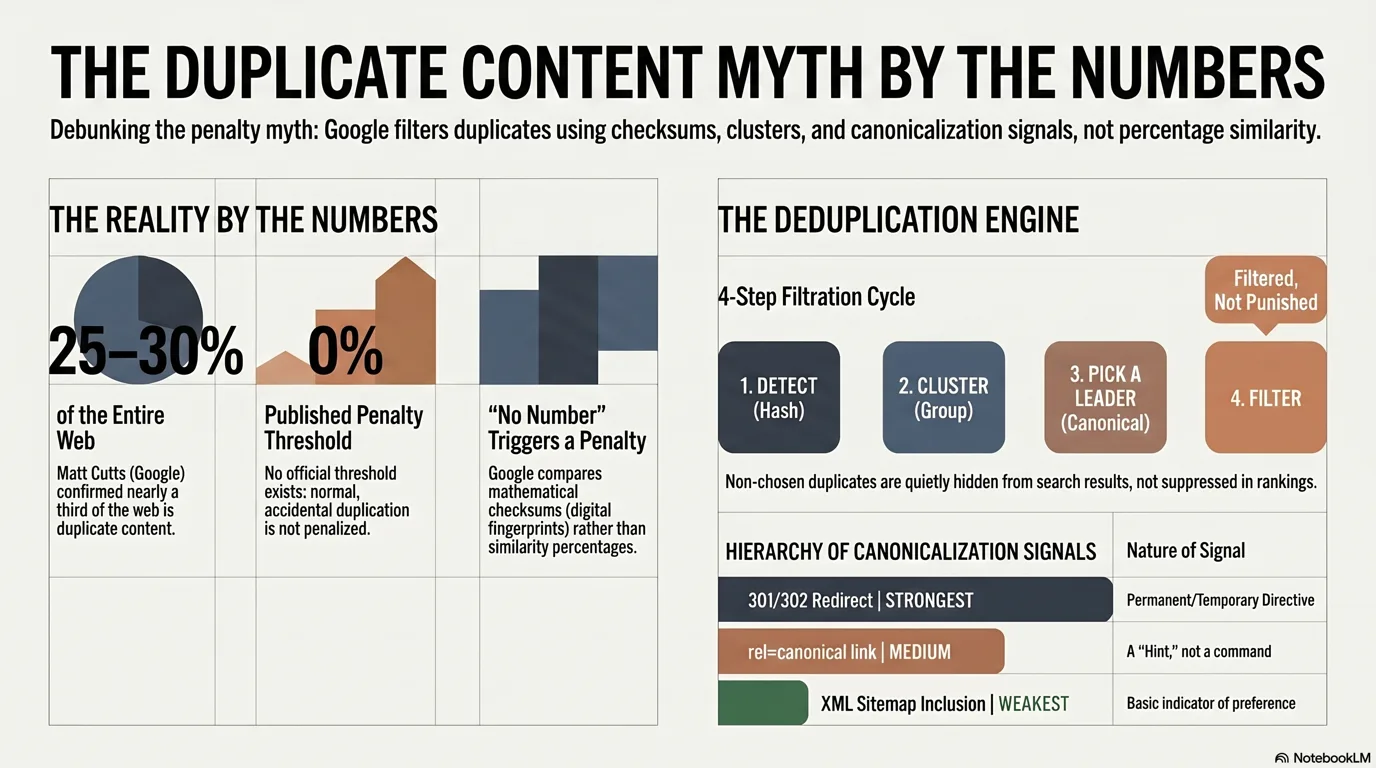
Two things are worth burning into memory here. First, rel=“canonical” is a hint, not a command. Google may choose a different canonical than you specified based on its own signals, which is exactly why Search Console sometimes reports “Duplicate, Google chose different canonical than user.” That message is not a penalty; it is Google telling you it overruled your hint.[1] Second, you do not actually have to do any of this. If you specify nothing, Google picks the version it judges objectively best to show users.
- Pointing the canonical at a redirected or non-duplicate page. The target should be a live, genuinely equivalent URL.
- Sending mixed signals. Your sitemap says URL A, your rel=canonical says URL B, Google has to guess, and may guess wrong.
- Using robots.txt to “canonicalize.” Blocking a URL can still leave it indexed without its content. Wrong tool for the job.
- Using the URL removal tool. That hides all versions, not just the duplicate, a self-inflicted disappearance.
- Setting the canonical via JavaScript that changes the value. If the rendered value differs from the source HTML, signals get muddy.
Sources: Google canonicalization troubleshooting docs and SEMrush's canonical guide.[3][12]
Cluster, Pick, Filter, Not Punish
The four-step process Google described identically in 2013 and 2020, the heart of the myth-busting.
If you remember one model from this entire article, make it this one. Both Matt Cutts (2013) and Gary Illyes (2020) have described Google's near-duplicate handling the same way, and it has four steps, none of which is “penalize.”
Detect
Google reduces each page to a hash / checksum and compares them. It's a fingerprint match, not a similarity percentage.
Cluster
All the matching pages are grouped together into a single cluster of duplicates.
Pick a leader
Google chooses one “leader page”, the canonical, to represent the whole cluster.
Filter
The non-chosen duplicates are filtered out of results to keep them clean. Hidden, not hurt.
The crucial word in step four is filtered. The duplicate page still exists; it simply doesn't appear when a better, canonical version already covers the same query. Your site isn't dragged down, one URL is suppressed in favor of another from the same cluster. That is a world away from a penalty, which would actively demote your domain.
And notice what's missing from the detection step: a percentage. There is a stubborn belief that you must keep pages, say, “70% unique” or risk a flag. When SEO consultant Bill Hartzer asked Mueller directly whether there's a percentage that represents duplicate content, the answer was blunt: “There is no number (also how do you measure it anyway?).”[6] Google compares checksums, not similarity scores.
In 2026, Mueller laid out nine scenarios that explain how Google decides two pages are duplicates or picks one over another. If Search Console says “Google chose a different canonical,” the cause is almost always technical, architecture, rendering, or parameters, not a penalty:
- Exact duplicate content across two URLs.
- Substantial duplication in the main content, even if some parts differ.
- Too little unique content versus a heavy template (giant menu, tiny post).
- URL-parameter patterns Google infers as duplicates (e.g. ?tmp=1234).
- A mobile version used for the comparison instead of desktop.
- Only the Googlebot-visible version is judged, not what users see.
- Bot-challenge or error pages served to Googlebot get matched as dupes.
- JavaScript that fails to render, leaving identical bootstrap HTML.
- System ambiguity or plain misclassification, it happens.
As Mueller put it: “There is no tool that tells you why something was considered duplicate.” Source: SEJ, 2026.[7]
Syndication, letting other sites republish your articles, is where the duplicate-content conversation gets genuinely practical, and where a lot of advice is now out of date. For years, the standard recommendation was: have your syndication partners add a rel=canonical pointing back to your original, so you keep the credit. In 2023, Google reversed that advice.
The 2023 syndication reversal
Google changed the recommended fix for republished content[9][10]
“Add rel=canonical (or block) so the original gets credit.”
Canonical is NOT recommended for syndication, partners should noindex the republished copy instead.
Google's documentation now states that the canonical link element is not recommended for avoiding syndication duplication, “because the pages are often very different.” The most effective solution, it says, is for partners to block indexing of the republished copy.[3] In practice that means asking your syndication partners to apply a noindex tag to their version, so your original is the one that ranks. For Google News specifically, noindex was always the advice, never canonical.[9]
Why the change? Because canonicals weren't reliably doing the job. In July 2023, NewzDash data showed that Yahoo News's syndicated copies of publishers' articles frequently outranked the original publishers in Google. The lever publishers actually control is noindex on the partner's copy, so that's what Google now recommends.[9]
The practical rule for small businesses
There's a deeper point hiding inside all of this. The fear this article dismantles is really the fear of reusing your own material, across pages, across sites, across languages. Once you accept that Google clusters and canonicalizes rather than penalizes near-duplicates, the real bottleneck stops being “will I get penalized?” and becomes the actual work: intelligently reworking source material into something that reads as genuinely original rather than copy-pasted. That distinction, between republishing the same block of text and rewriting it into a distinct, voice-consistent article, is exactly the line between what Google filters and what it rewards.
Where Real Penalties Actually Live
Duplicate content is housekeeping. Scraping, spam, and deception are where manual actions get handed out.
So if ordinary duplication is fine, what does get a site penalized? This is the distinction that matters most, because the same word, “duplicate”, sits on both sides of a very sharp line. On one side: normal, accidental, structural duplication. On the other: deliberate copying designed to manipulate rankings. Intent and value are what flip the switch.
✓ No penalty, Google just deduplicates
Google picks HTTPS and consolidates signals. No penalty.
Treated as duplicates of one page, deduplicated automatically.
Normal site-function variants. One version is shown.
Recognised as the same content; one canonical is chosen.
Expected on e-commerce. Filtered, never penalized.
Innocent overlap, Cutts: roughly a third of the web does this.
“Completely different content”, not duplicate at all.
✕ Real penalty, spam-policy violations
Republishing others' work with little added value. Spam policy violation.
Mass-producing pages mainly to manipulate rankings.
Hosting third-party pages on a trusted domain to exploit its ranking signals.
Pages built for engines, not people; showing Google different content.
Copy-paste affiliate templates with no original value.
Deceptive behaviour that triggers manual actions.
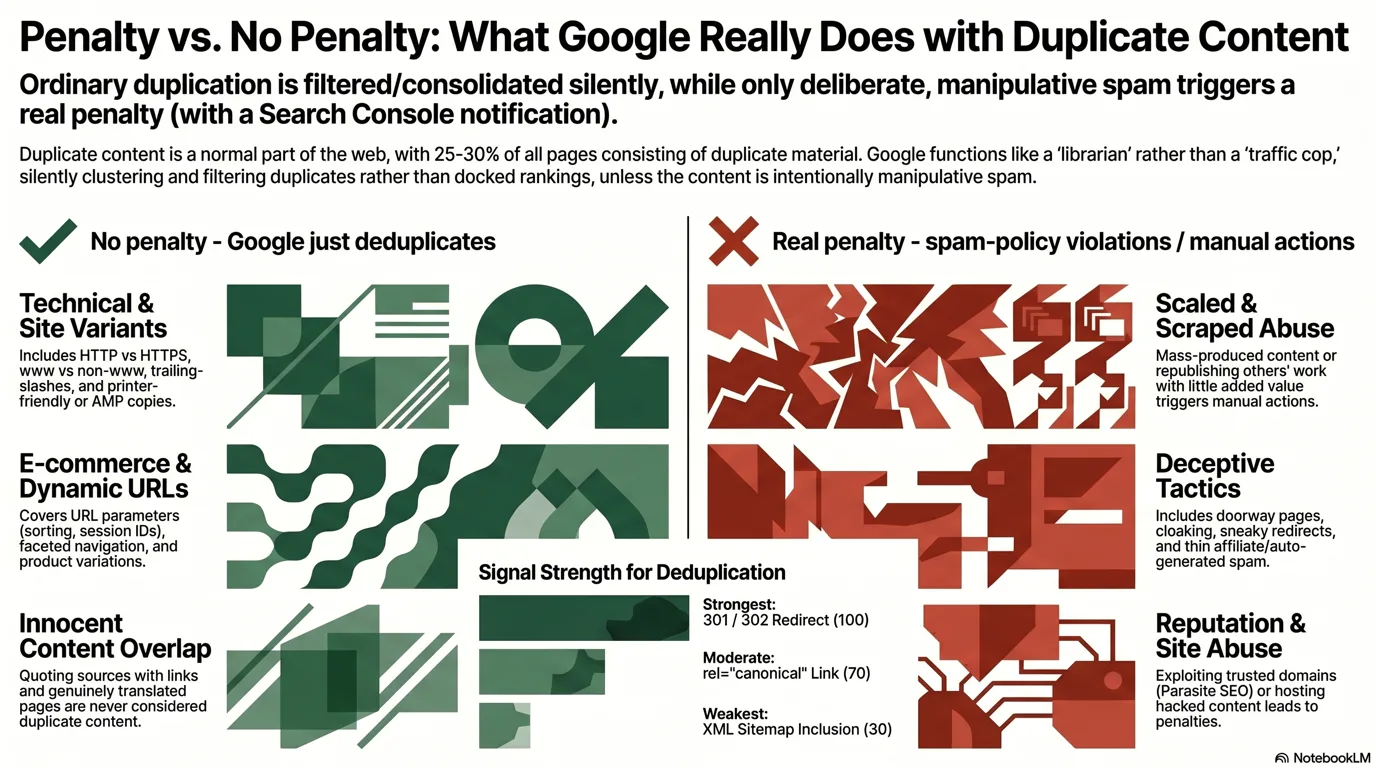
Google's spam policies explicitly prohibit scraping, scaled content abuse, site reputation abuse, cloaking, doorway pages, and thin affiliate spam, and these can get you ranked lower or removed entirely.[4] The penalties are delivered as manual actions: a human reviewer (or an automated system) flags the violation, your site can rank lower or vanish from results, and you are notified in Search Console with the chance to file a reconsideration request. That notification is the tell. A real penalty comes with a message; ordinary deduplication is silent.
A concrete, dated example makes the line vivid. Google's site reputation abuse policy, sometimes called “parasite SEO”, launched with the March 2024 core update, and the first manual actions landed in early May 2024, hitting big-brand domains that hosted third-party coupon and discount sections built purely to exploit the host's authority. Google tightened the policy language further on November 19, 2024, making clear that using third-party content to exploit a site's ranking signals is a violation “regardless of whether there is first-party involvement.”[5] That is what a real duplicate-adjacent penalty looks like: deliberate, manipulative, and explicitly against the rules, nothing like having an http and an https version of your homepage.
Common duplicate types, what Google actually does
Most of what owners worry about sits firmly in the ‘safe’ column
| Duplicate type | Example | What Google does | Verdict |
|---|---|---|---|
| Protocol / host variants | http:// vs https://, www vs non-www | Google consolidates to one canonical (HTTPS preferred). Add a redirect to be explicit. | Safe |
| URL parameters | ?utm_source=, ?sort=price, ?sessionid= | Detected as the same content; one URL is chosen. Set a self-referencing canonical. | Safe |
| E-commerce variations | Same product in red / blue / XL | Near-duplicates clustered; canonical points to a main product URL. | Safe |
| Boilerplate-heavy pages | Huge nav/footer, tiny unique body | Can be judged ‘too little unique content’, add substance, don’t just reshuffle. | Watch |
| Syndicated / republished | A partner reposts your article verbatim | Ask the partner to noindex the copy (2023 guidance) so your original ranks. | Watch |
| Scraped without permission | Someone copies your content to game rankings | This is the spam-policy zone, the scraper risks a manual action, not you. | Watch |
Translated Content & AI Search
Two modern anxieties, multilingual pages and AI Overviews, answered directly.
Two questions come up constantly from owners expanding their reach, and both deserve a clear answer.
Is a translated page duplicate content? No, not even close. Google's documentation is explicit: different-language versions of a page are only considered duplicates if the primary content stays in the same language (for example, if you translate just the header and footer but leave the body in English). A genuinely translated body is not duplicate. Mueller put it even more plainly: “Anything that is translated is completely different content.” From Google's point of view, duplication only exists when pages physically match, words and all.[11] A Spanish version of your English article is a separate, valuable page. The correct setup is hreflang on a per-page basis between language versions, and confirming each is indexed in Search Console.
Why this matters more in the AI-search era
This reframes the whole topic for the modern web. The old fear was defensive, “will duplication hurt me?” The new, more useful question is offensive: “am I the clearest, most original, best-consolidated version of this content?” In an AI-mediated search world, that is the thing worth optimizing for.
Your Action Plan
Stop worrying about a phantom penalty. Do these five things instead.
Ordinary duplicate content, variants, parameters, e-commerce options, reused boilerplate, is normal and not a spam violation. Redirect your energy to the two things that actually matter below.
Use 301 redirects for protocol/host variants, self-referencing canonicals on parameterized pages, and consistent internal linking. Don't send mixed signals between your sitemap and your canonicals.
If partners republish your work, ask them to noindex their copy (post-2023 guidance). If you republish others' content, noindex yours unless you've added real original value.
This is where real manual-action penalties live. Don't mass-produce thin pages, don't host parasite third-party content for ranking signals, and don't republish others' work without adding value.
Translated pages are distinct content. Use hreflang, verify indexing, and lean into multilingual reach, it expands your footprint with zero duplicate-content risk.
The real bottleneck, and where a content engine helps
The duplicate content penalty is a ghost story. It has frightened small business owners for years, kept good content unpublished, and turned routine technical housekeeping into a source of dread. The reality is far kinder: Google clusters, picks a leader, and filters the rest, silently, automatically, without malice. Save your worry for the things that genuinely carry a penalty, scraping, spam, and deception, and spend the energy you reclaim on making your content the best, most original version of itself.