The Duplicate Content Penalty Is a Myth (Google Says So)
There is no secret Google switch that bans you for publishing the same article in two places. The real risk is quieter, and it is the whole reason this topic matters.
If you run a small news site, a niche blog, or a one-person newsroom, you have almost certainly heard the warning: republish the same article on another site and Google will hit you with a duplicate content penalty. It is one of the most durable myths in SEO, and it keeps small publishers from a legitimate, decades-old growth tactic out of pure fear. So let us settle it with Google's own words. In its official SEO Starter Guide, Google addresses the so-called penalty directly: if the same content is accessible under multiple URLs, "it's fine; don't fret about it. It's inefficient, but it's not something that will cause a manual action."[1] Copying other people's content to deceive is a different story, but ordinary syndication, where you agree to let a partner republish your work, is explicitly non-malicious.
Wikipedia's own entry on duplicate content puts syndication in the same bucket, calling it "a popular form of duplicated content" and listing it among the non-malicious cases Google does not act against.[11] So if there is no penalty, why does this article exist? Because the real risk is subtler and far more common than a ban. When the same story lives on several sites, Google does not punish anyone. It simply picks one version to show in search and quietly filters the rest out. The danger for a small publisher is not a penalty. It is that the bigger, more authoritative partner site gets chosen as the version that ranks, so you do the work and they collect the traffic for your own story.
The one sentence that reframes the whole topic
That distinction changes everything about how you approach a syndication deal. Instead of asking "will I get penalized," which has a comforting and definite answer of no, you should be asking "will Google still show my version when someone searches for this story." That is a question you can actually influence, and the rest of this guide is about the specific, mostly non-technical moves that tilt the answer in your favor.
What Syndication Actually Is, and Why Small Publishers Do It
A legitimate reach strategy, not a loophole. It is also more mainstream than most owners realize.
Content syndication is republishing the same piece of content, an article, a video, an infographic, on one or more third-party sites in addition to or instead of your own. The goal is reach: getting your story in front of a partner's larger audience. News syndication is the same idea applied to journalism, where a newsroom licenses or shares its articles so partner outlets, a wire service, a larger national title, or an aggregator like a major portal, republish them, often word for word. It is how a small local scoop can end up on a national site, and how a niche analysis can reach readers who would never have found your domain on their own.
It helps to draw one clean line up front. Syndication is something you agree to. You control the terms, the timing, and the attribution. Scraping is theft. Someone copies your content without permission, and while you cannot always stop it, Google is generally good at identifying the genuine original. This article is entirely about the first kind, the deliberate, contractual kind, because that is where a few smart decisions protect your rankings and a few careless ones quietly hand them away.
If syndication feels like a fringe tactic, the data says otherwise. It is a mainstream channel, especially in business-to-business marketing. According to figures compiled by Madison Logic, 65 percent of B2B marketers use content syndication as a core lead-generation tactic, and a large majority lean on at least one syndication vendor.[12] Buyers rely on it too: a sizeable share of B2B purchasers use whitepapers and syndicated content to inform their decisions. The takeaway for a small publisher is reassuring. You are not bending the rules by syndicating. You are using a channel that the rest of the market already treats as standard practice.
Syndication is mainstream, not a fringe tactic
Adoption and buyer-reliance figures show the question is how to syndicate, not whether[12]
Sources: SalesBox survey via Madison Logic (Oct 2024) for the 65 percent core-tactic figure; industry vendor and buyer-behavior surveys for the remaining bars. The pattern is consistent across studies: syndication is a normal, widely used distribution channel, not a grey-hat shortcut.
What Really Happens: Canonicalization, Not Punishment
When the same article exists in several places, Google deduplicates. Understanding that process is the key to controlling the outcome.
Here is what Google actually does when it finds your article on three different sites. It does not reach for a penalty. It runs a process called canonicalization, which is just deduplication with a fancier name. Google crawls all the versions, picks one as the canonical (the version it considers definitive and shows in search), consolidates the ranking signals such as links toward that canonical, and filters the other copies out of the results.[2] From Google's point of view this is tidy and efficient. It does not want to show searchers five identical pages, so it shows the one it judges best and hides the rest.
The catch, and it is the single most important sentence in this whole article, is buried in Google's own documentation: Google may choose a different page as canonical than you do. As the docs put it, indicating a canonical preference "is a hint, not a rule."[2] Translation for a small publisher: if you syndicate to a much bigger, more authoritative partner, Google may decide their copy is the best one to show, and your original gets buried beneath it. That is not a penalty. It is deduplication working exactly as designed, just not in your favor.
The real problems duplicates cause
- The wrong version ranks. The partner outranks the originator for the originator's own story.
- Signals get split. Links and authority can scatter across versions instead of consolidating on yours.
- Indexing gets confused. Google may index the copy and skip the original entirely, particularly if the copy was found first.
This is where the small publisher's disadvantage becomes concrete. Authority matters in canonicalization, and by definition your syndication partner usually has more of it than you do, which is why you wanted to syndicate to them in the first place. Left unmanaged, that same authority gap is exactly what lets their copy win the canonical coin toss. The good news is that you are not at the mercy of Google's judgment here. There are explicit signals you can send, and a clear order of operations, that make your version the obvious original. That is the safe syndication playbook.
The noindex-First Safe Syndication Playbook
Five moves, in order, that keep Google crediting you as the source. Most of them are agreements, not code.
Protecting your rankings during syndication is less about technical wizardry and more about sequence and paperwork. Get the order right and require the right tags, and you keep both the reach and the rankings. Here is the playbook, from the cheapest insurance to the strongest guarantee.
The five safeguards, in order
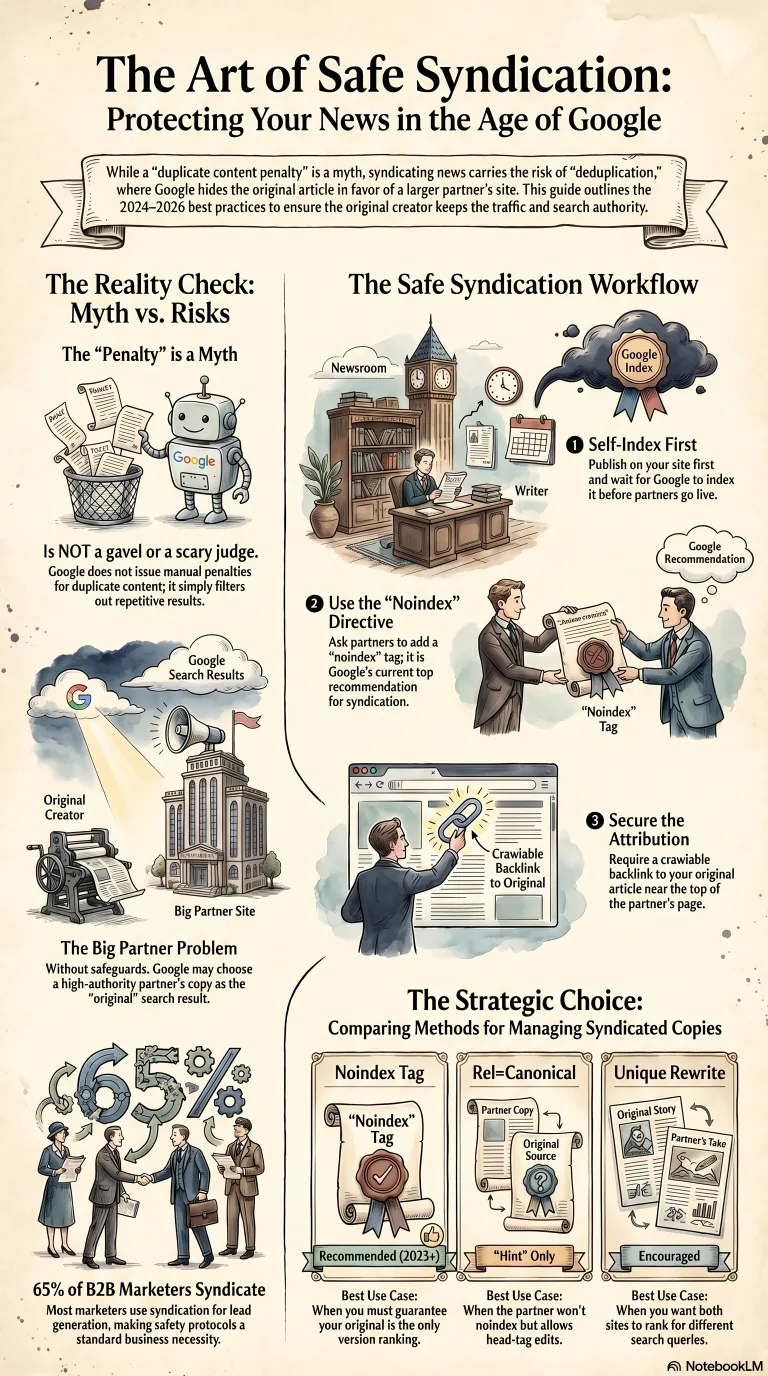
1. Publish the original on your own site first, and let Google index it before the copy goes live. This is the cheapest and most powerful insurance you have. New content can take anywhere from a few hours to a few weeks to be indexed, so build a lead time into every syndication agreement. Publish, then verify the page is actually in Google's index using the URL Inspection tool in Search Console or a quick site: search, and only then let the partner publish. When Google sees your version first, you start the canonicalization process already cast as the source.
2. Get the partner to add a noindex tag to the republished copy. This is Google's current top recommendation for news syndication, and it has been since the company revised its canonicalization guidance in May 2023. The partner adds a single line, <meta name="robots" content="noindex, follow">, which keeps their copy out of Google's index entirely. The copy still serves the partner's on-site readers, it still passes a link back to you, but it can never compete with your original in search because Google never indexes it. The follow value matters: it lets the link equity flow back to your page.
3. If the partner will not or cannot noindex, fall back to a cross-domain canonical. Here the partner adds a rel=canonical tag on their copy that points to your original URL. It tells Google your version is the source and that signals should consolidate to you. It is genuinely useful, but understand its limit: a canonical is a hint Google can override, and some content management systems strip or rewrite the tag without telling anyone. Treat it as the silver-medal option, and always verify the partner actually shipped it.
4. Always require a clear, crawlable link back to the original. A visible line such as "Originally published on YourSite," ideally near the top of the article and pointing to your exact URL, helps readers and search engines alike attribute the source. It is the simplest attribution signal there is, and it should be non-negotiable in every deal, regardless of which tag the partner uses.
5. Put all of it in writing. A syndication partner agreement should spell out who the original publisher is, that the partner will noindex (or, failing that, canonical) the copy, the backlink and attribution requirement, and the publishing timeline that guarantees you go live and get indexed first. Tags get forgotten and staff change. A written agreement is what survives both.
Do not combine noindex and a canonical on the same page
noindex and a rel=canonical on the same page is unpredictable, because a page told not to be indexed may never be crawled often enough for Google to even see the canonical.[9] Pick one signal. For news and competitive content, pick noindex. The two tags pull in different directions, and using both just muddies the message you are trying to send.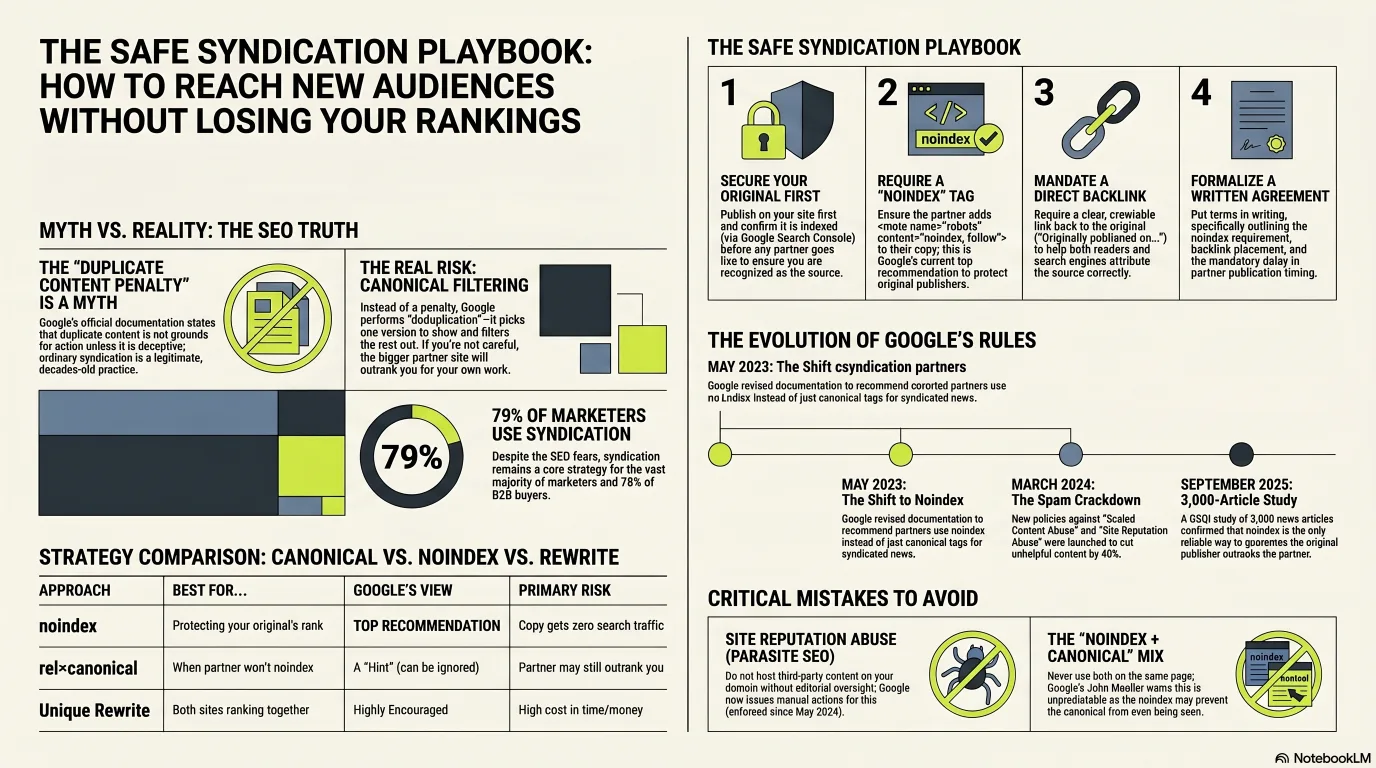
Canonical vs noindex vs Rewrite: The Decision Framework
Three legitimate approaches, three different outcomes. Pick by what you need to protect and how much both sites need to rank.
There is no single correct way to syndicate. There is a correct way for your goal. The three legitimate approaches differ mostly in one question: do you need your site to be the only version that ranks, or are you happy for both to appear? Here is how they compare.
| Approach | How it works | Best when | Main risk | Google's current view |
|---|---|---|---|---|
| Cross-domain rel=canonical | The partner adds a canonical tag on the copy that points back to your original URL, telling Google your version is the source. | The partner can edit head tags but will not noindex, and you are happy for the copy to still rank if Google prefers it. | It is only a hint Google can ignore, partner CMSs sometimes strip it, and the partner can still end up ranking instead of you. | Allowed, but no longer the top recommendation for news syndication. |
| noindex on the copy | The partner adds a robots meta tag (noindex, follow) so the republished copy stays out of Google's index entirely. | You need to guarantee your original is the only version that ranks, especially for news and competitive queries. | The copy gets zero search visibility, which is the point, and it needs partner cooperation. Do not also add a canonical. | Google's current recommended approach for news syndication, since May 2023. |
| Rewrite into a unique angle | The partner publishes a genuinely different version, or you both publish distinct pieces, so there is no verbatim duplicate at all. | You want both sites to rank, the content is evergreen or marketing-led, and verbatim text is not contractually required. | It costs time and money, it is not true syndication, and lazy spun rewrites can drift into scaled-content-abuse territory. | Encouraged. Google asks publishers to create original content, not just rehash. |
The reason Google and seasoned SEOs now lean toward noindex over a canonical for news is reliability. A noindex tag is a directive: Google has to obey it. A canonical is a hint: Google can weigh it against everything else and still pick the partner. For a one-off marketing article where you would be glad to see either version rank, that flexibility is fine. For a competitive news story where being the visible source is the entire point, you want the directive, not the suggestion.
- Is keeping your site as the ranking version critical? (News, competitive queries, anything where being the source matters.) Ask the partner to noindex the copy, and require a link back. This is the strongest protection.
- Can the partner add head tags but not noindex? Use a cross-domain canonical pointing to your original, plus the link back. It is weaker, so verify they actually implemented it.
- Do you want both sites to rank and have the budget? Have the partner publish a genuinely rewritten version with a unique intro, angle, or added data, so there is no duplicate to deduplicate.
- In every case: publish your original first, confirm it is indexed, require a visible backlink, and put the terms in the agreement. These four never change.
What Changed in 2024 to 2026, and Why It Raised the Stakes
Google spent two years pushing publishers toward noindex on the copy, while quietly making one kind of syndication far riskier than before.
The advice above is not static. Google has spent the last few years sharpening both its recommendations and its enforcement, and two threads matter for anyone syndicating in 2026. The first is a steady, consistent push toward noindex as the preferred safeguard. The second is a new set of spam policies that changed which side of syndication is dangerous. The timeline below tracks the recommendation thread.
Google's syndication rules, 2023 to 2025
The trend line is consistent: Google keeps steering publishers toward noindex on the copy[4][5][7][9]
Google updates its guidance to recommend that syndication partners add a noindex tag to the republished copy when the original publisher does not want to compete with the partner in Search.
Google rolls out a core update alongside new spam policies (scaled content abuse, expired domain abuse, site reputation abuse), with a stated goal of cutting unhelpful content by roughly 40 percent.
Google starts enforcing its site reputation abuse policy (often called Parasite SEO), initially via manual actions against pages hosted with little or no first-party oversight.
Google representatives publicly restate that original publishers should have partners add a noindex tag to syndicated copies, preferred over relying solely on cross-domain canonicals.
John Mueller clarifies that mixing a noindex tag and a rel=canonical on the same page is unpredictable, because a noindexed page may never be crawled to even see the canonical. Pick one.
Glenn Gabe of GSQI tracks roughly 3,000 syndicated news articles and concludes that noindexing the syndicated copy is the clear path to protect the original publisher.
The second thread is the March 2024 core update, which Google rolled out alongside major spam policy changes the same week, with a stated aim of reducing unhelpful, low-quality content by roughly 40 percent.[8] Two of those new policies bear directly on syndication. Scaled content abuse targets content generated at scale primarily to manipulate rankings rather than help users.[4] Crucially, it is method-agnostic: it does not matter whether the content is written by a human, spun by AI, or scraped and syndicated, what triggers it is volume plus manipulative intent. Blasting the same article, or thin AI-rewrites of it, across dozens of low-quality sites is exactly the pattern this policy was built to catch.
The more surprising change is site reputation abuse, widely nicknamed Parasite SEO. Google defines it as third-party pages published "with little or no first-party oversight or involvement, where the purpose is to manipulate search rankings by taking advantage of the first-party site's ranking signals."[7] It was announced on March 5, 2024 and enforcement began on May 7, 2024.[7] Google's own example calls out a news site hosting third-party coupons with little to no oversight.[8] The high-profile cautionary tale was the Sports Illustrated episode, where a once-trusted brand published third-party AI-generated product reviews under fake author names, with minimal editorial control.
The direction of risk flipped
There is a thread running through all of this that touches AI content specifically. Google's position is consistent: AI content is not penalized for being AI. It is penalized when it is produced at scale to game rankings without adding value, which is the scaled content abuse policy again. A small publisher who uses AI to help research and draft original, genuinely useful articles is on firm ground. A publisher who auto-spins the same wire story into fifty near-identical copies and sprays them across a network of thin sites is not. The line is value and intent, not the tool.
The Mistakes That DO Cause Problems
No penalty does not mean no risk. These are the careless moves that genuinely cost small publishers their rankings.
If there is no penalty, what actually goes wrong? Almost always, it is one of a handful of avoidable mistakes. None of them invokes a secret Google punishment. Each of them simply hands your canonical, your link equity, or your editorial reputation to someone else. Here are the four that catch small publishers most often.
Letting the copy go live before your original is indexed
If the partner publishes first, Google can treat their copy as the source. Publish on your own site first and confirm indexing before any partner goes live.
Verbatim republishing with no canonical, no noindex, no backlink
With none of the three safeguards in place, the syndicated copy can be treated as the original and absorb the ranking benefit. This is the classic way to lose your own story.
Trusting a canonical and never checking it
A cross-domain canonical is a hint, not a directive. Partner CMSs strip it, and Google can still pick the partner. Prefer noindex, and verify whatever the partner actually shipped.
Mass syndication across dozens of low-quality sites
Blasting the same article, or AI-spun versions of it, across many thin sites is now squarely in scaled-content-abuse territory after the March 2024 update. Syndicate to a few good partners instead.
Two more deserve a quick mention because they are technical traps. First, do not rely on robots.txt to "block" a duplicate. Google warns that robots.txt is not a canonicalization tool: a URL you block there can still get indexed without its content, which makes the problem worse, not better.[3] Second, do not host unvetted third-party content on your trusted domain at scale, the site reputation abuse trap covered above. Both are easy to avoid once you know they exist, and both are far more likely to cost you than any mythical duplicate content penalty.
The other way to syndicate safely: publish a version that is genuinely yours
Step back and the whole topic gets simpler. There is no duplicate content penalty for syndicating news, and there never has been. The real risk is that Google shows your partner's copy instead of yours, and you have direct control over that outcome. Publish first and confirm you are indexed. Ask partners to noindex their copy, or at least canonical it, and always require a link back. Syndicate deliberately to a few good partners rather than blasting your work across a network of thin sites. And give anything you host on your own domain the same editorial care as your own reporting. Do those things, and syndication does exactly what it is supposed to do: it grows your reach without costing you the rankings you worked to earn.
Related reading
- News vs No News: The SEO Impact of Regular Publishing: why staying active matters, and how syndication fits a publishing cadence.
- How to Rank with AI-Generated Content Without Getting Penalized: the scaled-content-abuse line in plain English.
- Technical SEO for Non-Developers: canonical tags, robots directives, and the rest of the plumbing.
- News Fact-Checking in 2026: the editorial oversight that keeps hosted content on the right side of site reputation abuse.