What Is AEO — and Why It Became a Separate Discipline
The same question used to land on ten blue links. Now it lands on one synthesised answer that may never link to you at all.
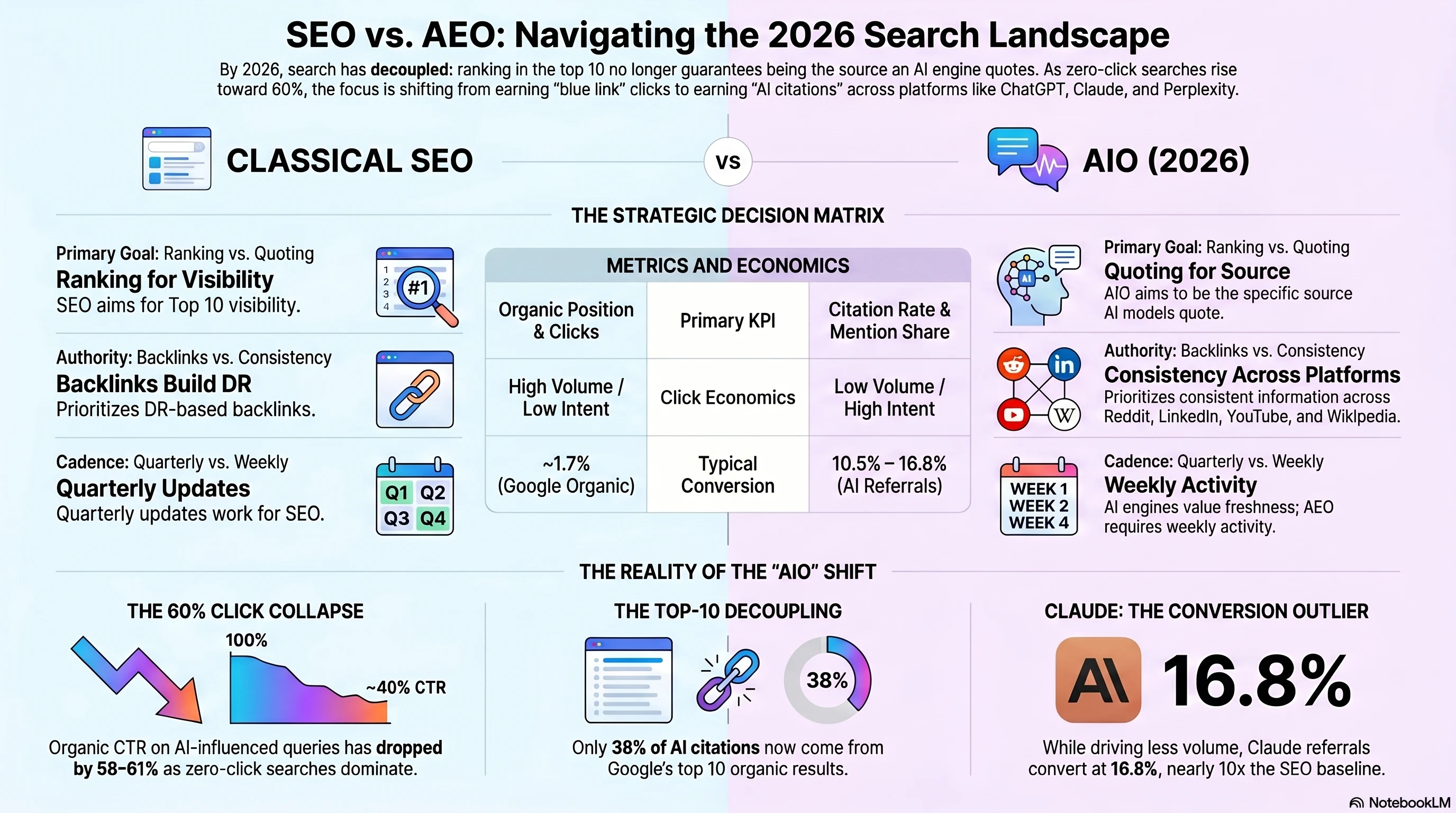
Answer Engine Optimization (AEO) is the practice of structuring your content, schema, and off-site footprint so that AI answer engines — ChatGPT, Perplexity, Claude, Google AI Overviews, Gemini, Bing Copilot — cite, name, or recommend your brand when users ask a question. Traditional SEO tries to rank a page in a list of links. AEO tries to be the source the model quotes inside the answer itself. Same intent, different surface, very different optimisation rules.
The reason AEO needed its own name is not a marketing rebrand. It is a measurable structural change in how people search. eMarketer's 2026 GEO/AEO analysis cites Search Engine Land's reference point that ChatGPT now passes 800 million weekly users and Google Gemini exceeds 750 million monthly users; Reuters confirmed OpenAI alone at 400M weekly active users earlier in the year.[5][7] Semrush's most-cited industry data point now reads: one in ten US internet users turns to generative AI first when they have a question.[7] Three years ago, that number was effectively zero.
The downstream effect on traffic is what makes this AEO's moment, not SEO's:
- Position-1 organic CTR on AIO queries fell 58% in Ahrefs's December 2025 re-run of their 300,000-keyword GSC study — nearly double the 34.5% drop they measured eight months earlier.[1]
- Seer Interactive measured organic CTR down 61% and paid CTR down 68% on AIO queries across 42 brands, 3,119 queries, and 25.1M impressions.[2]
- The zero-click rate climbed from 56% to 69% of all queries between May 2024 and May 2025 (Similarweb).[11] SEOProfy's 2026 update rounds the headline to "around 60% of searches now end without a click."[14]
- Kevin Indig's independent analysis found GSC data is now ~75% incomplete on AIO surfaces — your rank tracker is measuring a shrinking, partly invisible slice of the funnel.[10]
- Discovered Labs tracked the most important AEO-specific statistic of the year: in mid-2025, 76% of AIO citations came from pages in Google's top 10; by early 2026, that fell to 38%. In under a year, AEO citations and SEO rank measurably decoupled.[6]
The metric you used to chase is becoming partly invisible
This is the part that confuses smart marketers: AEO is not a replacement for SEO. SEO is now the necessary middle layer. The bottom of the stack — index, schema, internal links, technical health — still has to be impeccable. The middle layer — top-10 rankings on the queries that still get clicks — still has to be earned. AEO is the new top of the stack, where being the source the AI quotes is the goal, and where the metrics that win are different.
AEO vs SEO: The 12-Point Comparison
What actually changes between the 2015 SEO playbook and the 2026 AEO playbook — and what stays the same.
The temptation in 2026 is to treat AEO and SEO as different teams with different budgets. That's almost always wrong for a small site. The truer framing is that most of classical SEO becomes preconditions, and AEO is the layer that earns the citation. Here are the twelve dimensions where the discipline genuinely shifts:
| Dimension | Classical SEO | AEO (2026) |
|---|---|---|
| Goal | Rank in the top 10 blue links for a target keyword | Be the source the AI quotes (or names) when answering the question |
| Primary KPI | Organic position + organic clicks | Citation rate + mention share + share of voice across engines |
| Page goal | Earn the click | Earn the quote — even if the user never clicks |
| Content shape | Long-form, keyword-clustered, comprehensive | Definition-first lead, scannable blocks, schema, original data |
| Authority signals | Backlinks from high-DR domains | Information consistency across web + Reddit + LinkedIn + YouTube + Wikipedia |
| Schema | Optional — nice-to-have for rich results | Mandatory — FAQPage, HowTo, Article, Author feed LLM grounding |
| Off-site presence | Mostly link-building | Real presence on the platforms AI engines cite (Reddit, YouTube, LinkedIn, Wikipedia) |
| Freshness | Refresh annually | Steady cadence — Microsoft confirmed Gen AIs value fresh content; IndexNow accelerates pickup |
| Measurement tools | GSC, Ahrefs, Semrush rank trackers | Profound, Otterly, Ahrefs Brand Radar, Semrush AI Toolkit, Authoritas Generative |
| Failure mode | Drop in rankings → traffic loss | Excluded from answer → invisible across an entire consideration phase |
| Click economics | Lots of clicks per impression | Few clicks, but higher-intent: Claude 16.8% conversion, ChatGPT ~15%, vs Google ~1.7% |
| Cadence requirement | Quarterly publishing can still work | Weekly publishing minimum — abandoned blogs do not earn citations |
Three rows in that table deserve the most attention because they reshape budget allocation:
Authority signals. Backlinks built the classical SEO economy. They still matter — but Discovered Labs's analysis of Ahrefs data found that in early 2026, only 37.9% of URLs cited inside AIOs also appear in Google's top 10 organic results.[6] The other 62% are pulled through a different retrieval pipeline that weights content structure, information consistency across the web, and entity-level trust. A link-building budget that ignores Reddit, LinkedIn, Wikipedia and YouTube is now mis-allocated, even if the rank tracker still shows progress.
Cadence. Quarterly publishing was workable for SEO. AEO punishes silence faster. Microsoft's Fabrice Canel said it bluntly at SMX Munich 2025: "Gen AIs value fresh content in particular, partly as a reference check of their LLM training data. Use the API at indexnow.org to push that information as it's published or updated." Search Engine Land's coverage of GEO confirms 40–60% of cited sources change month-to-month across Google AI Mode and ChatGPT.[9] If you publish twice a year, the model that quoted you in March may not even know you exist by June.
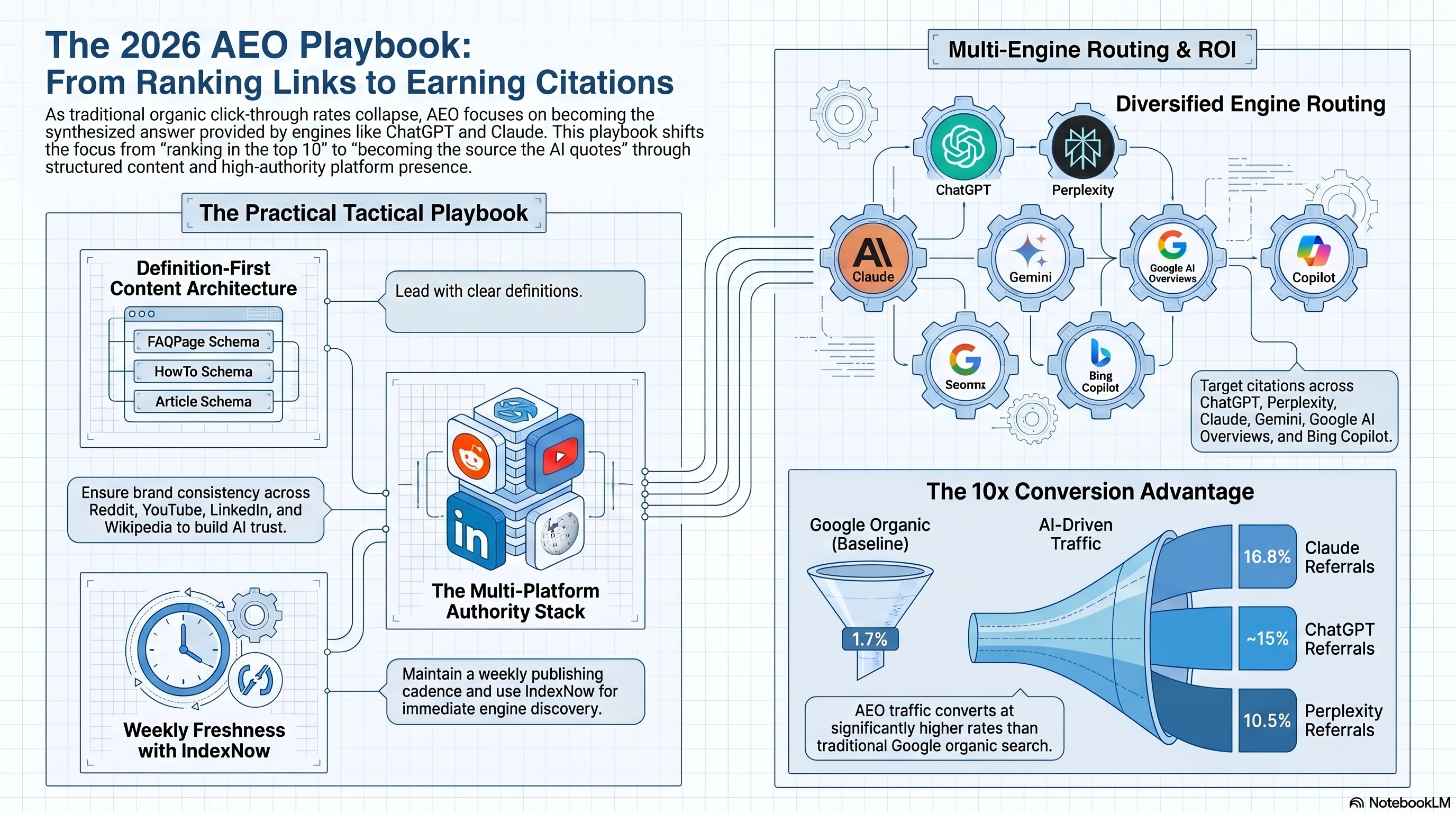
Click economics. The trade for fewer clicks is much higher intent. Digital Bloom's Feb 2026 cross-source analysis put Claude referrals at a 16.8% conversion rate, ChatGPT at 14.2–15.9%, and Perplexity at 10.5% — against a typical Google organic baseline near 1.7%.[8] AEO traffic is a tenth of the volume and an order of magnitude more valuable per visit. The financial case for AEO is built on that ratio, not on raw session counts.
The damage report by dimension (2024–2026)
Six independent measurements of where SEO is leaking pipeline to answer engines
Read together: the click is collapsing, the citation is moving outside the top-10, and the dashboard you use to track it is itself ~75% incomplete on AIO surfaces. AEO measurement requires new tools — not because SEO tools are bad, but because they are increasingly blind to the surface that matters.
How ChatGPT, Perplexity, Claude and Gemini Pick Sources
Each engine has its own retrieval pipeline. The differences matter for where you invest.
An "answer engine" is a stack of three things: an index of the web, a retrieval algorithm that selects passages relevant to the query, and a generative model that composes the answer. Every major engine does this differently, and the differences map directly to which optimisation moves work where.
ChatGPT Search runs its own retrieval stack on top of a hybrid web index (its own crawl plus Bing for parts of the long tail). It rewards content that is structured for passage extraction — short paragraphs with a single claim each, bullet lists, FAQs. The May 7, 2026 product update changed something material: ChatGPT began surfacing clickable brand callouts inside answers rather than relying on footnoted citations. Similarweb's clickstream data measured ChatGPT referrals up 157.7% week-over-week after that change, with homepage referrals up 354.7%.[3] The implication: brand-name SEO and a clean, click-worthy homepage now matter to AEO in a way they didn't six months earlier.
Perplexity is the most citation-friendly engine by design. Every answer carries 4–8 prominent source cards. Perplexity weights authoritative domains, fresh URLs, and original first-party data more heavily than ChatGPT does, which is why niche blogs and Reddit threads regularly show up in Perplexity answers alongside Wikipedia. For a small site, Perplexity is the highest-leverage answer engine to target first: small-site friendliness is structurally built in.
Claude (Anthropic) does not yet ship a consumer search UI in mid-2026, but Anthropic added web search to the API and to the Claude.ai product through 2025. Claude favours long-form, well-reasoned content for research-stage queries. Its referral share grew from 1.4% to 18.5% in eight months (Higoodie Wave 2),[4] driven by an MAU base concentrated in knowledge workers and technical buyers. Claude is the conversion outlier — 16.8% per visit, the highest of any major platform measured.[8]
Google Gemini is two products in one: the standalone chat product (>750M MAU per eMarketer/SEL), and the model that powers Google AI Mode and AI Overviews inside Search itself. The standalone product behaves like a workplace assistant. The integrated surfaces behave like an enhanced SERP — same Google ranking system underneath, but with answer synthesis on top. For AEO, that means whatever wins Google organic + AIO largely wins Gemini.
Bing Copilot / Microsoft 365 Copilot uses the same Bing index ChatGPT does. Microsoft's IndexNow API is the explicit, free, simple way to feed both. Copilot's measurable AI referral share sits near 4% but is materially under-counted in B2B panels because much of it is internal enterprise usage that never hits an external referrer.
B2B AI referral market share — Higoodie Wave 2 (Mar–Apr 2026 avg)
ChatGPT is still #1, but the gap closed dramatically in eight months[4]
Eight months earlier the same panel measured ChatGPT at 89.1%, Claude at 1.4%, Gemini at 2.4%, and Perplexity at 3.1%. The market restructured. "Optimise only for ChatGPT" now covers a third less of measurable AI referrals than it did a year ago — and the displaced share moved to surfaces with fundamentally different citation behaviour.
Per-visit conversion rate by AI referral source (Digital Bloom Feb 2026)
The AEO trade: an order of magnitude fewer visits, an order of magnitude higher intent[8]
Claude's 16.8% conversion rate is the highest of any platform measured despite its 2% raw traffic share. The lesson: AEO ROI is real even when AEO traffic is small. A 10-visit week from Claude can outperform a 100-visit week from generic Google organic on pipeline-attributed revenue.
The New Metrics: Citation Rate, Mention Share, Branded Lift
Rank and clicks were good metrics in 2015. They are partial metrics in 2026.
The AEO metric stack replaces (or rather, supplements) the SEO metric stack with four new measurements. Each one tracks a different part of the consideration funnel that classical analytics misses.
Citation rate. The percentage of priority queries on which your brand is named or cited inside the answer. The standard framing comes from Discovered Labs: "If you track 50 priority queries across ChatGPT, Claude, and Perplexity and your brand appears in 12 of them, your citation rate is 24%." This is the single most important new KPI because it maps to pipeline exposure: it counts the times a buyer evaluating your category was told you exist. Track it weekly, broken out by engine.
Mention share / share of voice. Within the queries that mention any brand in your category, what fraction mention your brand? This is the AEO analogue of market share — and it's competitive in a way citation rate isn't. A 100% citation rate against a competitor that always appears alongside you is mention share of 50%, not 100%. Profound, Otterly, Ahrefs Brand Radar, Semrush AI Toolkit, and Authoritas Generative all surface this.
Branded query lift. The increase in Google searches for your brand name itself, as AI answers exposed more buyers to you. This is the leading indicator that AEO is working before any direct AI traffic shows up in GA4: an AEO-cited brand often sees branded searches rise weeks before AI-referral sessions become measurable. GSC's branded-query filter, combined with Google Trends, is your free version of this.
AI-referral conversion rate. Per-engine conversion rate of the AI referral traffic you do get, tagged with UTM parameters or referrer matching on `chatgpt.com`, `perplexity.ai`, `claude.ai`, etc. This is the ROI proof point — and the easiest metric to underestimate if you only look at sessions.
Why the old metrics keep underselling AEO
The 8-Engine Routing Matrix
Each engine rewards a different content shape. Optimise for the ones your buyers actually use.
"Optimise for AI" is too coarse a directive to act on. The eight surfaces below each have a distinct user base, ranking logic, and citation pattern. For most small sites, you will earn the highest ROI by concentrating on 2–3 of them rather than spreading thin.
AI engines to optimize for
| Engine | Audience | What it rewards | Small-site angle |
|---|---|---|---|
| Google AI Overviews | ~2B monthly users; on ~48% of tracked queries (BrightEdge Feb 2026) | Top-10 organic presence + schema + definition-first blocks + freshness via IndexNow | Largest surface by volume. Comparison queries (95% AIO trigger) are the highest-leverage carveout for citation. |
| Google AI Mode | 75M+ US users (Alphabet Q4 2025) | Longer, multi-step answers; queries are ~3× longer than classic Google search | Favours genuinely deep how-to / step-by-step content over thin listicles. |
| ChatGPT Search | ~900M weekly activities (OpenAI). 62.6% of measurable B2B AI referrals | Bing index + ChatGPT's retrieval stack. Bullet points, FAQs, brand-name clarity | May 7 2026 update: ChatGPT now shows clickable brand callouts inside answers. Brand-name SEO matters again. |
| Perplexity | ~7.3% of B2B AI referrals. Punches above its weight on shopping + research | Citation-first by product design. Original data, authoritative sources, fresh URLs | Highest small-site friendliness — lists 4–8 sources per answer, surfaces Reddit and niche blogs. |
| Claude (Anthropic) | ~30M consumer MAU; 18.5% of B2B AI referrals (up from 1.4% in 8 months) | Long-form, well-reasoned content. Skews toward research-stage queries | Conversion outlier — 16.8% conversion rate is highest of any platform per Digital Bloom 2026. |
| Microsoft Copilot / Bing | ~4% of measurable AI referrals; large enterprise base via M365 | Same Bing index as ChatGPT; IndexNow is the explicit freshness API | IndexNow is free, simple, and powers half the answer-engine stack. |
| Google Gemini (standalone) | Grew ~9× Sep 2024–Mar 2026 (Similarweb). ~10.6% of B2B AI referrals | Workplace-assistant style. Quotes Google index aggressively | Whatever wins Google organic + AIO largely wins Gemini. |
| Grok / xAI / DeepSeek | Long tail. Visibility metrics still maturing | Mixed retrieval; Grok skews social-media signal | Not a 2026 priority for most small sites. Revisit late 2026. |
The pragmatic conclusion for a single-person small site: pick Google AI Overviews (because volume), Perplexity (because small-site friendliness and citation-first product design), and one of ChatGPT or Claude depending on whether your buyer is consumer or technical/B2B. That's three surfaces, all of which respond to the same underlying AEO tactics, with slightly different content shapes layered on top.
Where AI answer engines pull citations from (cross-engine, 2026)
YouTube, Wikipedia, Reddit and LinkedIn dominate. None require classical domain authority[9]
The structural opportunity: the platforms answer engines cite most are the ones small creators can actually compete on. YouTube and Reddit have no domain-authority barrier. A genuine niche YouTube channel and a real subreddit presence beat a backlink-heavy SEO campaign for AEO citation share in most non-YMYL verticals.
The 10-Point AEO Playbook
What the industry has converged on — sorted by difficulty so you can ship the easy ones this week.
The ten tactics below appear repeatedly across Frase, Jasper, Amsive, SEOProfy, Discovered Labs, Search Engine Land, Search Engine Journal, and Semrush coverage through 2025–2026. They are not exotic. They are the boring blocking-and-tackling of an AEO-shaped publication. Sorted here by execution difficulty so you can sequence them sensibly.
| Tactic | Why it works | Difficulty |
|---|---|---|
| Definition-first paragraph (40–60 words, exact question phrasing) | ChatGPT, Perplexity, and Google AIO lift these blocks nearly verbatim — same shape as a featured snippet. Lead with the answer. | Easy |
| Structured listicles, tables, FAQ blocks | Semrush + Surfer SEO data: AIOs pull heavily from <ul>, <ol>, <table>, and FAQ markup — not from styled divs or marketing copy. | Easy |
| Schema markup (Article, FAQPage, HowTo, Product, Author) | Microsoft confirmed schema feeds LLM grounding at SMX Munich 2025. Search Engine Land's controlled test correlated schema with AIO inclusion. | Easy |
| Submit to IndexNow on every publish/update | Powers Bing, Yandex, Naver, Seznam — and feeds the LLMs that ground on those indexes. Fresh content is one of the few cross-engine AEO levers. | Easy |
| Original first-party data, methodology, benchmarks | AI models prefer 'unique fact you can't find elsewhere' to reduce redundancy. A short methodology paragraph helps the model cite confidently. | Medium |
| Comparison content (X vs Y) with side-by-side tables | Seer measured 95.4% AIO trigger on comparison queries. Cited brands earn +35% organic / +91% paid clicks vs uncited. | Medium |
| Information consistency across the web | LLMs ground partly by cross-checking facts across sources. Same product name, same pricing, same description on your site, Wikipedia, LinkedIn, G2, Reddit. | Medium |
| Real bylined authors with bio, credentials, sameAs links | E-E-A-T turned to 11. Author entity schema with LinkedIn/ORCID makes the byline machine-verifiable for grounding. | Medium |
| Genuine presence on Reddit, YouTube, Wikipedia, LinkedIn | YouTube 23.3% of all AIO citations; Reddit top-5 in non-YMYL verticals. These are the platforms small creators can actually compete on. | Hard |
| Steady publishing cadence (≥1–2 quality pieces/week) | Freshness signals matter to AIO inclusion (Microsoft, confirmed). Abandoned blogs lose citation share fast — typical decay is visible inside 60 days. | Hard |
The three tactics that move the needle first
1. Rewrite your top five article leads as definition-first paragraphs. Forty to sixty words. Use the exact question phrasing as the H2 directly above. Strip every "in this article we will…" opener you have. ChatGPT, Perplexity, Claude, and Google AIO all lift this block, often nearly verbatim. Frase's 2026 AEO guide is unambiguous on this: outdated statistics, vague openers, and "discontinued product references" reduce citation probability.[13] Lead with the answer.
2. Add Article + FAQPage + Author schema sitewide. Microsoft's Fabrice Canel confirmed schema feeds Bing/Copilot's LLMs at SMX Munich 2025. Search Engine Land's controlled three-page A/B found only the well-schema'd version surfaced in an AI Overview. Author entity schema with sameAs links to LinkedIn / Twitter / ORCID makes the byline machine-verifiable — which directly maps to E-E-A-T at the moment grounding happens. (See our schema markup for small businesses guide for the JSON-LD blocks you can ship in 30 minutes.)
3. Ship two "X vs Y" comparisons per month, with original data. Comparison queries trigger AIOs 95.4% of the time. Cited brands earn +35% organic and +91% paid clicks vs uncited brands on the same SERP. Side-by-side tables, an honest "who should choose which" paragraph, an embedded original benchmark. The format is plain. The payoff is enormous, and it works on Google AIO, Perplexity, ChatGPT and Claude simultaneously.
Measurement & Tooling in 2026
The new tool stack — and the GSC blind spot you can't fix.
Classical SEO measurement is comprehensively broken on AIO surfaces. Indig's analysis is the most-cited number in the industry: GSC is ~75% incomplete on queries that trigger AIOs.[10] AIO impressions are reported opaquely, AIO click attribution is incomplete, and the AIO position itself isn't a stable rank. You cannot fix this with GSC. You need a separate AEO measurement layer.
The tool stack the industry has converged on, roughly in order of accessibility:
- Ahrefs SERP Feature filters + Brand Radar — filter for "AI Overview" presence per keyword; Brand Radar tracks mention share across AI surfaces. Available in mainstream Ahrefs plans.
- Semrush AI Toolkit — AI Overview tracker with prevalence and citation breakdowns. Same usability model as classical Semrush.
- Profound — purpose-built AEO platform measuring citation rate and share of voice across ChatGPT, Claude, Perplexity and Gemini for a set of priority queries you define. Enterprise pricing.
- Otterly.ai — lighter-weight AI visibility tracker; good entry point for solo operators and small marketing teams.
- Authoritas Generative AI — enterprise rank tracker with AIO penetration filters; their AIO publisher CTR research underpins much of the UK CMA complaint data.
- GA4 with explicit referrer matching on
chatgpt.com,perplexity.ai,claude.ai,gemini.google.com,copilot.microsoft.com— free, immediate, captures the AI referral conversion rate that justifies the budget.
The cleanest way to make AEO investment defensible internally is to compare per-visit conversion rate from AI referrals to per-visit conversion rate from Google organic. Digital Bloom's cross-source 2026 averages put the gap at roughly 10× — Claude 16.8%, ChatGPT ~15%, Perplexity 10.5%, Gemini ~5.6% vs Google organic baseline near 1.7%.[8]
In GA4, create a custom referral source group:
- Admin → Data display → Channel groups → Custom group: "AI Engines"
- Source contains:
chatgpt.com,chat.openai.com,perplexity.ai,claude.ai,gemini.google.com,copilot.microsoft.com,bing.com/chat,you.com,phind.com - Build an "AI Engines" report under Acquisition with conversion rate as the primary metric.
In 60 days you'll have a defensible ROI line: per-visit revenue from AI engines vs Google organic. In most B2B SaaS implementations the AI multiple is 8–20×. In e-commerce it's a more modest 2–4×. Either way, the conversation with the budget owner stops being "AI traffic is too small to matter" and starts being "per-visit value justifies a dedicated AEO budget."
The Realistic Small-Site Roadmap
Week 1 to month 6 — what one person, no team, no budget can actually ship.
The playbook above is comprehensive. If you treat it as a to-do list, you will not finish. Here is the sequencing that single-person sites are actually shipping successfully in 2026:
| Phase | Time | What you're doing |
|---|---|---|
| 1. AEO foundations | Week 1 | Add Article + Organization + FAQPage + Author schema sitewide. Rewrite the lead paragraphs of your top 5 posts as 40–60 word definition answers. Set up IndexNow. Build the GA4 "AI Engines" channel group above. |
| 2. Comparison content | Weeks 2–4 | Ship three "X vs Y" comparisons targeting your category's most-asked competitive queries. Tables, original data, "who should choose which" paragraphs. These are the highest-leverage AEO assets you can ship. |
| 3. Citation tracking | Week 4 onward | Pick 30–50 priority queries. Manually log each Friday: how many ChatGPT/Perplexity/Claude/Google AIO answers cite or mention your brand? That's your weekly citation rate. Compare across 8 weeks before declaring anything. |
| 4. Off-Google presence | Months 2–3 | Genuine participation on the two platforms your vertical's AIOs cite most. For most B2B, that is LinkedIn + Reddit. For consumer / lifestyle, it is YouTube + Reddit. For finance, it is LinkedIn + YouTube. Not promotional drops — real, helpful answers. |
| 5. Original data | Month 3 | Ship one piece of original first-party research per quarter — a 200-respondent survey, a methodology piece, a benchmark you can defend. AI engines preferentially cite the source nobody else has. |
| 6. Cadence | Months 4–6 | Publish 1–2 well-structured pieces per week. Microsoft confirmed freshness signals matter; Search Engine Land confirmed 40–60% of cited sources rotate monthly. Silence costs citations. |
| 7. Tooling upgrade | Month 6 | If citation rate trend is positive over 90 days, graduate from manual logging to Profound / Otterly / Ahrefs Brand Radar. Now you have a defensible business case to do so. |
The hidden lever: branded-query SEO is back
your-brand vs competitor queries. Own the "your-brand pricing" / "your-brand reviews" SERP. As answer engines surface more brand callouts directly, the buyers who do click need to find a clean, fast homepage and a clear product page — not a content-stuffed landing page. AEO is partly a return to brand SEO basics.Where News Factory fits the AEO playbook
Whatever tooling you use to keep the editorial flywheel turning — in-house writer, freelancer pool, an AI-assisted system like News Factory, or some hybrid — the strategic conclusion of this article holds. The shift from SEO to AEO is not a tactical pivot. It is the consideration phase moving upstream of the click. Optimise for the answer, measure citation share, build genuine presence on the platforms answer engines cite, and treat the click as a downstream consequence rather than the goal itself.
→ Do this now: Pick three articles on your site. Rewrite each lead paragraph as a 40–60 word definition-first answer using the exact question phrasing as the H2 above. Add Article + FAQPage schema. Submit to IndexNow. Set up the GA4 "AI Engines" channel group from the Measurement section. That is tonight's work — and it puts you ahead of the small minority of small sites that have actually done the AEO basics in 2026. The rest of the playbook follows from there.
Related reading
- AI Overviews & SGE: How Small Sites Can Still Win Clicks in 2026 — the Google-AIO-specific damage report and the comparison-query carveout.
- Schema Markup for Small Businesses — the JSON-LD blocks (Article, FAQPage, LocalBusiness, Product, Author) that feed answer-engine grounding.
- Topical Authority: Why Publishing More (Good) Content Wins SEO — the editorial cadence problem AEO inherits from SEO.
- GA4 + Search Console for Small Businesses — measurement context for the AI-referral channel group above.