The New SERP: What AI Overviews Did to the Click
Two years in, the numbers are bad — but they're not uniformly bad, and the gaps are where small sites can still win.
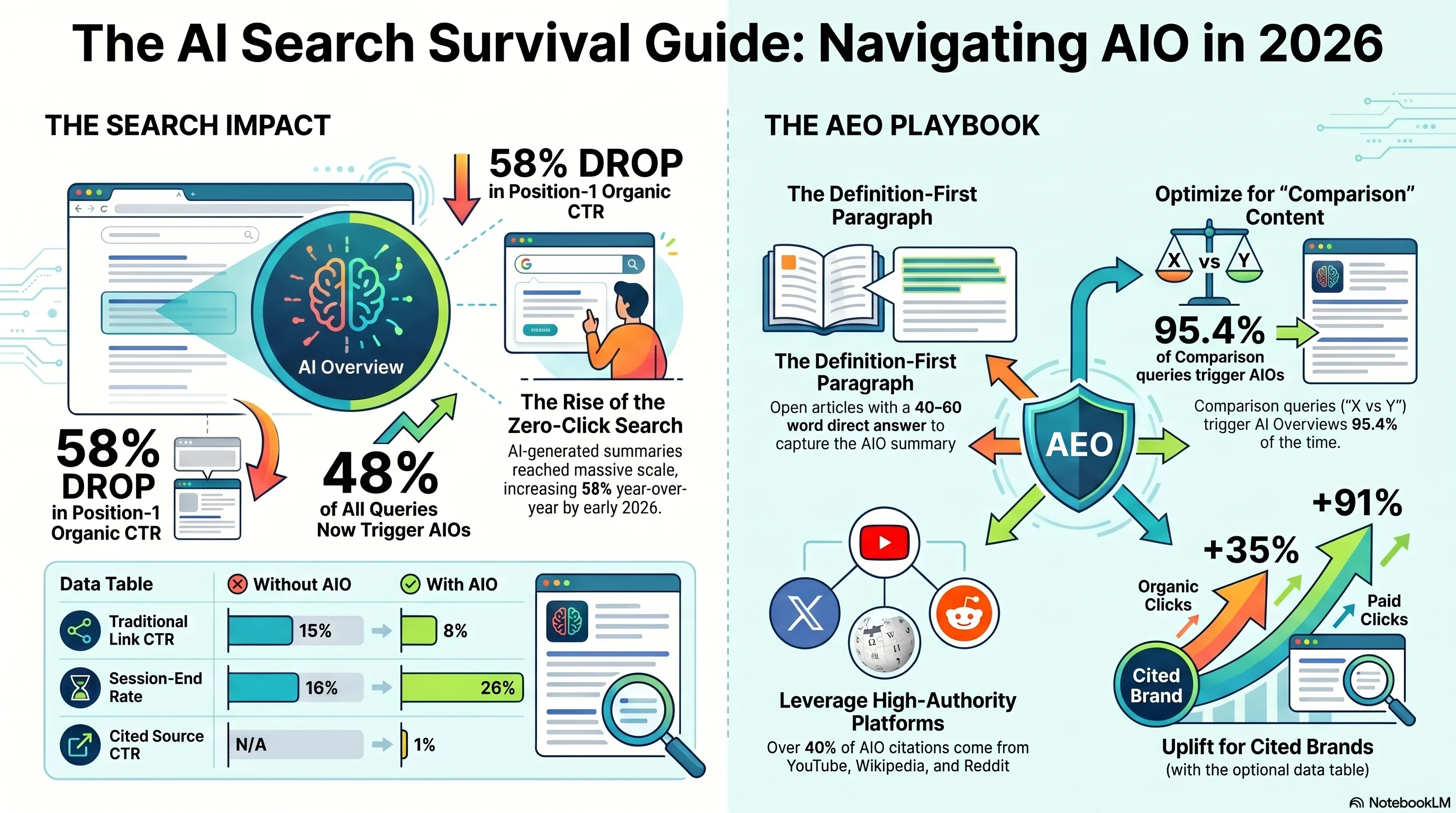
It has been two years since Google rolled AI Overviews (the rebranded successor to Search Generative Experience, "SGE") out to all U.S. users in May 2024. The headline change is structural: a Gemini-powered summary now sits above the traditional ten blue links on a large and growing share of queries, often pushing the first organic result below the fold even on desktop. According to BrightEdge's Generative Parser, AIOs now appear on roughly 48% of tracked queries as of February 2026, up from about 31% a year earlier — a ~58% year-over-year increase in coverage.[14]
The independent click data is unambiguous, and across four separate studies it tells the same story. Ahrefs re-ran its 300,000-keyword Google Search Console study in December 2025 and found position-1 organic CTR for AIO queries had fallen by 58% — nearly double the 34.5% drop they measured in April 2025.[1][13] Seer Interactive's long-running panel of 3,119 queries across 42 brands recorded a 61% organic CTR drop and a 68% paid CTR drop on AIO queries between June 2024 and September 2025.[3] Pew Research's March 2025 behavioural study tracked 900 U.S. adults across 68,879 real searches and found users who saw an AI summary clicked a traditional link 8% of the time vs 15% without one — a 46.7% relative drop — and clicked the AIO's own cited sources just 1% of the time.[4] And Authoritas, measuring 3,500 UK news terms, recorded −47.5% desktop and −37.7% mobile CTR loss for publishers; their data was filed as evidence in a UK CMA complaint.[8]
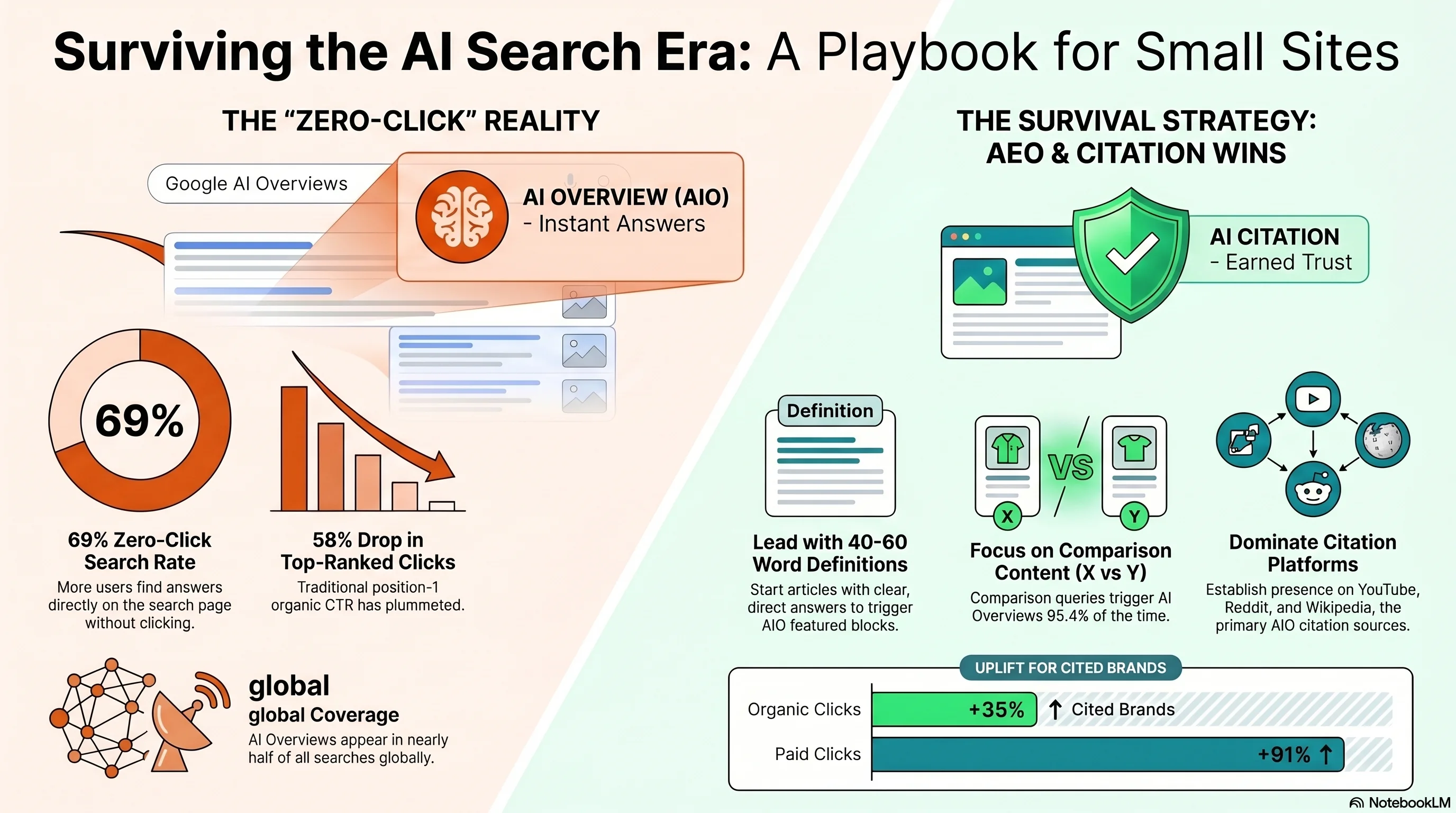
Add Similarweb's zero-click rate climbing from 56% to 69% of all queries between May 2024 and May 2025,[10] and Kevin Indig's GSC analysis suggesting GSC data is now ~75% incomplete because Google reports impressions opaquely on AIO surfaces,[11] and the picture for publishers is clear: the SERP got bigger, the AI summary at the top now answers most informational questions in-place, and the share of users who scroll past it to click an organic link has collapsed.
One number puts the rest in context
But the story has a second half that is much less covered, and it is the entire reason this article exists. There are five real opportunities buried in the same data:
- Citation matters far more than rank now. Seer found that brands cited inside the AIO box earn +35% organic and +91% paid clicks vs uncited brands on the same query.[3] The visibility there is more valuable than the rank below.
- The retreat is real. Semrush's 10M-keyword index measured AIO prevalence rising to 24.6% in July 2025, then falling back to 15.7% by November as Google pulled AIOs off commercial and navigational queries that monetised poorly.[2] BrightEdge's higher number reflects a different sampling frame; the real number is somewhere between, and parts of it are negotiable.
- The rebound has started. Seer's February 2026 update — covering 53 brands and 5.47 million queries — found organic CTR on AIO queries climbing from a 1.3% floor in December 2025 to 2.4% by February 2026, an 85% relative jump in two months. Still well below the June 2024 baseline of 1.76%, but the first sustained reversal anyone has measured.
- The platforms AIOs cite are the same platforms small creators can actually compete on. YouTube (23.3% of all citations), Reddit (top-5 in most non-YMYL verticals), LinkedIn for B2B, Wikipedia. None of these require domain authority in the classical sense.[14]
- The comparison-query carveout is enormous. Seer measured a 95.4% AIO trigger rate on "X vs Y" queries — and these are exactly the queries where being cited inside the AIO is worth +35% clicks. "Best for {job}" and "X vs Y" content, done with original data, is the single most tractable path to AIO citation a small site has.
The rest of this article is the realistic playbook that comes out of those five openings. We will go through the damage numbers in more detail, the query types and verticals that trigger AIOs (so you know where to fight and where to retreat), the citation patterns (so you know which platforms to invest in), and the eleven-point AEO/GEO playbook the industry has converged on. Then we'll be honest about ChatGPT and Perplexity — they are, in 2026, still a rounding error for referral traffic — and finish with a roadmap a single-person small site can actually execute.
By the Numbers: The 2024–2026 Damage Report
Five independent datasets, one direction — but the rebound has started.
The numbers below come from five different methodologies — Google Search Console data (Ahrefs, Indig), brand panels (Seer), real-user browser tracking (Pew), enterprise rank trackers (Authoritas, BrightEdge), and competitive keyword indices (Semrush). They disagree on the absolute prevalence number, but every single one points the same direction on click impact.
Click-through collapse: every position, every measurement
Independent studies, 2024–2026 — paid hit hardest, organic close behind, even non-AIO queries drifting down[1][3][4][8]
The Seer paid number (−68%) is the worst single measurement in the field — paid CTR fell from 19.7% to 6.34% on AIO queries. Even non-AIO query CTR fell 41%, suggesting users are drifting to ChatGPT, Perplexity, and social platforms even when Google doesn't insert an AIO.
The disagreement on prevalence is not noise — it's intent shift
BrightEdge says 48% of tracked queries; Semrush says 15.7% of a 10-million-keyword index. The gap is real and instructive. BrightEdge weights toward higher-intent, mid-funnel queries enterprise SEOs care about; Semrush's index is a much broader pool that includes the long-tail navigational and commercial queries Google has been quietly pulling AIOs from since mid-2025.[2] The Semrush data shows the shift clearly:
| Intent type | Share of AIO triggers, Jan 2025 | Share of AIO triggers, Oct 2025 |
|---|---|---|
| Informational | 91.3% | 57.1% |
| Commercial | 8.15% | 18.57% |
| Transactional | 1.98% | 13.94% |
| Navigational | 0.84% | 10.33% |
Informational queries — the bulk of long-tail blog content — became a smaller share of the AIO pie not because they triggered AIOs less but because commercial, transactional, and navigational queries triggered AIOs more. The threat is now broader and harder to dodge with niche selection alone.
The 8.64% nobody talks about
Ahrefs's July 2025 follow-up found that 8.64% of AI Overviews appear outside the top organic position.[12] Restated: in roughly 1-in-12 SERPs with an AIO, the AI summary sits below at least one organic result. For small sites that already rank well, this matters — the AIO push-down is not absolute, and the position you held before the AIO appeared still does work, even if the visible window shrunk. It also complicates rank-based forecasting: a rank-4 result that sits above an AIO can outperform a rank-2 result whose AIO consumed the entire visible viewport.
Tying these threads together gives a more honest framing than the dominant "AIOs killed SEO" narrative. AIOs reduced clicks dramatically on the informational queries that powered most blog traffic. They redistributed visibility from organic position to AIO citation. They are simultaneously expanding (more verticals, more query types) and retreating (fewer commercial queries) in different parts of the index. And the platforms users now consult — increasingly ChatGPT for research, Reddit for opinions, YouTube for tutorials — are accessible to small creators in ways that Google's domain-authority game often wasn't.
What Triggers an AI Overview
Pick your battles. Some query types trigger AIOs 95% of the time; some barely at all.
Before deciding which keywords to chase in 2026, look at which query shapes trigger AIOs. The most useful single dataset here is Seer Interactive's analysis of 49,353 queries by format and intent, supplemented by Semrush's 10M-keyword index for vertical breakdowns and BrightEdge's industry-category data.
AIO trigger rate by query format (Seer, 49,353 queries)
Comparison queries are the most AIO-saturated surface — and the highest-payoff target for citation strategy
The 95.4% comparison-query trigger rate is the single most actionable number in this article. If you write "X vs Y" content with real first-party data, you can almost guarantee an AIO appears — and being cited inside it is worth +35% organic clicks vs being uncited on the same SERP.[3]
AIO prevalence by industry vertical (BrightEdge, 2026)
Healthcare and education are almost universal AIO surfaces; real estate, shopping and arts are mostly untouched
Healthcare 88% / Education 83% / Enterprise tech 82% are AIO-saturated to the point that an uncited site essentially competes for scraps. Real Estate / Shopping / Arts & Entertainment under 3% (Semrush) are the verticals where classical SEO still works almost untouched.
Two structural facts come out of the keyword-level analysis that small sites should know:
- ~60% of AIO-triggering keywords have ≤100 monthly searches (Semrush).[2] The long-tail bias persists — AIOs are not just on big head terms.
- ~60% sit in the 21–60 Keyword Difficulty band. Not the highest-competition keywords; the messy middle. This is where AIOs are dense and where small sites have historically had a chance.
And the YMYL note matters because it's where Google's algorithmic restraint can be exploited:
Hard news is explicitly suppressed — and that's an opening for small sites with analysis
Practical translation: small sites should systematically prefer the edges of the AIO map. Either go where AIOs barely show up (real estate, shopping, arts, much of e-commerce, local "near-me" with strong local-pack), or go all-in on the AIO carveouts where citation is the win — comparison content, original-data pieces, and niche long-tail expertise.
Who Gets Cited (And Who Doesn't)
Three numbers structure the entire small-site strategy — and one of them is fixable.
If clicks are down 58% on position 1, the only honest follow-up question is: what's worth chasing instead? The answer, from every dataset that breaks AIO citations down by source, is the same. There are five-to-eight platforms that absorb most AIO citations — and three numbers that tell you exactly which ones a small site can actually compete on.
AIO citation source mix across all verticals (Surfer SEO, 46M citations)
YouTube, Wikipedia, and Google's own properties dominate; Reddit and LinkedIn are the openings small creators can actually exploit[14]
.gov domains appear 3× more often in AIO sources than in standard SERPs (6% vs 2% per Pew Research). YouTube's 23.3% share is a creator-economy fact, not a media-conglomerate one — individual channels with thousands of subscribers regularly appear in AIO citations alongside the New York Times.
Citation patterns are vertical-specific — pick your fight
| Vertical | Top AIO citation sources | Small-site opening |
|---|---|---|
| Health | NIH 39%, Healthline 15%, Mayo Clinic 14.8% | Brutal. .gov + authority hubs absorb almost every citation. Niche health blogs need a topic the big sources don't cover — rare conditions, lived experience, novel protocols. |
| Gaming | YouTube 93%, Reddit 78% | UGC-dominated. Build a YouTube channel and seed Reddit answers in your real subreddit — text-only fan sites are mostly shut out. |
| Finance | YouTube 23%, Wikipedia 7.3%, LinkedIn 6.8%, Investopedia 5.7% | Most fragmented major vertical. An independent finance blog with original analysis can absolutely earn citations alongside Investopedia. |
| News | Mainstream publishers + Google's own YouTube | Hard. Hard news is explicitly suppressed by Google on AIO; older news triggers AIO at 30%. Local angle and analysis beat breaking-news chase. |
| B2B SaaS | LinkedIn, vendor docs, comparison sites (G2, Capterra) | Strong opening. Comparison content, integration pages, and original product benchmarks are exactly what AIOs cite — and competitors rarely ship enough. |
| Local services | Google Maps + LocalBusiness schema + review aggregators | AIO trigger rate is lower for true "near me" intent. Local SEO fundamentals still win. |
The organic ↔ AIO citation overlap is the metric that actually predicts success
BrightEdge's analysis tracks how often a domain that ranks in the organic top 10 is also cited inside the AIO on the same query. The cross-vertical average sits around 17% in the top-10 — a 1-in-6 hit rate — but it varies wildly. Insurance shows a 63% overlap (a top-10 organic rank is roughly a coin-flip for AIO citation). Entertainment jumped from 3.2% to 18.5% in a single year (+15.3 pp). E-commerce moved only 0.6 percentage points. At the top-100 level, the overall overlap rose from 32.3% (Feb 2025) to 54.5% (early 2026) — a +22.3 pp swing in one year.[14]
What this means in practice: classical SEO ranking is now necessary but not sufficient. Get into the top 10 — that's still table stakes. But also do the things that earn citation specifically: schema markup, definition-first paragraphs, original first-party data, comparison content. And work the platforms — Reddit, YouTube, LinkedIn — that absorb the remaining citations.
The single most actionable line in this article
The AEO / GEO Playbook for Small Sites
Eleven tactics the industry has converged on — sorted by difficulty so you can ship the easy ones this week.
The terms AEO (Answer Engine Optimization) and GEO (Generative Engine Optimization) have become standard in the SEO trade press through 2025. They describe the same shift in different words: optimising not to be the page Google ranks first, but to be the source an AI model quotes. The eleven tactics below appear repeatedly across Semrush, Ahrefs, Search Engine Journal, Search Engine Land, and Backlinko coverage — sorted here by execution difficulty so you can prioritise.
| Tactic | Why it works | Difficulty |
|---|---|---|
| Definition-first paragraph (40–60 words, exact question phrasing) | AIOs lift these blocks verbatim — the same shape as a featured snippet. Lead with the answer. | Easy |
| Structured listicles + scannable HTML | Semrush data shows AIOs pull heavily from <ul>, <ol>, and <table> markup, not from styled divs. | Easy |
| Schema markup (Article, FAQPage, HowTo, Product) | Microsoft confirmed schema feeds LLM understanding; Search Engine Land's controlled test correlated it with AIO inclusion. | Easy |
| Original first-party data and methodology | AIOs prefer 'unique fact you can't find elsewhere' to reduce redundancy. A short methodology paragraph helps the model cite confidently. | Medium |
| Comparison ("X vs Y") content with side-by-side tables | Seer measured a 95.4% AIO trigger rate on comparison queries — the single most reliable surface. | Medium |
| Real bylined authors with bio, credentials, sameAs links | E-E-A-T turned to 11. Author entity schema with LinkedIn/ORCID makes the byline machine-verifiable. | Medium |
| Long-tail, deep-intent, firsthand-experience queries | 60% of AIO keywords already have ≤100 monthly searches (Semrush), but AIOs are weakest where firsthand expertise is required. | Medium |
| Branded search defense (PR, podcasts, newsletter, YouTube) | Cited brands earn +35% organic / +91% paid clicks vs uncited (Seer). Branded queries also resist AIO best. | Hard |
| Be on the platforms AIOs cite (Reddit, YouTube, Wikipedia, LinkedIn) | YouTube 23.3%, Wikipedia 18.4%, Reddit top-5 in most non-YMYL verticals. Real, useful presence — not link drops. | Hard |
| Track AIO citation share, not just rank | Aja Frost (Semrush) on SEL: success metrics are shifting from clicks/traffic to visibility and share of voice. | Medium |
| Diversify off Google (email, RSS, podcasts, newsletter) | The only fully AIO-proof channel. Publishers who diversified before 2024 are weathering the decline. | Hard |
The four tactics that matter most for a small site this quarter
1. The definition-first paragraph. Open every article with a 40–60 word, direct answer to the title question, using the exact question phrasing as an H2 above it. Treat it like the body copy of a featured snippet — because that is, in effect, what an AIO is. Semrush's analysis of AIO citation surface area found these blocks lifted nearly verbatim into Google's synthesised summary. No throat-clearing intros, no "in this article we will explore." Lead with the answer.
2. Schema markup, especially Article and FAQPage with author entities. Microsoft's Fabrice Canel confirmed publicly at SMX Munich 2025 that schema feeds Bing/Copilot's LLMs ("Gen AIs value fresh content in particular… Use the API at indexnow.org to push that information as it's published or updated"). Search Engine Land's three-page controlled experiment found that only the well-schema'd page surfaced in an AI Overview. FAQPage is the highest-leverage form: Q/A pairs are already shaped the way an AI grounding pipeline wants them. (See our schema markup guide for small businesses for the JSON-LD blocks that ship in 30 minutes.)
3. Comparison and "X vs Y" content with real first-party data. 95.4% trigger rate; +35% organic clicks for cited brands; structured tables are LLM-friendly. If you write nothing else this quarter, write three high-quality "{your category} vs {competitor}" comparisons with side-by-side feature tables, an honest "who should choose which" paragraph, and an embedded original benchmark or chart. The format is dull. The payoff is enormous.
4. Show up on Reddit and YouTube as a real participant. Reddit appears in the top-5 citation sources for most non-YMYL verticals; YouTube absorbs 23.3% of all AIO citations across the index. Neither requires Google domain authority. Neither is "spam linking" — Reddit's spam filters and community moderation kill that within hours. But a genuine subreddit presence and a YouTube channel that actually answers your niche's questions are the two channels small sites can build that classical SEO never gave them access to.
Classical SEO vs AEO/GEO: what actually changes
| Dimension | Classical SEO (pre-2024) | AEO / GEO (2026) |
|---|---|---|
| Primary KPI | Organic rank + organic clicks | AIO citation share + brand mentions + share of voice |
| Page goal | Earn the click | Be the source the model quotes (even if the user never clicks) |
| Content shape | Long-form, keyword-clustered, comprehensive | Definition-first, scannable, structured, with original data |
| Schema strategy | Optional; nice-to-have for rich results | Mandatory; FAQPage / HowTo / Article / Author are LLM grounding fuel |
| Off-site signals | Backlinks from authority domains | Real presence on Reddit, YouTube, Wikipedia, LinkedIn — the platforms AIOs cite |
| Measurement tools | GSC, Ahrefs, Semrush rank trackers | Ahrefs/Semrush AIO filters, Authoritas, Profound, BrightEdge Generative Parser |
| Cadence | Publish to claim a keyword, then refresh annually | Steady fresh content — "Gen AIs value fresh content in particular" (Microsoft, SMX 2025) |
HouseFresh is an independent air-purifier review site whose February 2024 essay "How Google is killing independent sites like ours" became the canonical case study of the AIO-and-HCU squeeze on small publishers.[9]
They documented being pushed out of top-10 product-review results not by competing reviewers but by mainstream brands — BuzzFeed, Rolling Stone, Forbes, Popular Science, Better Homes & Gardens — who write product roundups without ever testing the products. The HouseFresh team actually buys, tests, and measures every air purifier they review. The aggregators do not. Google's product-review-update wins for HouseFresh did not translate into traffic recovery; by 2025 the team reported needing to pivot to YouTube and email to survive.
The lesson is the bleak version of point #4 in the playbook above. For verticals where the AIO + brand-authority squeeze is structural (product reviews, hands-on testing, anything where domain rating beats subject-matter expertise in Google's eyes), the only durable strategy is to own the distribution. Email lists. YouTube subscribers. A real community. The thing that survived the 2024 squeeze for HouseFresh was their direct audience, not their organic rankings.
For the 2026 small site reading this: assume some version of the HouseFresh squeeze is coming for your niche too, and start building the off-Google channels now, not after the next algorithm update.
ChatGPT, Perplexity, Claude: Real Traffic or Hype?
The honest 2026 referral numbers — and why they matter anyway.
Every SEO conference, podcast, and trade publication in 2025 spent half its airtime on AI search engines. The realistic referral picture in 2026 is much smaller than the airtime suggested:
- ChatGPT Search (general availability since Nov 2024): 0.02% of publisher referral traffic — one click per 5,000 from Google.[10]
- Perplexity: 0.002% of publisher referrals — one click per 50,000 from Google.[10]
- Google AI Mode: 75M users by December 2025 (Alphabet Q4 2025 earnings); queries are 3× longer than traditional Google searches; ~1 in 6 use voice or image input. This is the channel that will matter at scale.
- Bing Copilot: continues to lag Google's overall query share (<5%). Mature AI integration; small traffic driver.
- Claude.ai: no consumer search UI as of mid-2026. Web search exists via API but no ChatGPT-Search-equivalent product.
The honest summary: ChatGPT, Perplexity, and Claude collectively deliver well under 0.1% of publisher referrals in 2026. They matter for brand visibility in AI answers, not for clicks. The Google AI Overview is still the only AI surface that meaningfully moves traffic — and it moves it down.
So why bother with AEO for the alt-engines? Three reasons. First, ChatGPT search referral share grew from essentially zero to 0.02% in fifteen months — the trajectory matters more than the absolute number. Second, Perplexity is disproportionately small-site-friendly: it lists 4–8 sources per answer prominently, cites Reddit and niche blogs more than ChatGPT does, and several B2B SaaS case studies (cited in Profound's deck) report higher per-visit conversion rates from Perplexity referrals than from Google. Third, the structural lesson — that being the source the model cites is the new visibility KPI — applies identically across all answer engines. Optimise once; it works on all of them.
The freshness lever Microsoft confirmed publicly
The Realistic Roadmap for Small Sites in 2026
Week 1 to month 6 — what one person, no team, no budget can actually execute.
If you are a one-person small site reading this, the playbook above will feel overwhelming. It is. Here is the realistic sequencing — not "do everything at once" but "do these things in this order, and you can run the whole thing yourself."
| Phase | Time | What you're doing |
|---|---|---|
| 1. AEO foundation | Week 1 | Add Article + Organization + FAQPage schema sitewide. Rewrite the lead paragraph of your top 5 posts as a 40–60 word direct answer. Submit to IndexNow. |
| 2. Comparison content | Weeks 2–4 | Ship three "{your category} vs {competitor}" pieces with side-by-side tables, original data, and clear "who should choose which" sections. Schema markup the tables. |
| 3. Off-Google distribution | Months 2–3 | Start an email list (Substack, Beehiiv, or your CMS). Pick the two platforms your vertical's AIOs cite most — typically Reddit + YouTube, or LinkedIn + YouTube for B2B. Show up weekly, not promotionally. |
| 4. Original first-party data | Month 3 | Ship one piece of original research per quarter — a small survey, a benchmark, a methodology piece. AIOs preferentially cite unique facts. Even a 200-respondent survey gives you something the big aggregators don't have. |
| 5. Citation tracking | Month 3 onward | Add an AIO-citation tracker (Ahrefs SERP-feature filter, Semrush AI Overview tracker, or Profound). The new KPI stack is citation share + brand mentions + email subscribers — not just rank and clicks. |
| 6. Cadence | Months 4–6 | Publish on a rhythm you can sustain — 1–2 well-structured pieces per week beats 5 thin pieces. Freshness matters to AIOs; abandoned blogs do not earn citations. |
Two honest caveats before we close.
The cadence problem is the real problem. Every tactic above is well-known in the industry; the reason most small sites don't execute is that publishing two well-structured, schema-marked, definition-first, original-data-bearing articles per week — for the months it takes the AIO citation signal to register — is a job. Most small sites are one or two people who also run the actual business. The bottleneck is not strategy. It is shipping.
The diversification number is the most important number in the article. Press Gazette's 2025 publisher survey found that publishers who diversified off Google before 2024 are weathering the decline; those who didn't are in trouble. The 43% three-year traffic-decline forecast publishers gave themselves in that survey is not a forecast you should accept passively. The email list, the YouTube channel, the newsletter — these are the channels that survive whatever Google ships next.
Where News Factory fits the AEO playbook
Whatever you use to keep the editorial flywheel turning — an in-house writer, a freelancer pool, an AI-assisted pipeline like News Factory, or some hybrid — the three principles for 2026 are the same. Lead with the answer. Structure for the model. Build the channels that survive when the SERP changes again. That's the realistic playbook, and it's what small sites can actually do.
→ Do this now: Pick three posts on your site, rewrite their lead paragraphs as 40–60 word direct answers using the exact question phrasing as an H2 above each one, and add Article schema. Submit to IndexNow. That's tonight's work — and it puts you in the small minority of small sites that have actually done the AEO basics in 2026. The rest of the playbook follows from there.
Related reading
- Schema Markup for Small Businesses: The 30-Minute SEO Win Most Sites Skip — the JSON-LD blocks (Article, FAQPage, LocalBusiness, Product) that feed AI grounding.
- SEO for SaaS: The Content Playbook That Drives Sign-Ups, Not Just Traffic — comparison content, integration pages, and the cadence problem applied to B2B SaaS.
- Topical Authority: Why Publishing More (Good) Content Wins SEO — the editorial cadence that earns trust signals AIOs use.
- GA4 + Search Console for Small Businesses — measuring AIO impressions (and the 75% GSC-incomplete problem).