The CMS Was Built for a Slower Web
The tool most publishers use to run their site was designed for a world where you sat down, wrote something, and hit publish. News does not move at that pace anymore, and neither can the platform underneath it.
Almost every website you visit is running on a content management system, whether the owner could name it or not. Roughly seven in ten sites on the web use a CMS, and a single platform, WordPress, powers about 41% of all websites and around 59% of the CMS market on its own.[1] The CMS is the quiet machinery of the internet: the thing that stores your pages, gives you an editor, and puts your words in front of readers.
But that machinery was designed for a slower, calmer web. The classic CMS assumes a human sits down, writes a post, formats it, and clicks publish, maybe once a day, maybe once a week. It is a blank canvas that waits patiently for you to fill it. That model works beautifully for a portfolio site or a small brochure. It falls apart the moment your job is to cover a fast-moving subject where a dozen relevant things happen every day and the value of a story is measured in hours.
That is the gap a news CMS exists to close. It is not a different kind of website; it is a content platform tuned for the speed, volume and freshness that news-style publishing demands. And in 2026 the category is being reshaped again, this time by AI agents that do not just store your content but help discover and draft it. This guide explains what a news CMS actually is, how it differs from the generic CMS you already know, and why niche publishers in particular can no longer afford to run a newsroom on a tool built for a slower web.
What Is a News CMS? A Working Definition
Before the strategy, the plain definition, short enough to quote and written to be the block an answer engine lifts when someone asks the question.
Strip away the vendor language and it comes down to purpose. A generic CMS manages content; a news CMS manages content that is time-sensitive, high-volume and sourced from the world outside your editor. Here is the definition this article will build on, kept deliberately tight:
A news CMS is a content management system built for the speed and volume of news publishing. Alongside the usual create, edit and publish tools, it adds real-time ingestion of feeds and sources, relevance filtering for a specific beat, fast multi-language publishing, and freshness signals that reward reacting quickly. An agentic news CMS goes further, using AI agents to discover, draft and publish stories with a human approving the result.
Notice what is doing the work in that sentence. Speed and volume: it assumes many pieces move through it quickly, not one a week. Real-time ingestion: content flows in from feeds and sources, it is not only typed by hand. Relevance filtering for a specific beat: it helps you find the stories that matter to your audience instead of drowning in everything. And freshness signals: it treats being early as a feature, because in both search and AI answers, recency wins citations.
The one-line version
How Is a News CMS Different From a Regular CMS?
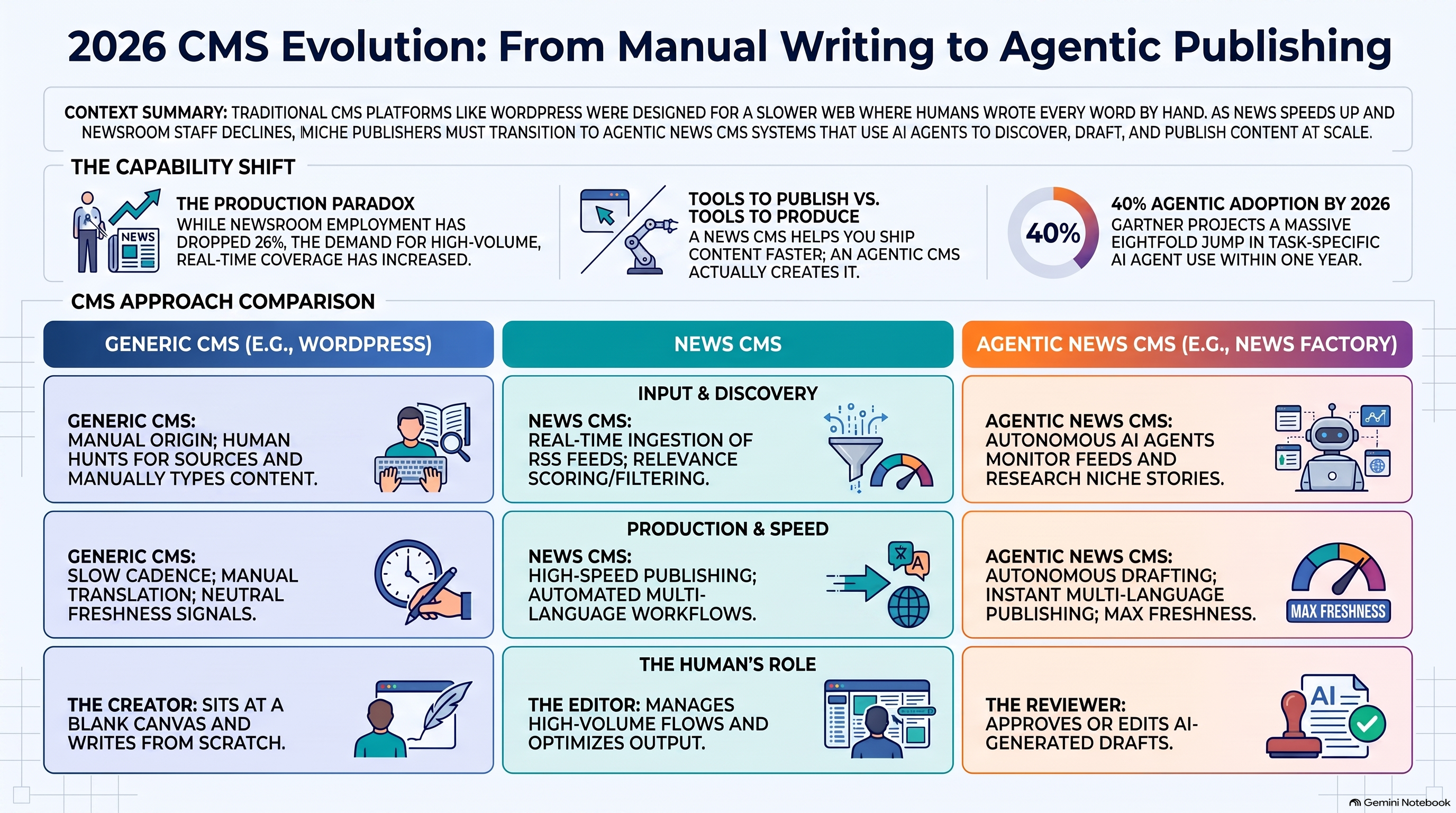
The clearest way to understand a news CMS is to line it up against the generic CMS most people already run, and against the agentic news CMS the category is moving toward.
Most site owners have used a generic CMS: open the dashboard, click new post, type, publish. It is a general-purpose tool, and its greatest strength, that it makes no assumptions about your content, is also its limit for a publisher. It does not know or care whether your subject is moving today, whether a competing site already covered a story, or whether the piece you wrote last week has gone stale. All of that is your job.
A news CMS makes different assumptions. It expects your content to be time-sensitive, so it puts speed and freshness at the center. It expects a steady stream of source material, so it can ingest feeds. An agentic news CMS goes one step further and puts AI agents to work on the parts a human used to do by hand: watching the sources, spotting what is relevant, and drafting the first version. The table below lines all three up across the dimensions that actually matter to a publisher.
| Dimension | Generic CMS | News CMS | Agentic news CMS |
|---|---|---|---|
| Where content comes from | A human writes every piece by hand | Editors work from live feeds and wires | AI agents discover and draft from monitored sources |
| Source ingestion | None; you paste text into an editor | RSS and feed import, often manual | Real-time autonomous monitoring of feeds in your niche |
| Relevance filtering | Your own editorial judgement | Basic tags and categories | AI relevance scoring surfaces what fits your audience |
| Publishing cadence | Whenever a person finds time to post | Scheduled desk shifts | Continuous, on a schedule you define |
| Multi-language | Manual re-writing or a plugin | Separate desks per language | Automatic translation and publish in several languages |
| Freshness | Only as fresh as your last free hour | As fast as the desk can turn copy | Reacts to breaking stories within minutes |
| Your role | Writer, editor and publisher at once | Editor coordinating a team | Reviewer who sets goals and approves output |
Read across any row and the same story repeats: the generic CMS leaves the work to you, the news CMS gives you tools to move faster, and the agentic news CMS shifts the work itself onto software so you become the reviewer rather than the writer. You can push a generic CMS like WordPress partway toward the middle column with plugins, importers and schedulers. What you cannot easily bolt on is the last column, where discovery and drafting stop being manual at all.
What Actually Makes a CMS a News CMS?
Vendors slap the word news on a lot of things. These are the capabilities that genuinely separate a publishing engine from a general-purpose editor, in plain English.
If the definition is the what, these are the how. A true news CMS earns the label through a handful of capabilities that a generic editor simply does not have. You do not need all of them to publish news, but the more of them a platform has, the less of the grind lands on you.
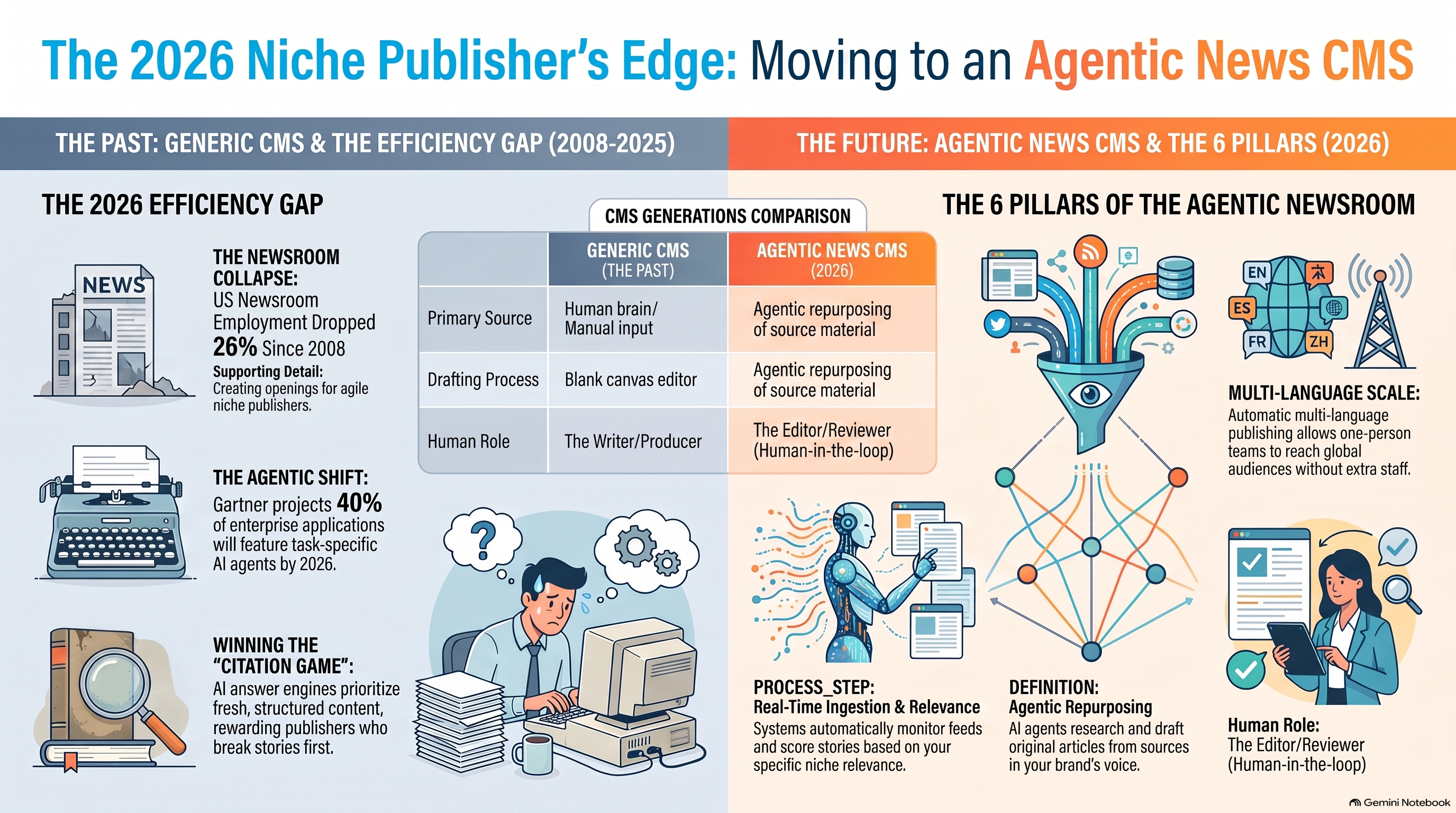
Real-time ingestion is the foundation. Instead of you hunting for what happened today, the platform watches RSS feeds and sources in your niche continuously and brings the raw material to you. Relevance scoring is what keeps that firehose usable: rather than dumping every headline on you, a news CMS ranks what is worth your attention for your specific audience. Agentic repurposing is the newer piece, where the system can take a source story and draft a full, original article in your voice rather than leaving you a blank page. Multi-language publishing turns one story into several, automatically, so a small operation can reach audiences it could never staff for. Freshness signals tie it together by treating speed as a ranking asset, because both Google and AI answer engines lean heavily on recent, well-structured pages. And running through all of it, a human in the loop: the point is not to remove the editor, it is to remove the busywork so the editor can focus on judgement.
- Real-time ingestion. The platform polls the feeds and sites you care about and queues new items as they appear, so your raw material is always current without a manual search.
- Relevance scoring. Incoming items are ranked or filtered against your beat, so a two-person site is not buried under a national wire.
- Agentic repurposing. Point the system at a source URL or a queued story and it drafts an original article, in your tone, with the facts organised, ready for review.
- Multi-language publishing. The same piece is translated and published across several languages from one workflow, rather than duplicated by hand.
- Freshness signals. Fast publishing and clear structure make you the recent, citable source that search and AI answers prefer.
- Human in the loop. You approve, edit or reject before anything goes live, and can widen autonomy only where the workflow has earned trust.
Why Do Niche Publishers Specifically Need One?
A national outlet has a desk of reporters. A niche publisher usually has one or two people. That asymmetry is exactly why the right platform matters more, not less, for the small operator.
The economics of publishing have moved hard against the small team. US newsroom employment has fallen about 26% since 2008, and the country has lost roughly a third of its newspapers since 2005, leaving thousands of communities and countless niches thinly covered.[4][5] That collapse is a tragedy for local coverage, but it is also an opening: subjects that big media no longer staffs are wide open for a focused independent publisher who can move fast and go deep.
The catch is that moving fast and going deep is precisely what a one-person operation cannot do by hand. You cannot manually monitor every feed in your niche, judge what matters, write it up, translate it, and do it again tomorrow, without burning out. This is where the platform stops being plumbing and starts being leverage. A news CMS lets a tiny team cover a beat with the reach that used to require a staff.
The opening left by shrinking newsrooms
Newsroom and newspaper decline is opening niches for focused independents[4][5]
Newsroom and newspaper decline per Pew and Northwestern Medill. The subjects big media no longer staffs are exactly the niches a small, fast publisher can own.
The freshness point is the one small publishers underrate. As readers shift from clicking blue links to reading AI-generated answers, being cited by those answers becomes the game, and the engines lean heavily on recent, clearly structured pages, rewarding whoever covers a rising story first and in the reader's own language.[12] Speed-to-publish, once a nice-to-have, is now a durable advantage, and it is precisely the advantage a manual, one-post-a-week workflow throws away.
The CMS landscape a news CMS sits inside
How much of the web runs on a CMS, and where the market is growing[1][2]
Usage share from W3Techs; headless CMS growth from Grand View Research. WordPress dominates the generic-CMS market, which is exactly why a purpose-built news CMS is a distinct category rather than a default.
Pick the beat the giants abandoned
What Is an Agentic News CMS, and Why 2026?
The category is not standing still. The defining shift of 2026 is the move from a news CMS that helps you publish to an agentic one that helps you produce.
For most of its history, a news CMS made publishing faster but still assumed a human did the producing: you found the story, you wrote it, the platform helped you ship it. The agentic shift changes the verb. An agentic news CMS puts AI agents to work on discovery and drafting themselves, so the system proposes stories and produces first drafts, and the human moves to reviewing and approving.
This is not a niche experiment. Gartner projects that 40% of enterprise applications will feature task-specific AI agents by 2026, up from less than 5% in 2025, an eightfold jump in a single year, and expects 33% of enterprise software to include agentic AI by 2028.[6][7] McKinsey estimates agentic AI could power up to roughly two-thirds of current marketing activities, the research, drafting and production work that eats a content team's week.[8] The tooling behind an agentic news CMS is being built out at enormous scale, which means it is getting cheaper and more accessible to a one-person publisher every quarter.
The agentic shift is accelerating
Analyst and consultancy forecasts for agentic AI penetration[6][7][8]
Gartner figures on enterprise-app and enterprise-software agentic penetration; McKinsey estimate on the share of marketing activities agentic AI could power. Different definitions, one direction of travel.
Agentic is not autopilot
How Do You Choose a News CMS in 2026?
If you are a niche publisher weighing your options, the decision is less about editor features and more about how much of the production grind the platform actually removes.
The temptation is to compare platforms on the surface, on how the editor looks or how many themes it has. For news-style publishing, those are the least important things. The questions that decide whether a platform will still serve you in a year are about ingestion, relevance, speed and language. Does it watch your sources for you, or do you still hunt? Does it help you find what is relevant to your beat, or hand you an undifferentiated feed? Can it publish across languages from one workflow, or does every translation double your work? And crucially, where does it sit on the autonomy dial, and can you control that dial yourself?
Weigh a generic CMS honestly here. WordPress and its peers are superb, mature, and endlessly extensible, and for many sites they are exactly right. But extending a generic CMS into a real news operation means stitching together importers, schedulers, translation plugins and AI writing add-ons, and then maintaining that patchwork yourself. A purpose-built news CMS treats those as first-class features. The right choice depends on how central speed and volume are to what you do: occasional posts, stay generic; a living beat, go purpose-built.
- Ingestion. Does it monitor RSS feeds and sources in your niche automatically, and how many?
- Relevance. Does it help surface what matters to your audience, or just list everything?
- Drafting. Can it repurpose a source into an original draft in your voice, or is every piece a blank page?
- Languages. Can it translate and publish across languages from one workflow, and how many?
- Autonomy control. Can you require approval on every post and widen autonomy only where you trust it?
- Integrations. Does it publish to where your audience already is, such as WordPress or another CMS?
A News CMS in Production, Not in Theory
Everything above describes a category. This is what that category looks like when it ships as a product a solo publisher can actually run.
News Factory is a direct, literal example of the agentic news CMS this article describes: its tagline is "Deploy AI Agents in Your News CMS." Where a generic CMS waits passively for a human to type, News Factory's AI agents monitor RSS feeds in your niche (5 on Pro, 10 on Business, 50 on Enterprise), surface trending stories, and research and draft full articles autonomously. On Pro and above, agentic automation discovers, processes and publishes on a schedule you define, and you choose whether to approve every post or let the agents run fully autonomous. It translates and publishes in up to five target languages and auto-publishes to WordPress, Drupal, Joomla and other CMSes. That is the news-CMS category in production: real-time ingestion, niche relevance, multi-language publish and agentic repurposing, with a human still in the loop.[13]
Line it up against the definition this article opened with. Real-time ingestion: the agents monitor your feeds continuously. Relevance filtering: they surface the trending stories that fit your beat. Agentic repurposing: they draft full articles from sources in your voice. Multi-language publish: up to five target languages from one workflow. That is the match, not a claim to do keyword research, backlinks or analytics, and not more than five languages, but the specific thing a news CMS actually is.
If a news CMS is what lets a small team cover a beat like a newsroom, the useful question is not whether to adopt one, but where to start narrow and keep a human in the loop.
See how News Factory runs the loopThe takeaway: a news CMS is a content management system built for the speed and volume of news, adding real-time ingestion, relevance filtering, fast multi-language publishing and freshness signals on top of a normal editor. An agentic news CMS goes further and uses AI agents to discover and draft, moving the human from writer to reviewer. For a niche publisher competing on speed and depth against thinly staffed giants, that is not a luxury in 2026, it is the platform that makes the whole operation possible.
Related reading
- The Newsroom of One - how one operator runs the agentic loop like a desk of twelve.
- What Is Agentic Content? - the AI workflow that plans, researches and fact-checks before you publish.
- News Monitoring as a Moat - how niche sites build authority by reacting faster than big media.
- AI Agents vs AI Writers - the capability gap between a draft machine and a content engine.
Available in other languages
- 🇬🇧What Is a News CMS, and Why Niche Publishers Need One in 2026
- 🇪🇸¿Qué es un CMS de noticias? Y por qué los editores de nicho necesitan uno en 2026
- 🇫🇷Qu'est-ce qu'un CMS d'actualités ? Et pourquoi les éditeurs de niche en ont besoin en 2026
- 🇩🇪Was ist ein News-CMS? Und warum Nischen-Publisher 2026 eines brauchen
- 🇵🇹O que é um CMS de notícias? E por que editores de nicho precisam de um em 2026
- 🇮🇹Cos'è un CMS per le notizie? E perché gli editori di nicchia ne hanno bisogno nel 2026