You Are No Longer Just Writing for Readers
The audience for your content now includes machines. ChatGPT, Perplexity and Google's AI Overviews read your pages, decide whether to trust them, and quote them back to millions of people who never visit your site.
For twenty years, publishing on the web meant writing for two audiences: people, and the search engine that ranked you for those people. The bargain was simple. You wrote something useful, Google sent you a click, and a human landed on your page. That bargain is quietly being rewritten.
Today a growing share of the people looking for what you know never see your website at all. They ask ChatGPT, they ask Perplexity, they read Google's AI Overview at the top of the results, and they get a synthesized answer that may quote you, paraphrase you, or ignore you entirely. The machine read your page so the human did not have to. Whether you get credit depends on whether the machine found your content clear, current, and trustworthy enough to cite.
This changes what "good content" even means. It is no longer enough to write something a person enjoys reading; the words also have to survive being read, parsed and fact-checked by an AI system that is deciding, in a fraction of a second, whether to stake its answer on you. And increasingly, the content that wins that contest is itself produced by AI systems that work the way the answer engines do: methodically, with sources, in multiple steps. That is what people mean when they say agentic content, and it is what this guide is about.
What Is Agentic Content? A Working Definition
Before the strategy, the plain definition, short enough to quote, and written to be the block an answer engine lifts when someone asks the question.
Strip away the jargon and it comes down to autonomy plus grounding. Here is the definition this article will build on, kept deliberately tight:
Agentic content is content produced by an AI system that works autonomously across multiple steps, planning, researching with live web and data tools, drafting, self-editing, and fact-checking, before a human reviews and approves it. Unlike single-prompt AI writing, an agentic system pursues a goal and grounds its output in verified sources.
Notice what is doing the work in that sentence. Autonomously across multiple steps, it is not one prompt and one answer, it is a sequence the system runs on its own. Live web and data tools, it goes and gets current information instead of reciting what the model memorized during training. Fact-checking before a human reviews, verification is built into the workflow, not bolted on afterwards. And crucially, the human is still there at the end, approving, not typing.[4][5][6]
The one-line version
Prompter vs Reviewer: The Real Contrast
The clearest way to understand agentic content is to line it up against the thing most people already do, typing a prompt into a chatbot and pasting the result.
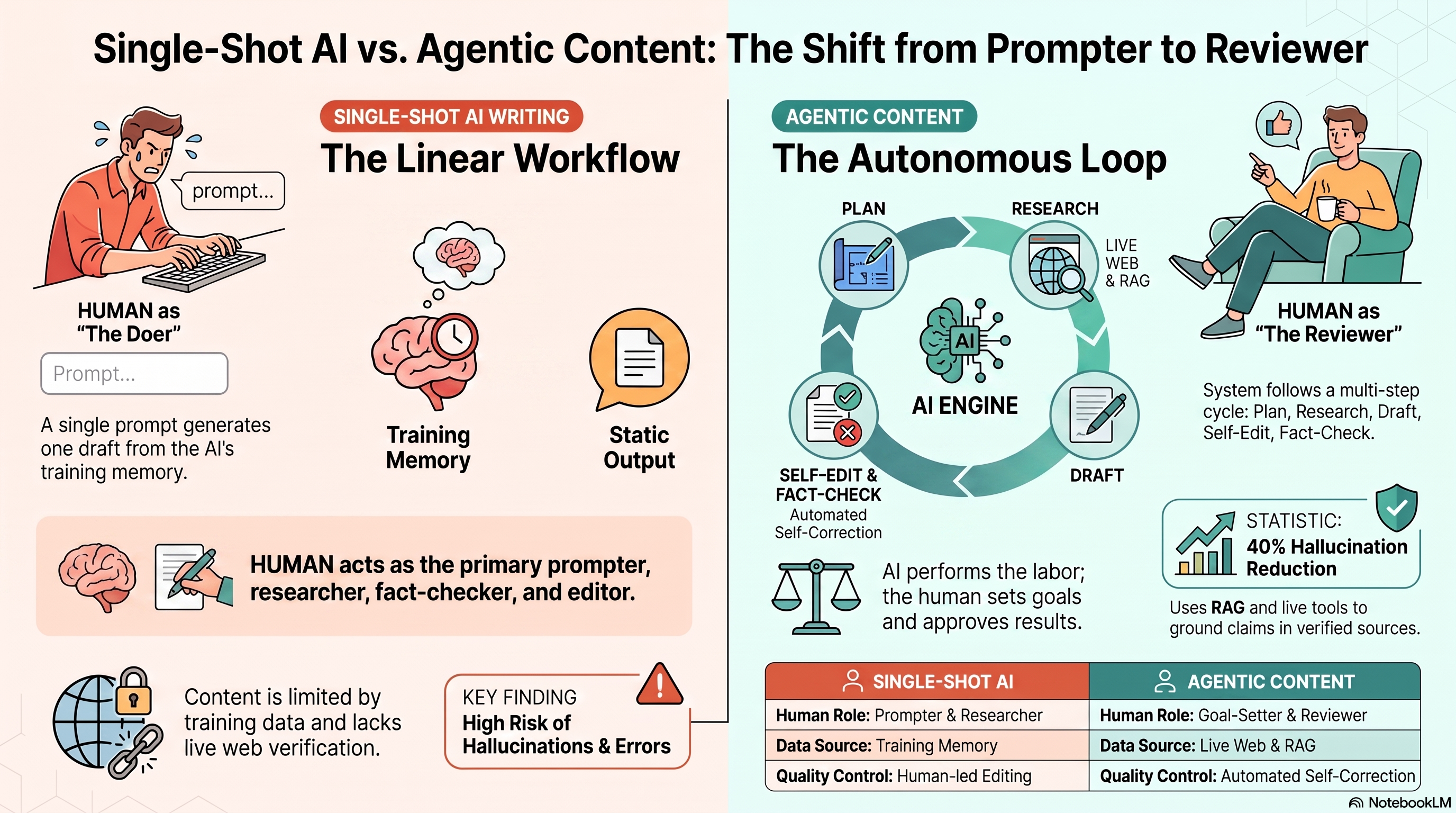
Most business owners have already tried "AI writing": open ChatGPT, type "write me a 600-word post about X", copy the answer, tidy it up, publish. That is single-shot AI writing, and it has a ceiling. The model answers from what it absorbed in training, it cannot check whether last quarter's number changed, and the quality of what you get depends entirely on the quality of the one prompt you happened to write. You are the prompter, and you are also the researcher, the fact-checker and the editor.
Agentic content flips the roles. The system takes on the multi-step production work, planning, researching, drafting, checking, and you become the reviewer who sets the goal at the start and approves the result at the end. The table below lines the two up across the dimensions that actually matter.
| Dimension | Single-shot AI writing | Agentic content |
|---|---|---|
| Autonomy | Responds to one prompt, then stops and waits for you | Pursues a goal across many steps without re-prompting |
| Tool use | None, writes only from what the model already knows | Calls live web search, data feeds and APIs to gather facts |
| Orchestration | A single model call produces a single output | A planner coordinates specialised steps and sub-agents |
| Fact-checking / grounding | You verify everything afterwards, if at all | Claims are grounded in retrieved sources and self-checked |
| Human's role | Prompter, you write the prompt and edit the draft | Reviewer, you set the goal and approve the finished work |
| Iteration | One pass; regenerate manually if it is wrong | Self-edits and re-drafts until quality gates pass |
| Consistency at scale | Quality drifts as you fire off more prompts | The same workflow enforces the same standard every time |
Read down the last column and a theme emerges: every row is about the system doing more of the work between your goal and the finished piece. That gap, between "here is what I want" and "here is a verified draft ready to approve", is exactly the space agentic content fills. The prompter closes that gap by hand, one message at a time. The reviewer lets a workflow close it, then judges the output.
Under the Hood, in Plain English
You do not need to understand the engineering to trust the output, but you should know the six steps a good agentic system runs so you know what you are approving.
The word "agentic" sounds technical, and under the surface it is. But the loop itself is intuitive, because it mirrors how a careful human researcher works. Instead of blurting out an answer, the system moves through stages, and each stage feeds the next.
The sequence is plan → research → draft → self-edit → fact-check → publish. First the system plans: it turns your goal into an outline and works out what it needs to find out. Then it researches, reaching out through live tools, web search, RSS feeds, data APIs, to gather current facts rather than relying on training-data memory. Only then does it draft, writing the piece grounded in what it just retrieved. It reviews its own draft against the brief, tightens it, and runs a fact-check pass that ties each claim back to a source and flags anything it could not verify. Finally it presents a finished, annotated draft, and a human decides whether it ships.
- Plan. A planner (or orchestrator) turns the goal into an outline, decides the sections, and lists the open questions research must answer.
- Research. The system issues tool calls, web search, feeds, databases, and pulls back current, citable material instead of recalling stale training data.
- Draft. It writes each section grounded in the retrieved passages, so sentences trace back to sources rather than to the model's memory.
- Self-edit. The draft is checked against the brief for coverage, tone and structure, then re-written where it falls short.
- Fact-check. Every statistic, name and claim is matched to a source; unsupported statements are flagged, not hidden, and dead links are caught.
- Publish. A human reviewer approves, edits or rejects. On a proven workflow, low-risk pieces can be allowed to publish automatically while the rest wait for review.
Why It's More Accurate: Grounding Beats Guessing
The single biggest fear about AI content is that it makes things up. Agentic content attacks that fear directly, because grounding a model in real sources measurably cuts fabrication.
A language model left to its own devices answers from a statistical memory of everything it read in training. Ask it for a figure it half-remembers and it will often produce a confident, plausible, wrong number, a hallucination. This is the reason so many publishers are nervous about AI content, and they are right to be.
Agentic content mitigates this with a technique called grounding, usually implemented as retrieval-augmented generation (RAG): before the model writes, it retrieves relevant source material, and it answers from those sources rather than from memory. The effect is not marginal. Grounding a model in retrieved evidence has been shown to cut hallucinations by 40% or more, and on Vectara's public hallucination leaderboard the best grounded-summarization models fabricate as little as 0.7% to 1.5% of the time.[9] When every claim is tied back to a retrieved source and then re-checked, the surface area for invention shrinks dramatically.
Grounding cuts fabrication
Hallucination reduction from grounding, and best grounded rates on the Vectara leaderboard[9]
The first bar is the reduction in hallucinations from adding retrieval; the lower two are absolute grounded-hallucination rates for top models (lower is better). Figures per the Vectara leaderboard and RAG research.
Grounded is not the same as guaranteed
Why It Matters Now: The Adoption Curve Is Bending
Agentic content is not a fringe experiment. The analysts and the largest consultancies are all forecasting the same steep climb over the next few years.
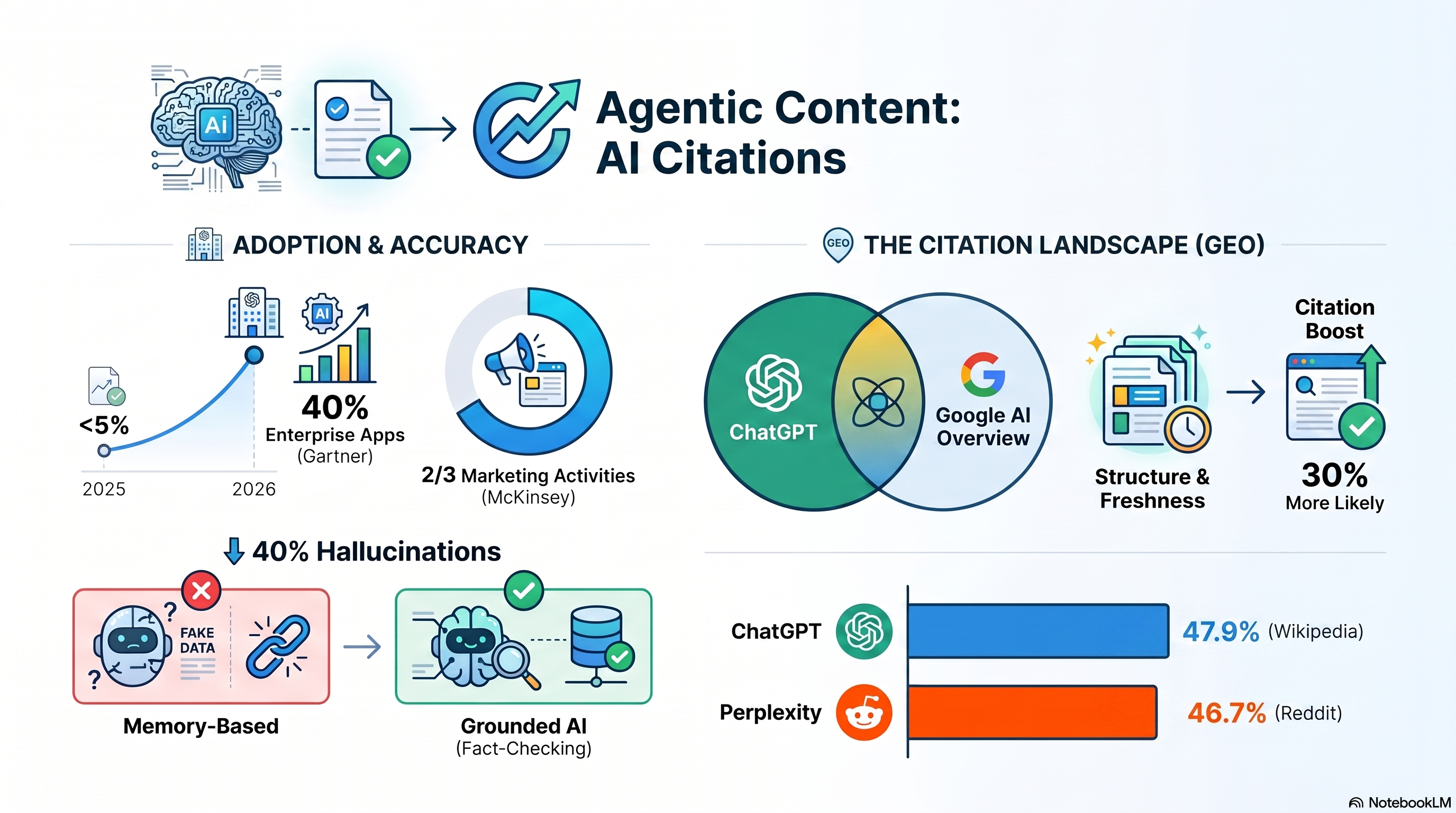
If this felt like a niche idea a year ago, the numbers have moved. Gartner projects that 40% of enterprise applications will feature task-specific AI agents by 2026, up from less than 5% in 2025, an eightfold jump in a single year.[2] Looking further out, Gartner expects 33% of enterprise software applications to include agentic AI by 2028, up from less than 1% in 2024, and forecasts that 15% of day-to-day work decisions will be made autonomously by agents by 2028.[1]
Marketing and content sit squarely in the path of that curve. McKinsey's analysis of agentic AI in marketing concludes that the technology could power up to roughly two-thirds of current marketing activities, not replacing the strategy, but automating the executional work of research, drafting and production that eats most of a content team's week.[3]
Agentic AI adoption is accelerating
Analyst and consultancy forecasts for agentic AI penetration[1][2][3]
Gartner figures on enterprise-app and enterprise-software penetration; McKinsey estimate on the share of marketing activities agentic AI could power. Different definitions, one direction of travel.
For a small publisher, the practical reading is not "the enterprises are doing it, so I must too." It is that the tools, the models and the workflows behind agentic content are being built out at enormous scale, which means they are getting cheaper, better and more accessible to a one-person operation every quarter. The capability that used to require a data-science team is arriving as a product.
Built to Be Cited: The GEO Payoff
Here is where the whole thing pays off for a publisher. Agentic content is not just more accurate, it is shaped, sourced and structured in exactly the way answer engines reward when they choose whom to cite.
Remember the opening: machines now read your content and decide whether to quote it. This discipline has a name, Generative Engine Optimization (GEO), and it turns out that content produced by a grounded, multi-step agentic workflow is naturally good at it. It cites sources, it is structured into clear passages, and it is current, three things answer engines look for.
The stakes are high because the engines barely agree with each other. An analysis of roughly 680 million citations found that ChatGPT and Google's AI Overview share only about 13.7% of their citation sources, meaning the same query can pull almost entirely different pages depending on the engine. The engines also have distinct habits: ChatGPT leans heavily on Wikipedia (~47.9% of its citations), while Perplexity leans on Reddit (~46.7%).[10] To be cited broadly, you cannot optimize for one engine; you have to be the clean, well-sourced, well-structured page that any of them would be comfortable quoting.
How AI answer engines pick their sources
Citation patterns across engines, and the structure premium[10][13]
Overlap and per-engine leanings from the ~680M-citation analysis; the structure premium reflects GEO research that well-structured content is around 30% more likely to be cited.
Two levers matter most, and agentic content pulls both. First, structure: well-organized content with clear headings, extractable answers and cited claims is around 30% more likely to be cited, which is why the definition earlier in this article sits in its own quotable block.[13] Second, recency: engines like Perplexity visibly favor fresh material, often weighting content from the last 30 days, which rewards publishers who cover topics as they move rather than once a quarter.[11][13] A workflow that researches live and publishes on a cadence is built for exactly this.
Write the quotable block on purpose
The Honest Caveat: Most Early Projects Will Fail
Agentic content is powerful and it is early. Pretending otherwise would be the opposite of the grounded honesty the whole approach is supposed to stand for.
There is a hype cycle around agentic AI right now, and it is worth naming plainly. Gartner forecasts that more than 40% of agentic AI projects will be cancelled by the end of 2027, citing escalating costs, unclear business value and immature risk controls.[1] Gartner's analysts have been blunt that most agentic AI projects today are early-stage experiments driven by hype, and that many are misapplications of the technology to problems that did not need an autonomous agent at all.
The lesson for a small publisher is not to stay away, it is to stay grounded, in every sense. The projects that fail tend to be the ones that removed the human, chased full autonomy before the workflow was proven, or applied agents to work that a simple template would have handled. The projects that succeed keep a person in the loop, start narrow, and treat the agent as a very fast, very literal researcher that still needs an editor.
Autonomy is a dial, not a switch
Agentic Content in Production, Not in Theory
Everything above describes a category. This is what that category looks like when it ships as a product a solo publisher can actually run.
Agentic content is not a hypothetical. It is exactly the category News Factory was built for: its tagline is "Deploy AI Agents in Your News CMS." Where a single-shot AI writer hands you one draft and stops, News Factory's AI agents act as researchers and writers that monitor RSS feeds in your niche, surface trending stories, and research and draft full articles autonomously. On Pro and above, agentic automation discovers, processes and publishes on a schedule you define, and you choose whether to approve every post or let the agents run fully autonomous. It translates and publishes in up to five target languages and auto-publishes to WordPress and other CMSes. In other words, News Factory is agentic content in production: the multi-step, tool-using, human-supervised loop described in this article, running as a product rather than a concept.
Line it up against the definition this article opened with. Multi-step orchestration: the monitor, research, draft and publish stages run as a chain. Tool use: the agents watch live feeds and research before drafting. Human in the loop: you keep the approve-or-autonomous choice on every piece. That is the match, not a claim to do keyword research, backlinks or analytics, and not more than five languages, but the specific thing agentic content actually is.[15]
If agentic content is where publishing is heading, the useful question is not whether to adopt it, but where to start narrow and keep a human in the loop.
See how News Factory runs the loopThe takeaway: agentic content is content produced by an AI system that plans, researches with live tools, drafts, self-edits and fact-checks before a human approves it. It is more accurate because it is grounded, it is rising fast because the whole industry is building it, and it is built to be cited by the answer engines that increasingly stand between you and your audience. Start narrow, keep the human, and treat the agent as a fast researcher, not an unsupervised publisher.
Related reading
- The Newsroom of One - how one operator runs the agentic loop like a desk of twelve.
- AI Agents vs AI Writers - the capability gap between a draft machine and a content engine.
- Agentic Content Pipelines - how the plan, draft and publish stages wire into one assembly line.
- How to Get Cited by ChatGPT & Perplexity - the GEO tactics that earn answer-engine citations.