The Click Is Quietly Disappearing
For two decades the deal was simple: rank well, earn the click, get the visitor. AI answer engines are breaking that deal by answering the question before anyone reaches your page.
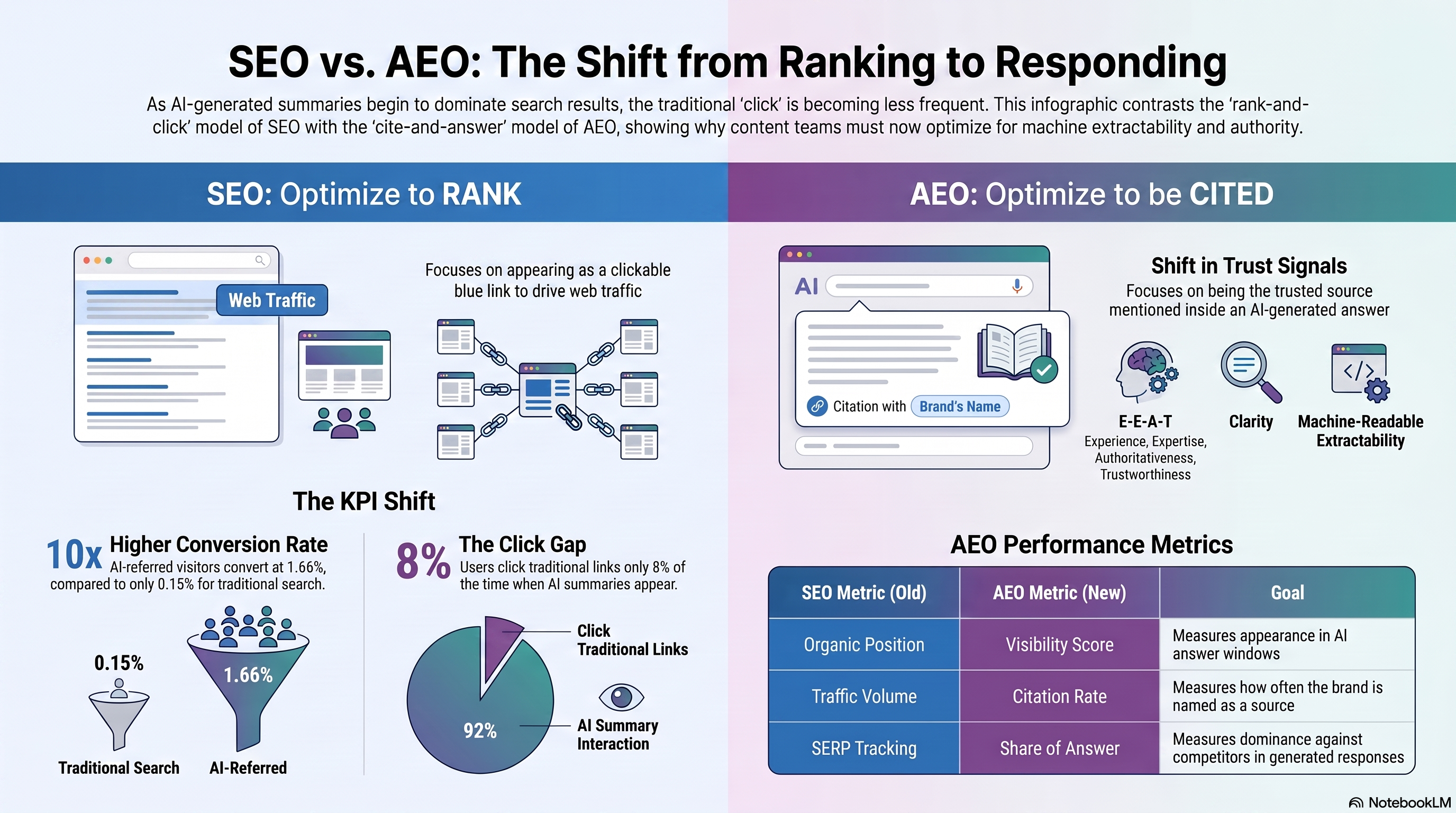
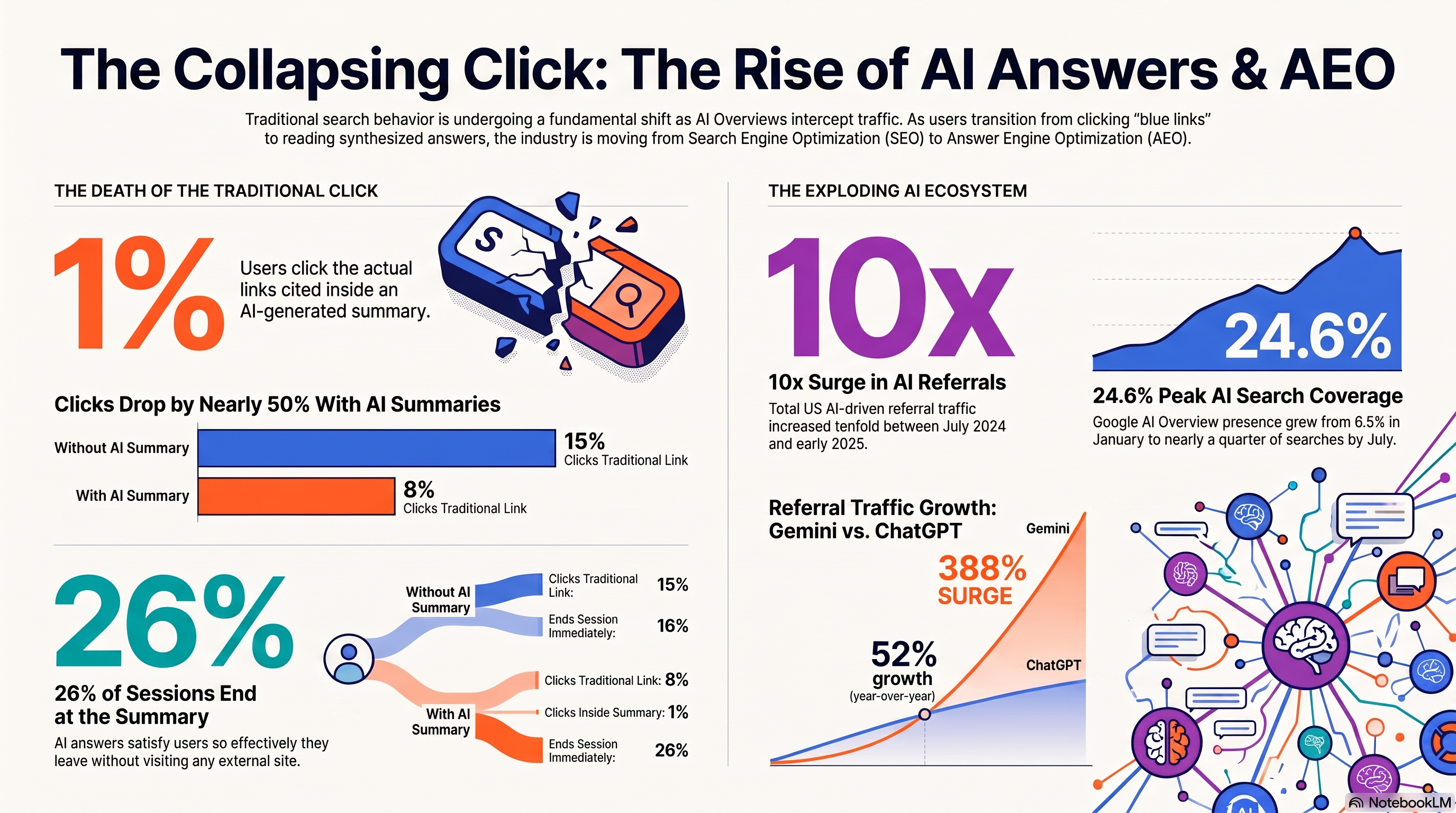
Here is the number that should reorganize how your content team thinks about its job. When an AI summary appears at the top of Google's results, users click a traditional link only 8% of the time, compared with 15% when no summary is present. And a link inside the summary itself? Just 1% of visits.[1] The click, the metric that has defined web publishing since the late 1990s, is being answered away.
This is not a fringe effect on a handful of queries. In July 2025, Google's AI Overviews appeared on roughly a quarter of all searches, and a majority of users now see at least one AI summary in a typical session.[4] When someone asks a question and reads a synthesized answer that quotes three or four sources, the winner is no longer whoever ranked first. The winner is whoever got cited, named, paraphrased, and trusted inside the answer. That shift, from ranking for clicks to being cited inside answers, is what Answer Engine Optimization is about, and it is why content teams are quietly rewriting their playbooks.
None of this means SEO is dead. It means the goal moved. This guide explains what AEO actually is, why it is displacing rank-and-click as the operating model, how each major engine decides whom to cite, the new metrics that replace position tracking, and the specific things your team should change on Monday morning.
What Is Answer Engine Optimization? A Working Definition
Before the strategy, the plain definition, kept short enough to quote, and written as the block an answer engine can lift when someone asks what AEO means.
Answer Engine Optimization inverts the target of everything you know about SEO. Instead of shaping a page to rank as a clickable link, you shape it to be the source a model trusts and names. Here is the definition this article builds on, kept deliberately tight:
Answer Engine Optimization (AEO) is the practice of structuring, formatting, and sourcing content so AI answer engines, ChatGPT, Perplexity, Google AI Overviews, Gemini, and Claude, can easily understand, trust, and cite it as the direct answer to a user's question, rather than optimizing pages to rank as clickable blue links.
Notice what changed. The target audience is no longer only a human scanning ten blue links; it is a model deciding, in a fraction of a second, whether to stake its answer on you. Success is no longer a position on a results page; it is a citation inside a generated answer, which can happen with or without a click.[10] And the qualities that win, clarity, trustworthiness, and extractability, are things you can engineer into the content itself.[8]
The one-line version
Why AEO Is Replacing SEO as the Operating Model
AEO is not erasing SEO, it is changing the scoreboard. As clicks fall and AI referrals surge, 'rank and get the click' stops being the metric that predicts business value.
The reason the model is shifting is arithmetic, not hype. If clicks fall when AI summaries appear, then the traffic that traditional SEO was optimized to capture is being intercepted upstream. Pew found users end their browsing session 26% of the time after landing on a page with an AI summary, versus 16% without, the answer satisfied them, so they left.[1] Meanwhile, the audience is migrating to the engines themselves: ChatGPT grew from about 400 million weekly users in February 2025 to 800 million by that autumn.[6]
Two data points capture the whole transition. First, Google's own AI Overview coverage climbed steeply through 2025 before settling, showing how quickly the answer layer spread across ordinary queries. Second, referral traffic from AI engines is exploding year over year, which is where the new visibility (and, increasingly, the new conversions) now lives.
Google AI Overviews spread across the SERP in 2025
Share of queries showing an AI Overview, Semrush study of 10M+ keywords[4]
Coverage rose from 6.49% of queries in January 2025 to a ~24.6% peak in July before pulling back to 15.69% in November. Even after the pullback, roughly one in six queries now carries an AI answer.
And the traffic that survives is arriving through a new front door. Similarweb data reported by Digiday shows AI referrals growing at rates that dwarf anything in traditional channels: ChatGPT referrals were up 52% year over year in the September–November 2025 window, and Gemini referrals were up a staggering 388%.[3] Adobe measured US AI-driven referral traffic rising more than tenfold between July 2024 and February 2025.[2]
AI referral traffic is growing far faster than any legacy channel
Year-over-year referral growth, Sep–Nov 2025, Similarweb via Digiday[3]
ChatGPT accounts for about 87.4% of all AI referral traffic across ten industries, but Gemini's 388% growth shows how fast the newer engines are compounding. AI platforms are still only ~1% of overall web traffic, but the slope is what matters.
The clinching argument is quality, not just quantity. When those AI-referred visitors do land on a site, they convert far better than any other channel: Microsoft Clarity data across 1,200+ sites found LLM-referral sign-up conversion at 1.66%, more than ten times the 0.15% from traditional search.[3] Fewer clicks, but dramatically warmer ones. That is the whole case for AEO in a sentence: the clicks that remain are worth more, and you only get them if you are the source the answer cites.
AI-referred visitors convert far better than search or social
Sign-up conversion rate by channel, Microsoft Clarity across 1,200+ sites[3]
A visitor arriving from an AI answer has often already been pre-qualified by the engine, which is why LLM-referral conversion (1.66%) towers over search (0.15%), direct (0.13%) and social (0.46%).
SEO is the foundation, not the enemy
How Each Answer Engine Picks Its Sources
There is no single algorithm to optimize for. Each engine retrieves and cites differently, so a brand can dominate Perplexity and be invisible in Google AI Overviews at the same time.
The most important operational fact about AEO is that the engines do not agree with each other. They use different backends, different retrieval logic, and different trust signals. A page that ChatGPT loves may never surface in a Gemini answer. That is why the emerging best practice is per-engine tracking rather than one blended score, and why understanding each engine's mechanics is the difference between guessing and targeting.[11]
The common denominator, though, is encouraging: across all four major engines, the same fundamentals win, a clear direct answer near the top, explicit entity naming, dated and linked facts, and self-contained sentences. Get those right and you are legible to every engine at once.[11]
A few practical takeaways fall straight out of that breakdown. For ChatGPT, your Bing Webmaster Tools health matters more than your Google ranking, because ChatGPT Search leans on Bing and licensed media partners.[11] For Perplexity, your presence and accuracy on review platforms like G2 and Capterra shapes commercial-query citations. For Claude, writing sentences that carry a number, an entity and a source together plays directly into its sentence-level Citations API. And for Google's AI Overviews, do not obsess over the top three, cited pages frequently sit anywhere from position 4 to 20, chosen for credibility and intent-fit rather than raw rank.[11]
Optimize for the shared denominator, then tune per engine
The Metrics That Replace Position Tracking
If you cannot measure rank-and-click the same way, you need a new dashboard. AEO swaps organic position and traffic volume for visibility, citation rate and share of answer.
You cannot manage what you do not measure, and the old SEO dashboard, built around SERP position and organic traffic, simply does not capture whether an AI answer named your brand. AEO introduces a parallel set of KPIs. The mental model is a one-for-one swap: every SEO metric has an AEO counterpart that answers the new question, 'are the engines citing us, correctly, more than our competitors?'[8]
| SEO KPI (old) | AEO KPI (new) | What it actually measures |
|---|---|---|
| Organic position | Visibility score | How often your brand is mentioned anywhere in an AI answer, not where you rank. |
| Traffic volume | Citation rate | How often your domain is actually cited as a source inside an AI answer. |
| SERP rank tracking | Share of answer | Your mention share versus competitors across a set of priority prompts. |
| Click-through rate | Sentiment score | Whether the AI frames your brand positively, neutrally or negatively. |
| Bounce / dwell time | Accuracy score | Whether the model represents you correctly rather than hallucinating. |
| Conversions from organic | Assisted conversions | Sign-ups and sales from sessions that an AI answer influenced upstream. |
A whole category of tools has appeared to track these numbers, because you cannot read AI answers at scale by hand. They range from enterprise platforms to budget monitors, and most now break results out per engine so you can see that you are strong in one and absent in another.[12] A quick honesty note before the table: this article is educational, not a sales pitch for any of these, pick based on budget and how many prompts and engines you need to watch.
| Tool | Tier | Rough price | What it tracks |
|---|---|---|---|
| Profound | Enterprise | ~$499/mo | Visibility, citation, sentiment and share-of-answer at enterprise scale. |
| Peec AI | Mid-market / agency | ~€89-$100/mo | Citation frequency, source URLs and competitive share of voice across ChatGPT, Perplexity and Google AI Overviews. |
| Otterly.ai | Budget / light | ~$29/mo | Lightweight prompt monitoring and mention tracking for small teams. |
| Semrush AI Toolkit / Frase / others | Add-on | Varies | AI visibility bolted onto existing SEO suites (also Athena, SE Ranking, Surfer, Writesonic, ZipTie, HubSpot, Conductor). |
Watch the leading indicators, not one blended number
What Content Teams Actually Change on Monday
AEO is less a rewrite of your content and more a rewrite of how you structure, source and schedule it. Here are the concrete operational shifts that move the citation needle.
The good news for a content team is that AEO does not demand a new skill set so much as a new discipline. Most of the levers are formatting and sourcing habits you can adopt immediately, without new headcount. The theme running through all of them: make every page easy for a machine to extract a trustworthy, self-contained answer from.[5] (This very article practices what it preaches, notice each section opens with a tight, direct answer.)
Lead answer-first. Open each section with a 30–60 word direct answer, then follow with atomic one-to-three-sentence paragraphs. Answer engines lift the clean, self-contained block, not the meandering intro.[8] Format for questions. Use question-based headings that mirror how people actually ask, 60% of Google queries starting with who/what/when/why trigger an AI summary, as do 53% of queries of ten words or more.[1] Add structured data. FAQPage, Article, HowTo and Product schema help engines parse your answers, with a concise answer under each FAQ entry.[8]
Build a trust block near the top. Author plus credentials, a last-updated date, one or two cited sources, and a 40–50 word answer summary, the signals E-E-A-T and every engine reward.[8] Write self-contained sentences. Put the number, the entity and the source in the same sentence; this is what makes a line citable by Claude and quotable by all of them.[11] Name your entities early. Vague 'set the stage' intros reduce retrieval likelihood; say what the subject is in the first sentence.[11]
The single biggest operational change: cadence
Feeding the Answer Engines Without Burning Out Your Team
AEO creates one hard, unglamorous input problem: keeping up a fresh, structured, well-sourced publishing rhythm. That is the part most teams cannot sustain by hand.
Step back and the whole discipline resolves to a single demand: AEO rewards content that is answer-first, well-sourced, freshly updated, and published consistently enough that answer engines keep re-crawling and trusting your domain. Getting one page right is easy. Doing it every week, across a niche, in the structured format engines prefer, without exhausting a small team, that is the genuinely hard part.
That steady cadence of structured, sourced articles is exactly what News Factory automates. Its AI agents monitor your niche, research trending stories, and draft full articles in your voice, so your site keeps producing the kind of current, authoritative content answer engines prefer to cite. To be clear about what it is and is not: News Factory does not track your citation share for you, dedicated AEO tools like Profound or Peec do that. What it solves is the input problem AEO creates: maintaining a real, fresh, well-structured publishing rhythm without burning out a writing team.
AEO measurement tells you whether you are being cited. The harder question is whether you can keep publishing fresh, structured, sourced content fast enough to earn those citations in the first place.
See how News Factory keeps the cadenceThe takeaway: AEO is optimizing content to be cited as the answer inside ChatGPT, Perplexity, Gemini, Claude and Google AI Overviews, rather than ranked as a clickable link. It is replacing rank-and-click because clicks are collapsing (8% with an AI summary vs 15% without) while AI referrals surge and convert. Win it by leading answer-first, writing self-contained sourced sentences, tracking citation share per engine, and, hardest of all, keeping a fresh publishing cadence the engines keep coming back to.
Related reading
- AEO vs SEO in 2026 - the side-by-side breakdown of the two disciplines and where they overlap.
- How to Get Cited by ChatGPT & Perplexity - the tactical GEO moves that earn answer-engine citations.
- What Is Agentic Content? - the AI workflow that plans, researches and fact-checks before you publish.
- News Monitoring as a Moat - why reacting faster than big media builds citation authority.
References & Sources
Available in other languages
- 🇬🇧What Is Answer Engine Optimization (AEO) and Why It's Replacing SEO for Content Teams
- 🇪🇸¿Qué es la Optimización para Motores de Respuesta (AEO), y por qué está reemplazando al SEO para los equipos de contenido?
- 🇫🇷Qu'est-ce que l'Optimisation pour les Moteurs de Réponse (AEO), et pourquoi remplace-t-elle le SEO pour les équipes de contenu ?
- 🇩🇪Was ist Answer Engine Optimization (AEO), und warum es SEO für Content-Teams ablöst
- 🇵🇹O que é Answer Engine Optimization (AEO), e por que está substituindo o SEO para equipes de conteúdo
- 🇮🇹Cos'è la Answer Engine Optimization (AEO), e perché sta sostituendo la SEO per i team di contenuti